

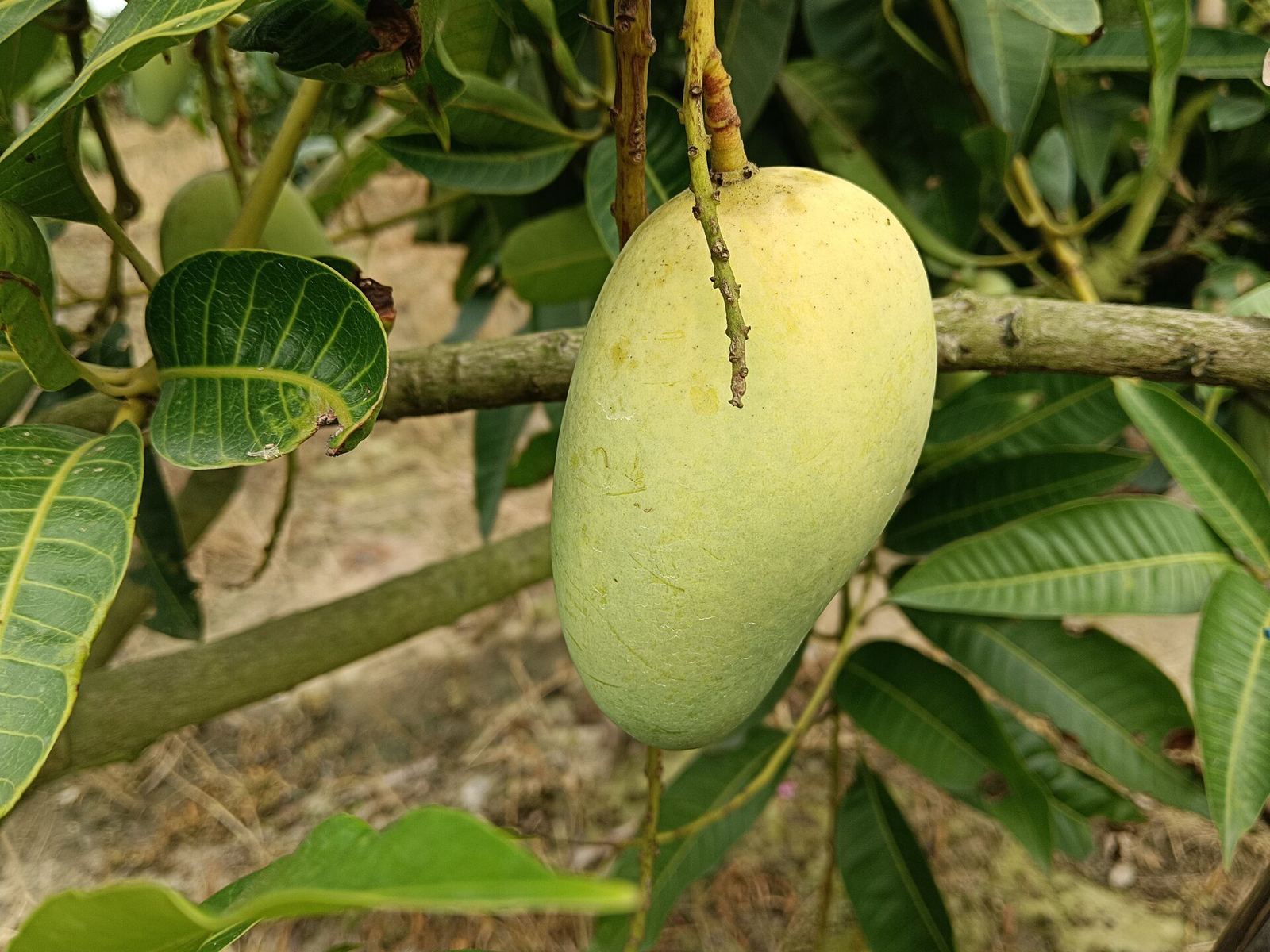
A ripe mango gives slightly when you squeeze it gently, smells sweet and fruity at the stem end and feels heavy for its size. Skin color is not a reliable sign. Different varieties turn different colors, and some stay green when ripe. If your mango is still firm, leave it on the counter for 3–8 days. If you grow your own, our mango tree guide explains when to pick so the fruit ripens well indoors.
How to tell if a mango is ripe: 4 cues
Use these together. No single sign is perfect, but the squeeze and the smell are the best two.
Squeeze
Smell
Shape
Weight
Is color a reliable sign of a ripe mango?
No. A red blush on a Tommy Atkins or Kent comes from sun on the skin and is not a sign of ripeness, and Keitt stays mostly green even when fully ripe. If you only look at color you will leave good fruit on the counter for too long, or grab a hard one that merely looks pretty.
| Variety | Color when ripe | Better cue |
|---|---|---|
| Ataulfo (honey, Champagne) | Deep golden yellow, often with slightly wrinkled skin | Wrinkles and a soft give |
| Tommy Atkins | Red and orange blush, some green stays | Squeeze and smell |
| Kent | Greenish yellow with a red blush | Soft give, sweet smell |
| Keitt | Often stays green | Squeeze and smell only |
| Nam Doc Mai | Greenish to bright yellow | Squeeze and smell at the stem |
Colors vary with the crop and the growing conditions, so treat the table as a rough guide. Ataulfo is a special case. Slight wrinkling on the skin usually means the flesh has sweetened. Small black freckles on the skin are normal, but large sunken black patches or a weeping, leaky spot mean rot.
How to ripen a mango on the counter
A mango that is mature but still firm will ripen on its own. Most take about 3–8 days at room temperature.
- Leave it out of the fridge. Keep unripe mangoes at room temperature, ideally 65–75°F (18–24°C), out of direct sun. Do not stack them.
- Speed it up with a paper bag. Put the mango in a paper bag with a banana or apple, fold the top over and leave it. Ripening fruit gives off ethylene gas, and the bag holds it close, which can speed ripening by a day or two. Use paper. A plastic bag traps moisture and can rot the fruit.
- Check every day. Squeeze and smell it daily, since the step from ready to overripe can be quick.
- Move it when it is ready. Eat the mango, or put it in the fridge to hold it for a few days.
A mango picked very early may never ripen properly. It can shrivel and stay sour instead. If you have no way of telling, buy fruit with full shoulders and a bit of give.
How to store mangoes
Where you keep a mango depends on whether it is ripe.
- Unripe: Keep at room temperature. Do not refrigerate. Mangoes are sensitive to chilling, and storage below about 50–55°F (10–13°C) can cause uneven ripening, dull skin and poor flavor.
- Ripe, whole: Move to the fridge to slow things down. It should keep for around 3–5 days. Let it come back to room temperature before eating for the best flavor.
- Cut: Keep in an airtight container in the fridge and eat within a few days.
- Frozen: Freeze cubes in a single layer on a tray, then bag them. They keep for several months, and are good in smoothies. See how to cut a mango for tidy cubes.
Mangoes from your own tree
Tree-ripened mangoes taste better than shop-bought ones, which are picked mature but green. Pick when the fruit has filled out at the shoulders and the color begins to change, or when the first fruit drops on its own. Then ripen it on the counter as above. Do not leave mangoes to ripen on the ground, because they bruise and attract insects. In Florida, most varieties are ready between May and September.
Common ripening problems
- Mango stays hard for over a week: it may have been picked too early or stored too cold. Give it a few more days in a warm spot, with a banana in a paper bag.
- Skin looks ripe, but flesh is stringy or sour: some varieties are fibrous, and no amount of ripening will fix that.
- Fermented smell: it is overripe. If the fruit smells sour or like alcohol, throw it out.
Want to grow your own? Start with our mango tree guide and choose a variety that suits your zone.
Frequently asked questions
How can you tell if a mango is ripe without cutting it?
Squeeze it gently. A ripe mango gives slightly under your thumb, like a ripe peach. Then smell the stem end, which should smell sweet and fruity. Skin color alone is unreliable because it differs by variety.
Is a red mango ripe?
Not necessarily. The red blush on varieties like Tommy Atkins and Kent develops on the tree in the sun, and it does not show ripeness. Some mangoes, such as Keitt, stay green when they are ripe, so feel and smell the fruit instead.
How long does it take a mango to ripen on the counter?
A mature but firm mango usually ripens in about 3–8 days at room temperature, depending on how mature it was when picked. Putting it in a paper bag with a banana can shave a day or two off.
Should you put mangoes in the fridge?
Only once they are ripe. Cold stops unripe mangoes from ripening properly, and they can end up with dull skin and flat flavor. A ripe mango keeps in the fridge for a few days.
Sources
- Mango (Postharvest Handling and Storage), UC Davis Postharvest Research and Extension Center
- Mango Handling and Ripening Protocol, National Mango Board
- Mango Fruit Facts, California Rare Fruit Growers