

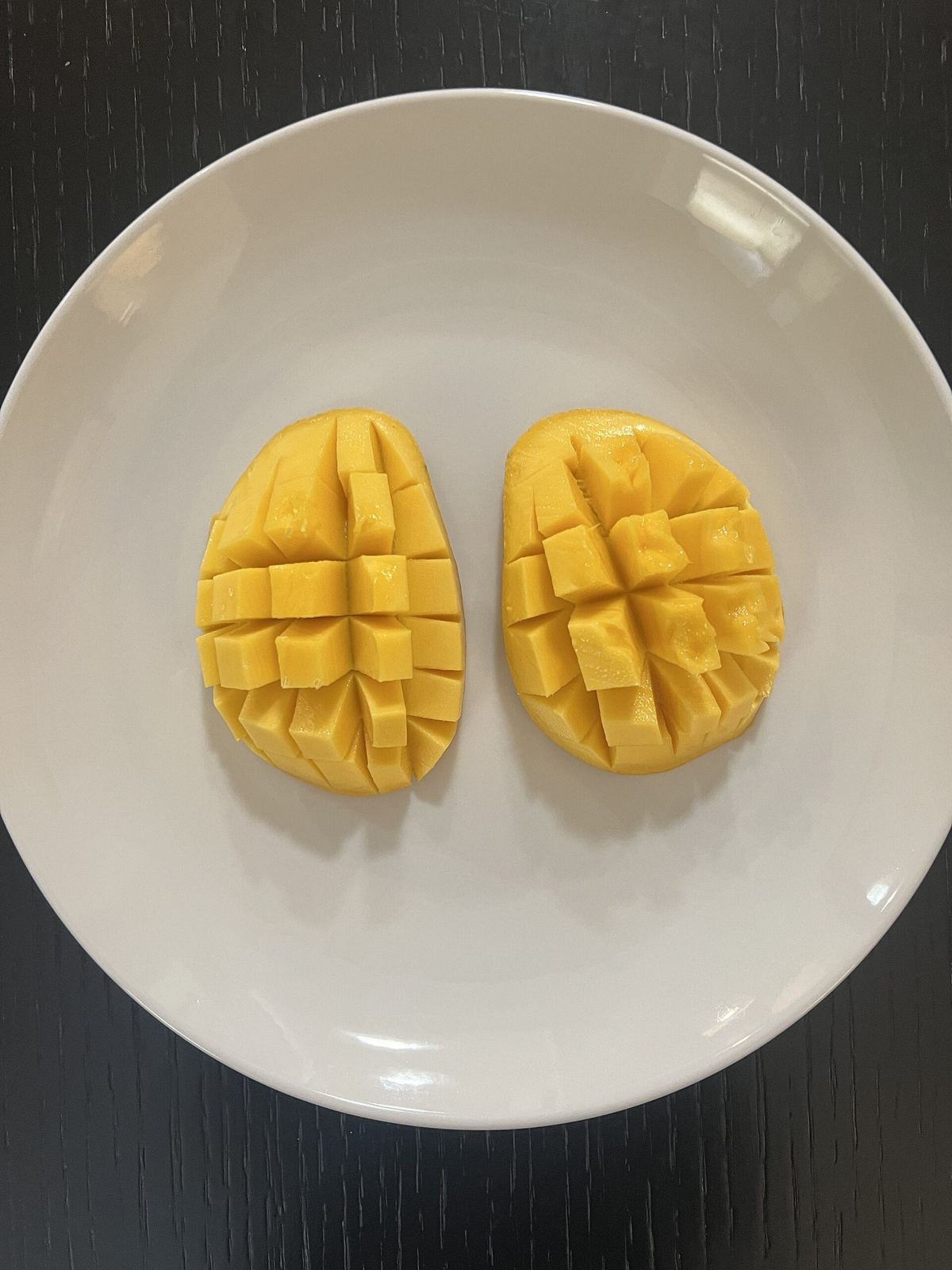
To cut a mango, stand it upright and slice off the two fat “cheeks” on either side of the flat seed, then cube, strip or scoop the flesh from each cheek. The seed is a long, flat oval at the center, so you cut about ½ inch (1 cm) to either side of it. Below are three ways to turn those cheeks into pieces you can eat: the hedgehog, strips and the drinking glass. All three work best on a ripe mango that is still slightly firm. If you grow your own, our mango tree guide shows you how to get fruit like this at home.
Before you cut: check the mango is ready
A ripe mango gives slightly under your thumb and smells sweet at the stem. If yours is rock hard, give it a few days on the counter; our guide on how to tell if a mango is ripe explains how. Wash the skin before cutting so the knife does not drag dirt through the flesh, and pat it dry so it does not slip.
You need a sharp knife, a cutting board that will not slide (set a damp towel under it) and a bowl. A paring knife works for scoring, and a vegetable peeler is handy for method two.
Method 1: The hedgehog (cubes)
This is the classic way to get neat cubes, and it is the one most people mean by “how to cut a mango.”
- Find the seed. Stand the mango on the cutting board, stem end up. The seed is the flat oval in the middle, so you want to cut to one side of it.
- Slice off the first cheek. Cut down about ½ inch (1 cm) from the center line, following the curve of the seed. You will end up with one large cheek, one cheek on the other side, and a slim middle slice holding the seed.
- Score a grid. Hold a cheek in your palm. Cut parallel lines about ½ inch (1 cm) apart through the flesh down to the skin, without piercing the skin. Turn the cheek and cut lines across to make a grid.
- Flip it inside out. Push up on the skin from underneath, so the cheek turns inside out like a hedgehog and the cubes fan out.
- Cut away the cubes. Slice across the base of the cubes with your knife and let them fall into the bowl.
If the cubes do not fan out, the mango is probably too firm or too soft. Firm ones fan better after a day or two on the counter. Very soft ones are better scooped (method 3).
Method 2: Slice the cheeks, then cut strips
Strips are better for a platter, a salad or a fruit bowl, and this method has the least waste.
- Cut the cheeks off as in method 1.
- Lay each cheek skin-side down and slice lengthwise strips through the flesh, stopping at the skin.
- Slide the knife between the skin and the strips to free them, or scoop the flesh out with a large spoon in one pass.
- Use a peeler if you would rather peel the whole mango first. Peel from stem to tip, then cut the cheeks off. A ripe mango is slippery, so go slowly, or grip it with a paper towel.
Method 3: The drinking-glass method
This way is neat for very ripe mangoes, and it requires no knife skills at all.
- Cut off the two cheeks, keeping them skin-side out.
- Hold a cheek in one hand. Set the rim of a sturdy glass with a thin edge (a pint glass or a wine glass works) against the flesh, between the flesh and the skin.
- Push the glass down along the skin. The flesh slides off into the glass in one piece.
- Repeat on the other cheek, then cube or slice the pieces.
A spoon does the same job: slide a large spoon between the flesh and the skin and scoop, turning the cheek as you go.
What to do with the seed
The big flat seed is covered with fibers and a good deal of flesh. Cut as much of it away as you can from the middle slice, in strips along the seed. The cook gets to gnaw the rest.
The seed itself is not edible. Put it in the compost, or plant it. A fresh seed can sprout, as our guide to growing a mango tree from seed explains, though a seedling may take 5–8 years to fruit.
Cutting tips
- Know your variety. Ataulfo (honey) mangoes have a thin seed, so their cheeks are slimmer, and you can cut closer to the center. Large varieties such as Kent and Keitt have more flesh to the side of the seed.
- Chill ripe fruit first. A ripe mango that has been in the fridge for an hour is firmer, so cleaner to cut. (Do not chill an unripe one.)
- Use a sharp knife. A dull blade slips on the skin and crushes the flesh.
- Cut over a bowl. Ripe mangoes are juicy, so work over a rimmed board or a bowl to catch the juice for a smoothie.
- Shape matters less than you think. If the cuts are ragged, cube the pieces and nobody will know.
A note on mango skin and sap
What to do with the cut mango
Eat it fresh, toss the cubes into yogurt or a salad, or blend them. To keep cut fruit, put it in an airtight container in the fridge and use it within a few days. For longer storage, freeze the cubes on a tray, then move them to a bag. Our guide on ripe mangoes covers storing whole fruit.
Want to grow your own? Start with the mango tree guide, then pick a variety that suits your zone.
Frequently asked questions
What is the easiest way to cut a mango?
Slice off the two "cheeks" on either side of the flat seed, score the flesh of each cheek in a grid without cutting the skin, then push the skin inside out and slice off the cubes. This is called the hedgehog method.
How do you cut a mango around the seed?
The seed is a long, flat oval that runs from stem to tip. Stand the mango on its end, cut about ½ inch (1 cm) off the center line on each side, and you clear the seed. Trim the remaining flesh from around the seed with a knife.
Can you eat the mango skin?
It is not usually eaten. The skin is tough and bitter, and it carries sap that can irritate skin and mouths, as mango is in the same plant family as poison ivy and cashew. Peel it, and wear gloves if you have reacted to mango before.
What do you do with the mango seed?
Most people throw it out or compost it. You can plant it if you want to grow a tree, but the fruit it makes may not match the one you ate.
Sources
- Mango Fruit Facts, California Rare Fruit Growers
- Mango Dermatitis After Urushiol Sensitization, National Library of Medicine (PMC)
- Mango Handling and Ripening Protocol, National Mango Board