

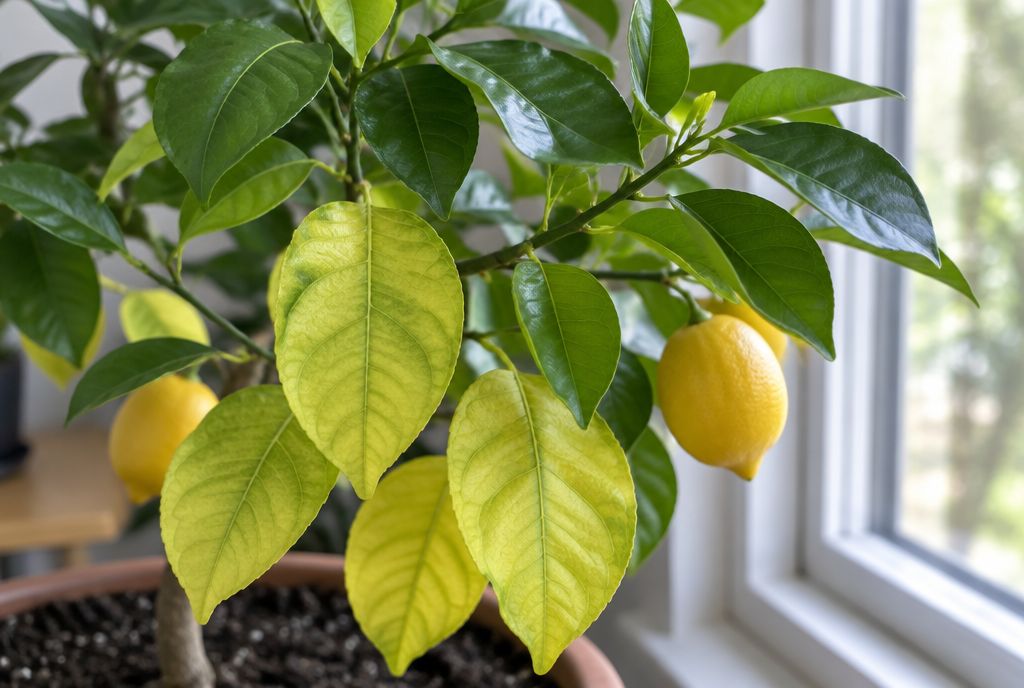
Yellow leaves on a Meyer lemon tree usually come from wet roots, a nutrient shortage or cold, and the pattern on the leaf tells you which. Check the soil first, because Texas A&M AgriLife says overwatering is the most common cause of poor performance of container citrus. If the soil is fine, match what you see to the table below. This page supports our Meyer lemon tree guide, and it covers leaf curling too.
Diagnose it: yellow leaves by pattern
UF/IFAS describes how each nutrient shortage shows up on citrus leaves. Look at which leaves are affected, and where the green is left.
| What you see | Likely cause | What to do |
|---|---|---|
| Light green to yellow leaves over the whole tree, no distinct pattern. Older leaves turn yellow-bronze before they drop. | Nitrogen shortage (UF/IFAS) | Feed with a citrus fertilizer. See how to fertilize a Meyer lemon. |
| Leaf veins stay darker green while the tissue between them yellows, starting on new leaves. In severe cases the yellow fades to ivory and new leaves are smaller. | Iron shortage (UF/IFAS). Lemons on high-pH soil are prone to it. | Check the soil pH (lemons prefer 5.5–6.5). Use an iron supplement made for citrus and follow the label. In a pot, flush salts and refresh the mix. |
| Yellowing starts near the base of the leaf and spreads, leaving a green inverted V on the midrib at the tip and base. | Magnesium shortage (UF/IFAS) | Use a citrus fertilizer that includes magnesium and micronutrients, or a magnesium source on the label. |
| Small yellow blotches between green veins. In severe cases the leaf is yellow except for the veins. | Zinc shortage (UF/IFAS) | Use a citrus fertilizer with micronutrients, or a zinc product made for citrus, as the label directs. |
| Yellow, drooping leaves and soil that stays wet. Leaves drop. | Overwatering or poor drainage (Texas A&M AgriLife) | Let the top inch of mix dry between waterings, empty saucers and check the drainage holes. |
| Leaves yellow, brown or drop after a cold night | Cold damage. Citrus is generally damaged below about 24°F (UC IPM), and lemon leaves are damaged at 22–24°F (UF/IFAS). | Protect the tree on cold nights. Wait for new growth before you cut out any wood. |
| Leaves drop after the tree is moved indoors or out | A sudden change of light (Texas A&M AgriLife) | Keep conditions steady and acclimate gradually next time. See Meyer lemon trees indoors. |
Iron, magnesium and zinc shortages look similar at a glance, so check where the green stays and whether new or older leaves are affected. If you are still unsure, a soil test through your county extension office will tell you the pH and which nutrients are low.
Step by step: find the cause
- Check the soil. Push a finger in 1–2 inches (2.5–5 cm). If it is wet and the leaves are yellow, stop watering. If a pot is heavy and the mix stays soggy, check the drainage holes.
- Note which leaves are yellow. All over the tree points to nitrogen. New leaves with green veins point to iron. Older leaves with a green V point to magnesium.
- Think about what changed. A recent cold night, a move indoors, a new pot or a change in feeding is often the trigger.
- Look for pests. Check the new growth and the undersides of leaves for aphids, leafminer trails and scale.
- Fix one thing, then wait. Correct the most likely cause and watch the next flush of leaves.
Why Meyer lemon leaves curl
Curling is a different problem from yellowing, though the two often show up together. Check these causes.
- Aphids. UF/IFAS says the brown citrus aphid feeds on new growth, causing distortion. Look for clusters of small insects on the tips and sticky residue. Wash them off with a strong spray of water and repeat.
- Citrus leafminer. UF/IFAS says immature leaves are attacked in warm weather, and less so in winter. You see silvery trails and twisted, curled new leaves. UF/IFAS says trees three or more years old tolerate the damage, so a mature tree needs no special treatment.
- Water stress. A dry pot makes leaves curl and droop, and so does a waterlogged one. Check the soil before you do anything else.
- Cold or wind. Chilled leaves can curl and drop. Move the tree to shelter.
When yellow leaves point to something bigger
Scale insects can split bark and kill limbs, according to UF/IFAS. If a branch has yellowed, dried and shows scale bumps, cut it out. If the yellowing returns on a tree that is in good soil and a good pot, ask your county extension office to look at it, especially if you live near a citrus quarantine area. Our Meyer lemon tree in a pot guide covers watering and feeding for containers.
Frequently asked questions
Why are my Meyer lemon tree's leaves turning yellow?
The usual causes are wet roots, a nutrient shortage, cold and a sudden change of light. Texas A&M AgriLife says overwatering is the most common cause of poor performance of container citrus. UF/IFAS describes the nutrient patterns, which differ between nitrogen, iron, magnesium and zinc.
What does a nitrogen shortage look like on a lemon tree?
UF/IFAS says it shows as light green to yellow foliage over the entire tree, without any distinctive leaf pattern. Older leaves turn yellow-bronze before they drop. Feeding the tree with a citrus fertilizer on schedule corrects it.
Why are my Meyer lemon tree's leaves curling?
Look at the new growth first. UF/IFAS says the brown citrus aphid feeds on new growth and causes distortion, and the citrus leafminer attacks immature leaves in warm weather. Leaves can also curl when the soil gets too dry or stays too wet.
Should I cut off yellow leaves?
Not at once. A leaf that is yellow because of a nutrient shortage may stay on the tree and recover partly once you correct the cause. Remove leaves that are fully yellow and loose, or damaged by pests, and wait before you do more pruning.
Why does my Meyer lemon lose leaves indoors?
A sudden change in light is the usual cause. Texas A&M AgriLife says to avoid extremely rapid changes in light exposure to prevent excessive leaf drop. Acclimate the tree gradually when you move it in or out.
Sources
- Citrus Nutritional Deficiency and Toxicity (CH142), UF/IFAS Extension
- The Lemon Tree: Lemon Growing in the Florida Home Landscape (HS402), UF/IFAS Extension
- Citrus, Texas A&M AgriLife Extension
- Cultural Tips for Growing Citrus, UC IPM, University of California