

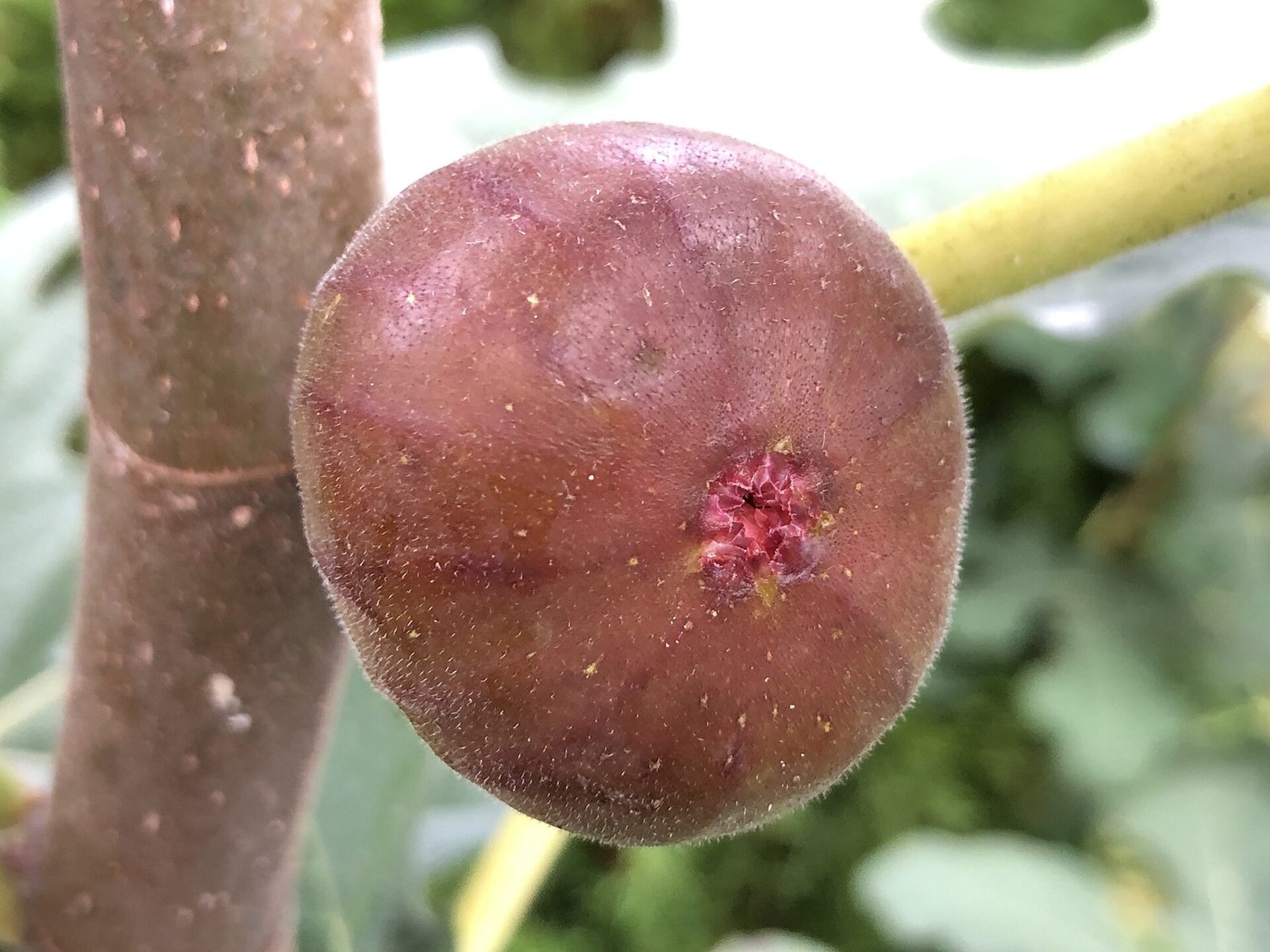
A ripe fig has changed color, feels soft, hangs with its neck bent downward and has an open eye at the bottom. Penn State Extension puts it this way: harvest when the fig changes color, softens, the stem bends downward and the ostiole opens. Figs will not ripen once they are off the tree (Illinois Extension), so wait for these signs before you pick. If you grow your own, our fig tree guide covers the whole season, from planting to harvest.
How to tell if a fig is ripe: 4 cues
Use these together. No single sign is perfect, but the soft give and the bending neck are the most reliable two.
Color
Soft give
Bending neck
Open eye
Is color a reliable sign of a ripe fig?
Not on its own, because ripe figs are different colors. A ripe Kadota is yellowish green, while a ripe Black Mission is black-purple, so learn your variety.
| Variety | Skin when ripe | Flesh |
|---|---|---|
| Chicago Hardy | Deep purple or brown | Soft, neck bends, drooping |
| Brown Turkey | Purplish brown | Pinkish amber |
| Celeste | Light violet to violet-brown | Reddish amber |
| Black Mission | Black-purple, elongated | Reddish-pink (UF), watermelon to pink (CRFG) |
| Kadota | Yellowish green | Amber, tinged pink at the center |
| LSU Purple | Glossy purple | Amber-to-pink |
Colors vary with weather and growing conditions, so treat the table as a rough guide. Compare them in our fig varieties guide.
Do figs ripen after picking?
No. Figs should be harvested only when they are fully ripe, because they will not ripen once they are off the tree (Illinois Extension). Unlike a mango or a banana, a fig that is picked early does not improve on the counter. It stays firm and bland. If you have no tree, buy figs that are soft rather than hard.
When are figs ripe?
A common fig bears two crops. The breba crop comes in spring on last season’s growth, and the main crop comes in fall on new growth (CRFG). Exact timing depends on your variety and your zone, and a few examples are:
- Celeste: begins ripening in early July in Florida (UF/IFAS).
- LSU Purple: a light crop in early spring, a heavy main crop in early July and a later crop sometimes lasting into December in Louisiana (LSU). UF/IFAS puts the main crop in August.
- Black Mission: an everbearing fig that fruits from summer to winter (UF/IFAS).
In cold zones, where the top dies back in winter, you may lose the breba crop and wait for the main crop on new growth. Pick every day or two in peak season, because ripe figs go from ready to overripe fast, and ripe fruit attracts birds and insects.
How to store figs
Fresh figs do not keep well. The California Rare Fruit Growers say they can be stored in the refrigerator for only 2–3 days.
- Whole, ripe: Keep in a single layer in the fridge, and eat within 2–3 days. Let them come back to room temperature before eating for the best flavor.
- Extra figs: Cook them into jam or a sauce, or dry them. The California Rare Fruit Growers note that Celeste is very sweet and usually dried.
- Unripe: Do not bother storing them. They will not ripen.
Common ripening problems
- Figs stay hard and green: the tree may be too young, too shaded or heading into cold weather. Several conditions can prevent fig fruit from ripening or cause it to drop prematurely (Clemson), so check the sun, the water and the variety first. Figs need full sun, with at least 6 hours and ideally 8 or more.
- Sour or fermented smell: insects have entered the open eye, which is called souring. Clemson says the only control is to grow a tight- or closed-eye variety.
- Split fruit: rain during fruit development and ripening can split figs (CRFG). Pick ripe fruit promptly after rain.
- Birds get there first: birds, rabbits and squirrels eat fig fruit (UF/IFAS), so net the tree as the fruit ripens.
Once you have a basket, see how to eat a fig. Want to grow your own? Start with our fig tree guide and choose a variety that suits your zone.
Frequently asked questions
How can you tell if a fig is ripe?
Penn State Extension says to harvest when the fig changes color, softens, the stem bends downward and the ostiole (the small opening at the bottom, or eye) opens. Use all four cues together, because color alone differs by variety.
Do figs ripen after you pick them?
No. Illinois Extension says figs should be harvested only when they are fully ripe, because they will not ripen once they are off the tree. A fig picked firm stays firm and bland.
How long do fresh figs keep?
Only 2–3 days in the refrigerator, according to the California Rare Fruit Growers. Eat them quickly, or turn extras into jam or dried fruit.
When do figs ripen?
A common fig bears two crops. The breba crop is a spring crop on last season's growth, and the main crop ripens in fall on new growth (CRFG). In Florida, UF/IFAS says Celeste begins ripening in early July, and Black Mission fruits from summer to winter.
Sources
- Figs in the Home Garden, Penn State Extension
- Go Figure: Figs Are a Great Addition to Home Gardens, University of Illinois Extension
- Fig Fruit Facts, California Rare Fruit Growers
- The Fig (HS27/MG214), UF/IFAS Extension