

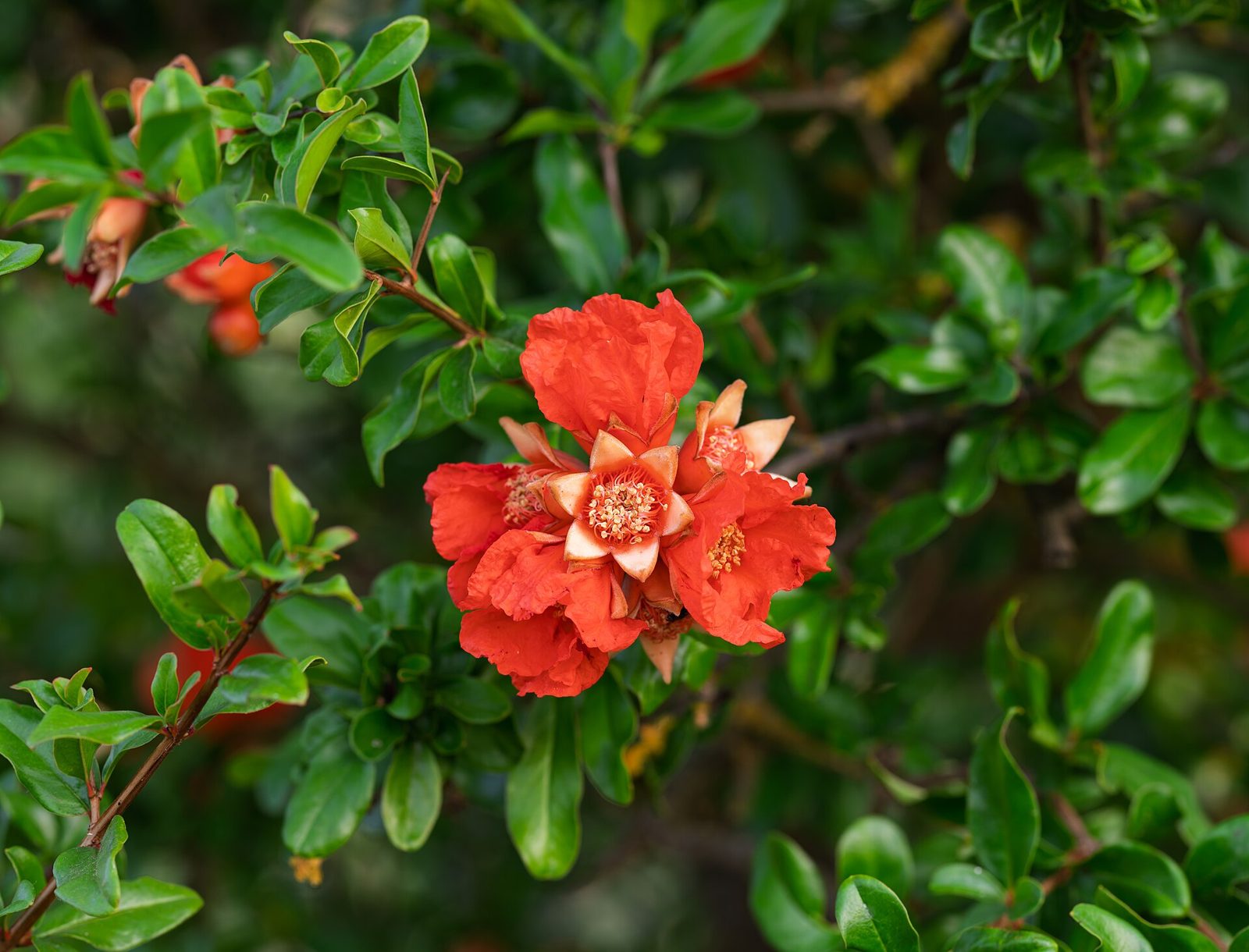
A pomegranate tree that flowers but gives no fruit is usually too young, short of sun, overfed or overwatered, or set back by cold. UF/IFAS says fruit drop is aggravated by over-fertilization and excess irrigation, and TAMU says full sun gives the best flower and fruit formation. Work through the list below, starting with the age of the plant. For planting and care, see our pomegranate tree guide.
When pomegranate blossoms appear
Bloom begins in April and continues through June, either continuously or in three to four flushes depending on the variety (UGA). A healthy tree can carry flowers for weeks, and the fruit takes months more to mature, with early cultivars ripening from the end of August and late ones into October or early November (UGA). So a tree in full bloom in May will not have ripe fruit until late summer or fall.
Not every blossom needs to become a fruit, and some fruit drop is normal. What matters is whether the tree holds a crop through to harvest.
Why a pomegranate tree flowers but does not fruit: diagnosis
| What you see | Likely cause | What to do |
|---|---|---|
| A young plant that flowers but sets nothing | Age. A tree from a hardwood cutting fruits in year two after planting, and one from seed takes at least three years (UGA). TAMU says 3 to 4 years. | Wait, and keep care steady. |
| Lots of leafy growth and few fruit | Too much nitrogen or water. UF/IFAS says fruit drop is aggravated by over-fertilization and excess irrigation. | Feed lightly, with nitrogen only (TAMU), and water on an even schedule. |
| Flowers on a plant in a shady spot | Too little sun. TAMU says full sun gives the best flower and fruit formation. | Move the plant, or prune neighbors that shade it. |
| Flowers and young fruit lost after a hard winter | Cold damage. UF/IFAS says 12°F may severely injure dormant trees, and TAMU says some varieties are damaged at 18°F. | Shelter the plant on cold nights, and choose a hardier variety such as Kazake or Salavatski. |
| Only a few fruit set on a lone plant | Poor fruit set. CRFG says cross-pollination increases fruit set. | Plant a second variety nearby. |
| A plant pruned hard late in the season | Pruning at the wrong time. UGA says major pruning happens in winter before bud break. | Prune in winter, and do not cut back hard after growth starts. |
Fixes in order
- Check the age. Count from planting. A cutting fruits in year two, and a seedling takes three or more years. If your plant is younger than that, give it time.
- Check the sun. Full sun gives the best flower and fruit formation (TAMU). Prune back shade or move a potted plant.
- Go light on nitrogen. For most plantings, nitrogen is the only nutrient you need to apply each year (TAMU). More feed means leafy growth, and UF/IFAS says over-fertilization aggravates fruit drop.
- Water on an even schedule. Water steadily, and avoid flooding the plant. TAMU suggests every 7 to 10 days once it is established, and UF/IFAS says excess irrigation aggravates fruit drop.
- Protect from cold. Shelter young plants before a hard freeze. Potted plants can move into an unheated garage or shed.
- Help pollination. One plant is self-fruitful (UGA), but a second variety nearby can increase set (CRFG).
Keep a note of what you change and when. Pomegranates bloom from April through June (UGA), and fruit follows months later, so give each change a full season before you judge it.
Flowers drop, then fruit drops
A pomegranate that sheds some flowers and a few small fruit is behaving normally. It becomes a problem when almost everything falls. UF/IFAS says drop is aggravated by practices favoring vegetative growth, such as over-fertilization and excess irrigation. Cut both back, and check that the plant is getting full sun.
Fruit that sets but fails later
Sometimes a plant sets fruit and then loses it, or the fruit looks fine but is bad inside. UGA says Alternaria usually enters the fruit during bloom and fruit set, causing heart rot. Pests can add to the damage, and TAMU lists whiteflies, thrips, mealybugs, stink bugs and scale as leaf pests. Look at your leaves through the season.
Fruit that cracks open on the plant is a different problem, usually from uneven watering. Our guide on why pomegranates split explains the cause and the fix.
When to expect fruit
If you have worked through the list and the plant is healthy, sunny and past its third year, the next step is patience. Fruit comes with age and steady care. When it arrives, our guide on how to tell if a pomegranate is ripe tells you when to pick, and how to cut a pomegranate shows how to enjoy it.
Frequently asked questions
Why does my pomegranate tree flower but not fruit?
The usual causes are age, too little sun, too much nitrogen or water, cold damage and poor fruit set. UF/IFAS says fruit drop is aggravated by over-fertilization and excess irrigation, TAMU says full sun gives the best flower and fruit formation, and a young plant may simply need more time.
When does a pomegranate tree bloom?
UGA says bloom begins in April and continues through June, either continuously or in three to four flushes depending on the variety. Fruit follows, and early cultivars start to ripen near the end of August.
How long does a pomegranate tree take to fruit?
A tree from a hardwood cutting bears fruit in year two after planting, and one from seed takes at least three years (UGA). TAMU says 3 to 4 years after planting.
Do pomegranate trees need a pollinator?
No. UGA says pomegranates are self-fruitful, so one tree can set fruit alone. CRFG says cross-pollination increases fruit set, so a second variety nearby can help.
Why is my pomegranate tree dropping flowers and small fruit?
Some loss is normal, but heavy drop points to practices that favor leafy growth. UF/IFAS says over-fertilization and excess irrigation aggravate fruit drop. Go lighter on nitrogen and water on an even schedule.
Sources
- Pomegranate Production (C997), UGA Extension
- The Pomegranate (MG056), UF/IFAS Extension
- Texas Fruit and Nut Production: Pomegranates, Texas A&M AgriLife Extension
- Pomegranate Fruit Facts, California Rare Fruit Growers