

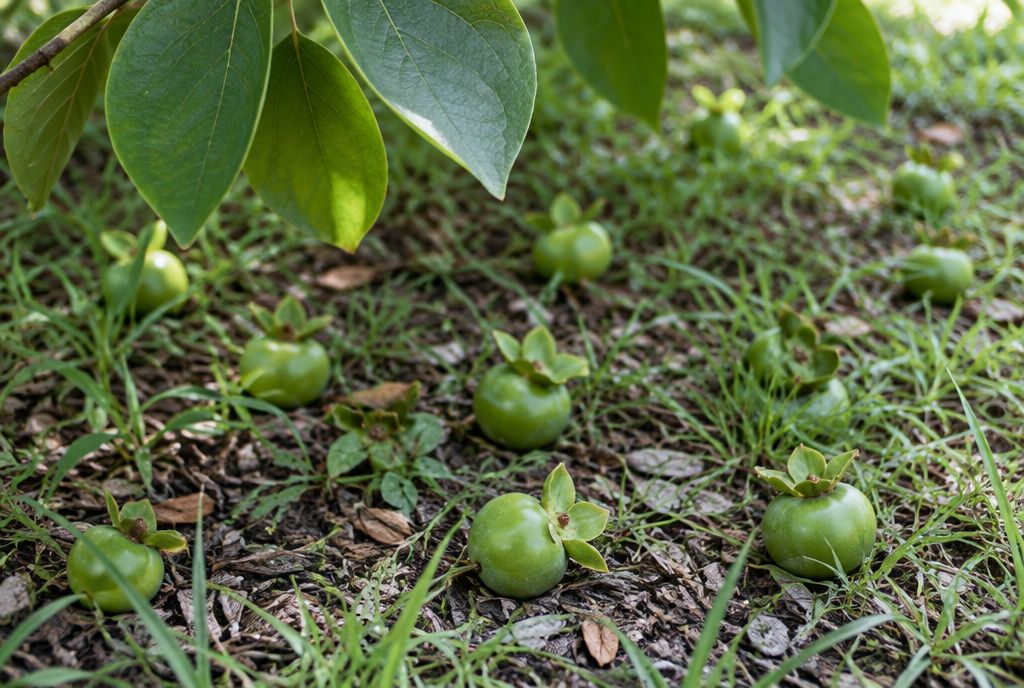
A persimmon tree dropping small green fruit in late spring or early summer is usually normal. UF/IFAS describes a first drop after petal fall, and lighter drops in June and later. CRFG says many immature fruit can fall from May to September. It becomes a problem when a lot of fruit falls, which points to too much nitrogen, uneven watering, a shaded canopy or a pollination gap. This page helps you tell the difference. For planting and care, see our persimmon tree guide.
What is normal: the two drops
A persimmon sheds fruit in stages.
- First drop, after petal fall. The tree sheds the first batch of small fruit (UF/IFAS).
- June drop and after. UF/IFAS says subsequent drops can also occur in June and later, but they are normally lighter. CRFG says some immature fruit can fall right through summer.
If the tree holds a good crop after these, there is nothing to fix.
Why a persimmon tree drops fruit: diagnosis
UF/IFAS says the extent of the drop depends on multiple factors, such as previous season crop load, pollination, water and nutrient excesses, and lack of light infiltration into the canopy. Here is how to match what you see to the cause.
| What you see | Likely cause | What to do |
|---|---|---|
| Lots of green fruit falling after you fertilized | Too much nitrogen. CRFG and UGA say excess nitrogen can cause fruit drop, and UF/IFAS adds heavy quick-release nitrogen. | Stop feeding and go light next year. CRFG says most trees do well with a minimum of fertilizing. |
| Fruit falling after a wet spell, with soggy soil | Overwatering raises drop (UF/IFAS), and CRFG lists root rot from waterlogging. | Let the soil drain, water less often and fix standing water. |
| Fruit falling in a dry spell | Water stress. A steady supply helps the tree hold fruit. | Water deeply and regularly, but do not overwater. CRFG gives about 36–48 inches a year, applied gradually in spring and tapering off in fall. |
| Fruit mostly lost from the inside of a dense canopy | Lack of light in the canopy (UF/IFAS). | Thin crossing and crowded branches so light and air reach the fruit. |
| A heavy crop last year, and fewer fruit this year | Previous season crop load (UF/IFAS). | Nothing to fix directly. Keep watering steady and feeding light. |
| A pollination-variant type with no pollinator nearby | UF/IFAS lists pollination among the causes, and CRFG says some climates require pollination for adequate production. | Ask your nursery whether your variety needs seeds to do well, and plant a pollinator with male flowers if it does. |
How much drop is too much? If most of the fruit falls over several weeks and one of the causes above applies, act on the cause. If a few small fruit fall and the rest keep growing, leave the tree alone.
What to do about persimmon fruit drop
- Wait out the normal drops. Give the tree through June, and a little beyond, before you decide there is a problem.
- Check your watering. Keep the soil evenly moist during the growing season without waterlogging it. Overwatering and water excesses are on UF/IFAS’s list of causes.
- Cut back nitrogen. UF/IFAS gives a split plan of 50% in March and 25% each in June and September with a balanced fertilizer, while CRFG says most trees need little. If fruit drop is heavy, go lighter.
- Open the canopy. Thin the center of the tree in the dormant season so light reaches the fruit.
- Check the pollination type. Most Asian types are fine alone, but American persimmons need both male and female trees (UF/IFAS).
If your persimmon tree has never fruited
A young tree may just need time. LSU AgCenter says it takes about three years for a persimmon to fruit and eight to ten to reach its full potential, and UF/IFAS agrees. If the tree is past that age, look at these:
- Late frost at bud break. UF/IFAS reports damage at 27°F for one hour after bud break, and CRFG says leaves are killed at 26°F while the tree is growing. Cover the tree on a frost night.
- Too much nitrogen. CRFG says excess nitrogen can cause fruit drop, so feed lightly.
- Shade. CRFG recommends full sun, with some partial shade tolerated.
- American persimmon without a partner. UF/IFAS says most cultivars need both male and female trees for proper fruiting.
Fruit that disappears rather than drops
If fruit goes missing near harvest, look for thieves rather than a tree problem. CRFG lists squirrels, deer and birds among persimmon pests. Our guide on how to tell if a persimmon is ripe helps you pick before they do, and how to eat a persimmon shows what to do with the crop.
Frequently asked questions
Is it normal for a persimmon tree to drop fruit?
Yes. UF/IFAS describes an initial drop after petal fall, and later drops in June and after that are normally lighter. CRFG says many immature fruit drop between May and September. A tree that sets a lot of fruit sheds the surplus.
What causes a persimmon tree to drop fruit?
UF/IFAS says the extent of the drop depends on multiple factors, such as previous season crop load, pollination, water and nutrient excesses, and lack of light getting into the canopy. Excess nitrogen is a known cause too (CRFG, UGA), as is overwatering and heavy quick-release nitrogen (UF/IFAS).
Why is my persimmon tree not fruiting?
A young tree may simply be too young, since you should expect about 3 years to the first fruit and 8–10 years to full production (LSU AgCenter, UF/IFAS). After that, check for a late frost at bud break, too much nitrogen, shade, and pollination. Most American persimmons need male and female trees (UF/IFAS).
Should I water or feed more when fruit drops?
Neither automatically. Water steadily without waterlogging, and cut back on nitrogen if you have been feeding heavily. CRFG says most trees do well with a minimum of fertilizing.
Sources
- Japanese Persimmon Cultural Practices (HS1389), UF/IFAS Extension
- Persimmon Fruit Facts, California Rare Fruit Growers
- Persimmons, UGA Extension, Colquitt County
- Persimmons, LSU AgCenter