

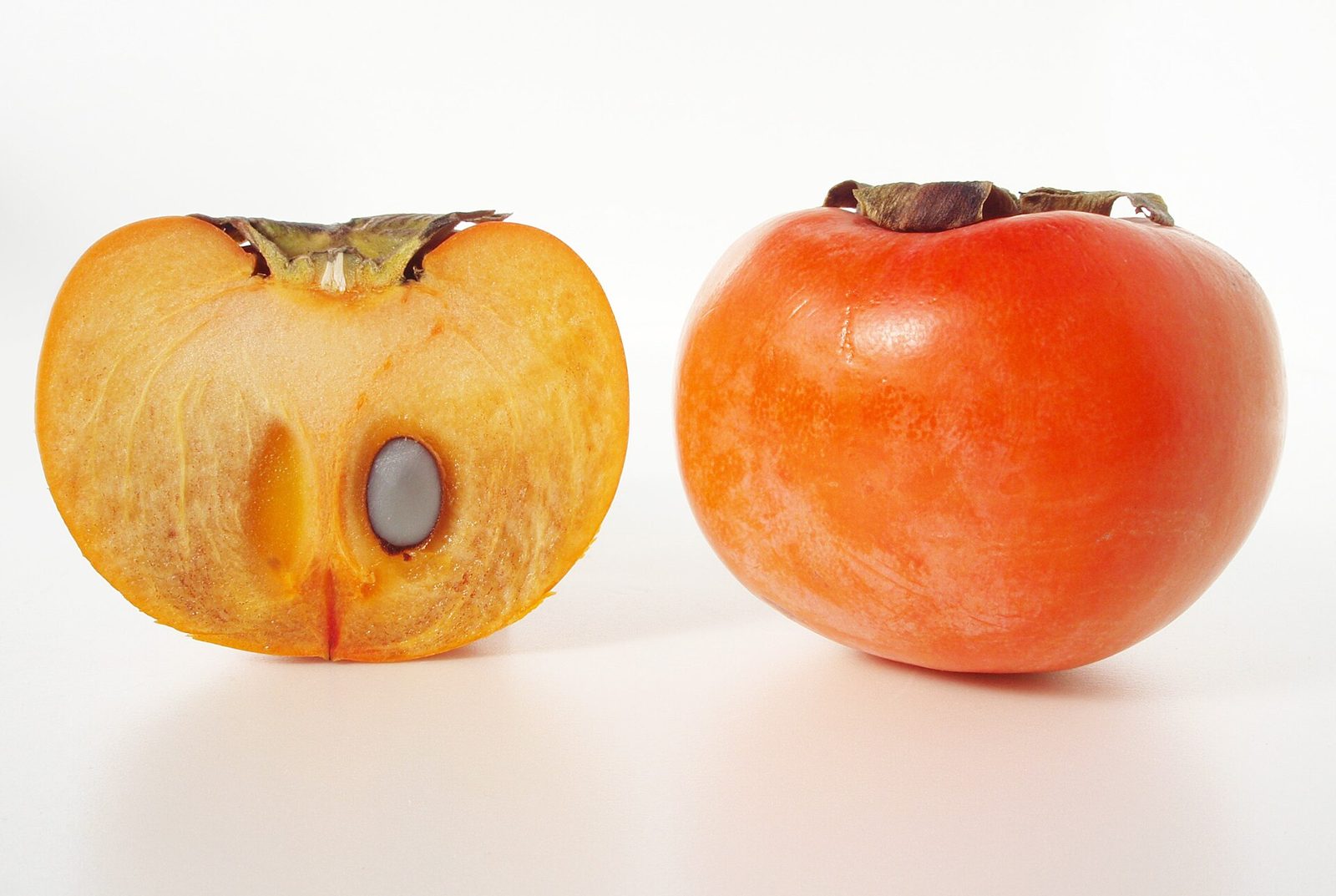
A persimmon is ripe when it is fully colored, but what that means for eating depends on the type. Non-astringent persimmons such as Fuyu and Jiro are ready as soon as they are fully colored, and you can eat them firm. Astringent ones such as Hachiya are only ripe when they are soft, like jelly. Biting a firm Hachiya makes your mouth pucker, so know which you have. If you grow your own, our persimmon tree guide explains the two types and when to harvest.
How to tell if a persimmon is ripe: 4 cues
Use these together. The type tells you what ripe should feel like.
Type
Color
Press
Season
What ripe looks like for each type
| Type | Eat it when | Cue |
|---|---|---|
| Fuyu | Fully colored, firm or slightly soft | Deep orange skin, light orange flesh (CRFG) |
| Jiro | Fully colored, firm | Orange-red skin, ripens late October and early November (CRFG) |
| Hachiya | Soft all over | Glossy deep orange skin; flesh turns to jelly |
| Saijo | Soft, though traces of astringency may remain (UF/IFAS) | Dull yellow skin when mature (CRFG) |
| Tanenashi | Soft and ripe (Clemson) | Deep yellow to orange (UF/IFAS) |
| American | Soft, usually after a frost (UF/IFAS) | Green to orange when ripe |
| Nishimura Wase | Seeded fruit only; otherwise astringent (UF/IFAS) | First fruit in early August in Florida |
The last row is a warning. UF/IFAS says Nishimura Wase must be fully seeded to be non-astringent, so a firm fruit with no seeds will be puckery.
How to ripen a persimmon on the counter
An astringent persimmon that is fully colored but firm will soften on its own (CRFG). Texas A&M says fruit ripens equally on or off the tree.
- Leave it at room temperature. Keep firm astringent fruit on the counter out of direct sun, and check it every day. It will soften and turn sweet.
- Speed it up with rice. UF/IFAS says covering the fruit with uncooked dry rice for 3–5 days softens it and removes astringency. Bury the fruit in a bowl of rice and leave it.
- Or freeze it. Freeze the fruit overnight, then thaw it, as CRFG describes. UF/IFAS gives 24 hours in the freezer. The texture becomes soft and jelly-like.
- Eat or chill it when it is ready. Once it is soft, eat it or move it to the refrigerator to hold it a few days.
UF/IFAS also notes that ethylene gas can speed ripening, and that growers in Japan use 35–40% ethyl alcohol, sealed in for 10 days at 69°F (21°C). Those are commercial methods, so stick with the counter, the rice or the freezer at home.
Persimmons from your own tree
For astringent types, CRFG says to harvest when the fruit is hard but fully colored, while UF/IFAS says to pick at full color when soft or nearing softness. Either way, you finish ripening indoors. You can also leave astringent fruit on the tree until it is soft if the birds allow. For non-astringent types, harvest when fully colored. Clip the fruit with a short stem rather than pulling it.
How to store persimmons
- Hard astringent fruit: CRFG says mature, hard astringent persimmons keep at least a month in the refrigerator.
- Non-astringent fruit: CRFG says they keep a short time at room temperature, and UF/IFAS says Fuyu lasts up to 30 days at room temperature.
- Soft, ripe fruit: Eat it soon, or put it in the refrigerator.
Common ripening problems
- Puckery, dry feel in the mouth: the fruit is astringent and not soft yet. Give it more time, or use rice or the freezer.
- Stays hard on the counter: astringent types need to go soft, which can take days. Make sure it was fully colored when you picked it.
- Seedless firm fruit that still puckers: it may be a pollination-variant type, which is only non-astringent when seeded (UF/IFAS).
- Fruit falling before it is ripe: see why a persimmon tree drops fruit.
Once yours is ripe, learn how to eat a persimmon. Want to grow your own? Start with our persimmon tree guide, and for a similar project, see how to tell if a fig is ripe.
Frequently asked questions
How can you tell if a persimmon is ripe?
It depends on the type. A non-astringent persimmon such as Fuyu or Jiro is ready when it is fully colored, and you can eat it firm. An astringent one such as Hachiya is ripe only when it is soft, like jelly (CRFG). Judge by color first, then by feel.
Can you eat a persimmon before it is soft?
Only a non-astringent type. Fuyu and Jiro are edible while firm. An astringent persimmon such as Hachiya is not edible until it is soft-ripe, and a firm one is intensely puckery (CRFG).
Do persimmons ripen after they are picked?
Yes. CRFG says astringent persimmons will ripen off the tree if stored at room temperature, and Texas A&M says fruit ripens equally on or off the tree.
How do you ripen a persimmon faster?
UF/IFAS says covering fruit with uncooked dry rice for 3–5 days induces softening and removes astringency. CRFG says freezing overnight and then thawing works, and UF/IFAS gives 24 hours of freezing.
How long do persimmons keep?
CRFG says mature, hard astringent persimmons keep at least a month in the refrigerator, while non-astringent types keep a short time at room temperature. UF/IFAS says Fuyu lasts up to 30 days at room temperature.
Sources
- Persimmon Fruit Facts, California Rare Fruit Growers
- Japanese Persimmon Cultivars in Florida (MG242), UF/IFAS Extension
- Japanese Persimmon Cultural Practices (HS1389), UF/IFAS Extension
- Persimmons, Texas A&M AgriLife Extension