

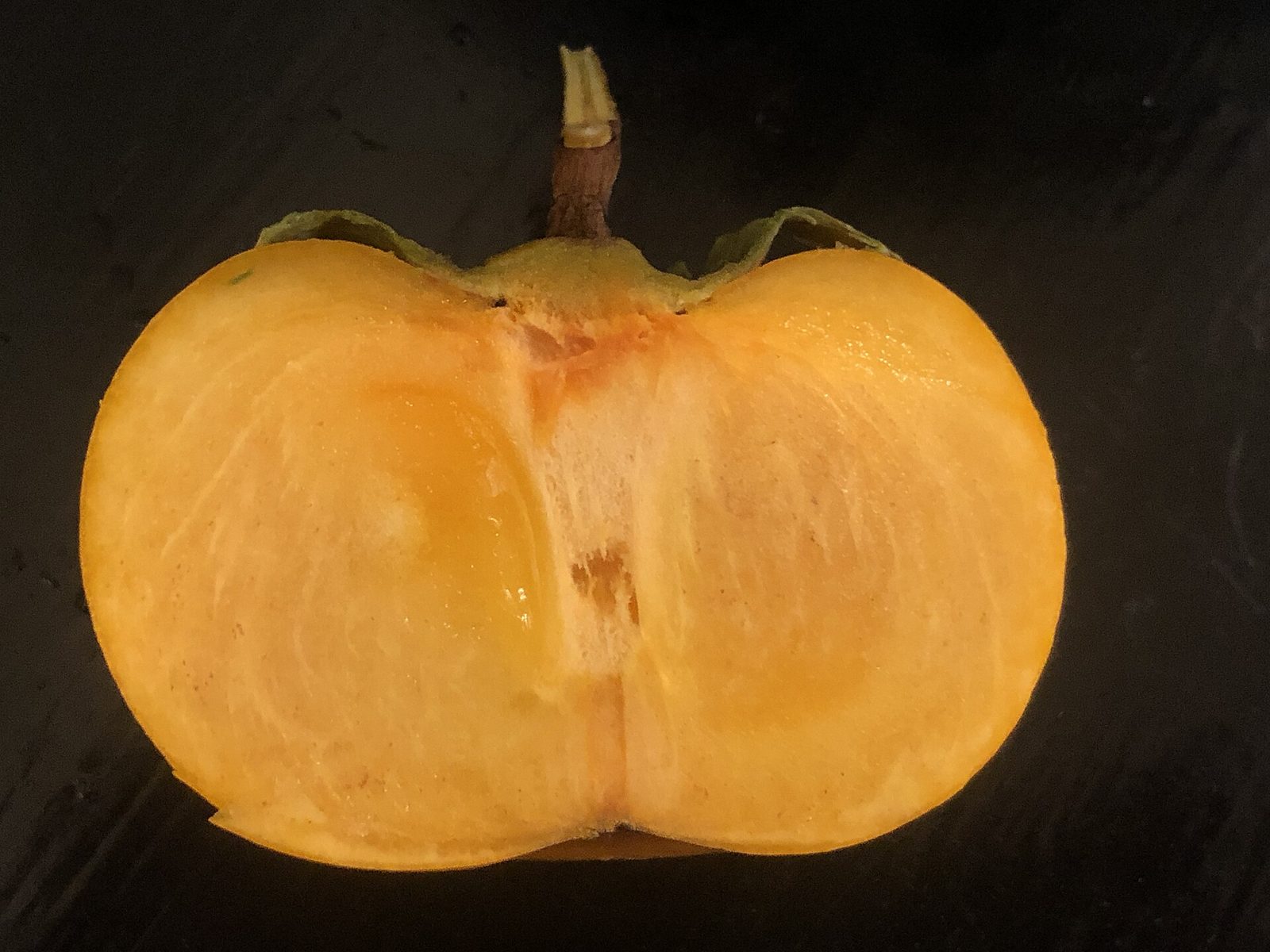
To eat a persimmon, first check the type: slice a firm Fuyu like an apple, or wait for a Hachiya to turn soft and scoop it with a spoon. Non-astringent persimmons such as Fuyu and Jiro are edible while firm. Astringent ones such as Hachiya must be soft-ripe, or they make your mouth pucker (CRFG). The steps below cover both, plus the ways to soften an astringent fruit and how to store them. If you grow your own, our persimmon tree guide shows you how to get fruit like this at home.
Before you cut: which kind do you have?
This is the step that matters. A persimmon that looks ripe may not be edible yet.
- Fuyu or Jiro (non-astringent): Eat when fully colored, firm or slightly soft. CRFG says a little softening after harvest improves the flavor.
- Hachiya, Saijo or Tanenashi (astringent): Eat only when soft all over. Our guide to ripe persimmons explains the signs and how to speed things up.
How to eat a firm Fuyu persimmon
Fuyu is the easiest persimmon to eat because it is non-astringent while firm (UGA, Clemson). It is medium-large, oblate and faintly four-sided, with sweet, mild, light orange flesh (CRFG).
- Wash and dry it. Rinse the skin and dry the fruit so it does not slip.
- Remove the calyx. Twist or cut out the leafy cap on top, with a small cut around the stem.
- Slice it. Cut it into wedges or rounds, like an apple. Peel it first if you prefer, because the skin is a matter of taste.
- Eat it fresh. Eat the slices as they are, or add them to a salad or cheese board.
If the fruit has a few seeds, remove them. CRFG says that fruit from trees that do not need pollination will have seeds if it was pollinated.
How to eat a soft Hachiya persimmon
A ripe Hachiya is soft all over, and the flesh is sweet and rich (CRFG). It is too soft to slice, so use a spoon.
- Check that it is soft. The whole fruit should give under gentle pressure. If any part is firm, wait.
- Cut off the calyx. Slice the top off, leafy cap and all.
- Scoop it out. Halve the fruit and scoop the pulp with a spoon, or cut off the top and eat it straight from the skin.
- Use the pulp. Eat it as it is, stir it into yogurt or oatmeal, or bake it into puddings and quick breads.
UF/IFAS says Hachiya is mostly dried in Japan, which is another way to use it.
How to eat an American persimmon
The native American persimmon is a different fruit: round, 1½–2 inches long, and decidedly astringent and not edible before it ripens (UF/IFAS). It usually ripens after a frost and is eaten soft, so treat it like a Hachiya and wait until it gives under gentle pressure. Clemson lists Killen as a cultivar with good flavor and firm fruit.
How to soften an astringent persimmon
If your astringent fruit is still firm, you can speed it up.
- Counter: CRFG says astringent persimmons ripen off the tree at room temperature.
- Rice: UF/IFAS says covering the fruit with uncooked dry rice for 3–5 days induces softening and astringency removal.
- Freezer: CRFG says freezing overnight and then thawing works, and UF/IFAS says 24 hours.
Freezing and storing persimmons
Mature, hard astringent persimmons keep at least a month in the refrigerator (CRFG), so you can ripen a few at a time. Non-astringent fruit keeps a short time at room temperature, and UF/IFAS says Fuyu lasts up to 30 days. Soft, ripe fruit is best eaten soon, or you can scoop the pulp into a container and freeze it for baking later.
Persimmon eating tips
- Read the label. If you do not know the type, wait until the fruit is completely soft.
- Ripen a few at a time. Keep hard astringent fruit in the refrigerator and bring a few out to the counter as you need them.
- Know the seeds. Fruit from trees that do not need pollination may carry seeds if they were pollinated, and may differ in size, flavor and texture from seedless fruit (CRFG).
- Cut the calyx off every time. The dry, leafy cap is not worth eating on any type.
What to do with persimmons
Eat a firm Fuyu out of hand, slice it into salads or put it on a cheese board. Spoon a soft Hachiya on its own, or mix the pulp into baking. Our guide on how to tell if a persimmon is ripe covers choosing and ripening, and the persimmon varieties guide compares Fuyu and Hachiya. For another soft, sweet autumn fruit, see how to eat a fig.
Want to grow your own? Start with the persimmon tree guide, then pick a variety that suits your zone.
Frequently asked questions
How do you eat a Fuyu persimmon?
Wash it, cut out the leafy calyx on top and slice it into wedges or rounds, like an apple. Fuyu is non-astringent while firm (UGA, Clemson), so there is no need to wait for it to soften. Peel it if you prefer.
How do you eat a Hachiya persimmon?
Wait until it is completely soft, then cut off the calyx and scoop out the sweet flesh with a spoon. CRFG says astringent types must be soft-ripe to eat, and a firm Hachiya is intensely puckery.
Can you eat a persimmon that is not soft?
Only a non-astringent type such as Fuyu or Jiro. An astringent persimmon is not edible until it is soft-ripe (CRFG).
Can you freeze persimmons?
Yes. CRFG says freezing astringent fruit overnight and thawing it softens it, and UF/IFAS gives 24 hours. You can also freeze the scooped pulp in a container for later.
How do you store persimmons?
Mature, hard astringent persimmons keep at least a month in the refrigerator (CRFG). UF/IFAS says Fuyu lasts up to 30 days at room temperature. Eat soft, ripe fruit soon.
Sources
- Persimmon Fruit Facts, California Rare Fruit Growers
- Japanese Persimmon Cultural Practices (HS1389), UF/IFAS Extension
- Japanese Persimmon Cultivars in Florida (MG242), UF/IFAS Extension
- How to Grow Persimmons in South Carolina, Clemson Cooperative Extension