

A cold hardy banana tree exists, but it is the ornamental Musa basjoo, not a fruiting banana. NC State says Musa basjoo growth dies back to the ground in zones 5 to 8, and the rhizomes are cold hardy to minus 10°F if properly pruned and mulched. Fruiting bananas are zone 9–11 plants: UF/IFAS says temperatures below 28°F (−2°C) may kill them to the ground. This guide expands on the cold section of our banana plant guide with which plant to choose and how to overwinter it.
Hardy ornamental or fruiting banana?
Pick the plant that matches your goal, because the two are not interchangeable.
| Musa basjoo (hardy banana) | Fruiting banana (Dwarf Cavendish and others) | |
|---|---|---|
| Use | Ornamental foliage; the fruit is not for eating | Bananas you can eat |
| Zones | Dies back to the ground in zones 5–8 and regrows (NC State) | In the ground in zones 9–11; a pot elsewhere |
| Cold | Rhizomes hardy to −10°F with pruning and mulch (NC State) | Leaf damage near 32°F; below 28°F may kill to the ground (UF/IFAS) |
| Size | Pseudostems to 6 ft, leaves make it look twice as tall (Arkansas Extension) | Dwarf Cavendish 4–7 ft (CRFG) to tall types of 20+ ft |
The University of Arkansas Extension calls the hardy banana the most cold-hardy banana, surviving winter temperatures of minus 5°F without protection or minus 20°F with heavy wintertime mulch. It says the plant is perfectly hardy through most of the South and can be grown throughout much of the Midwest. It is grown for its big tropical leaves, so plant it for the look and not for a bunch of bananas.
How cold hurts a banana plant
UF/IFAS says plant growth slows below 60°F (16°C) and stops at 50°F (10°C). Chilling damage and irreversible freeze damage may occur at or below 32°F (0°C), and temperatures below 28°F may kill plants to the ground. The signs of a freeze are a water-soaked look, then browning and death of leaves, pseudostems and fruit (UF/IFAS).
A freeze is not always the end. CRFG says plants can survive short dips to 28°F, and that if the temperature does not fall below 22°F and the cold period is short, the underground rhizome will usually survive. The plant you see is replaceable. The corm below is the part to protect.
Which method for which situation?
| Your situation | What to do |
|---|---|
| Fruiting banana, zones 9–11 | Mulch the base. Bank soil or cover the plant when a hard freeze is forecast. |
| Fruiting banana, zone 8 or colder | Grow it in a pot and move it under cover, or dig it and store it. |
| Musa basjoo, zones 5–8 | Cut back and mulch heavily, as in method 2 below. |
| Any banana, any zone, in a pot | Move the pot to a frost-free spot, as in method 4. |
Method 1: Mulch the rhizomes
LSU says a good layer of mulch over the rhizomes can help them survive winter. It is cheap and works in zones 9–11, where the risk is a few hard nights rather than a long freeze. Spread leaves, straw or shredded bark over and around the base once the weather turns cold. Pull it back a little in spring so the soil can warm.
Method 2: Prune and mulch a hardy banana
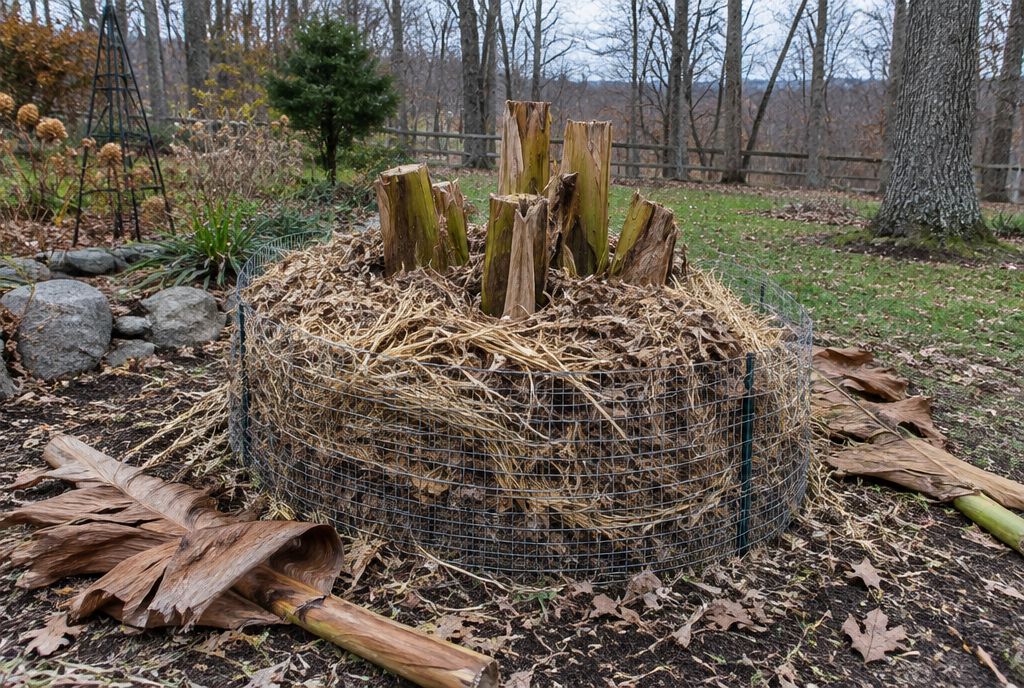
This is the routine for Musa basjoo in zones 5–8, and it is what the photo at the top shows. NC State says the rhizomes survive minus 10°F outdoors if properly pruned and mulched, and Arkansas says minus 20°F with heavy wintertime mulch.
- Wait for the leaves to be killed by frost. A hardy banana is happiest growing until the first hard frost. Once the leaves are brown and collapsed, the plant is dormant.
- Cut the stalks back. Cut the pseudostems back to short stumps. Remove the dead leaves and dispose of them, so they do not rot against the stumps.
- Build a cage. Make a ring of wire mesh or hardware cloth around the clump, wider than the stumps and a little taller.
- Fill it with dry material. Pack the cage with straw and shredded leaves, covering the top of the stumps. Keep it as dry as you can, because wet mulch holds cold and rots the stumps.
- Cover the top. Lay a board or a sheet of rigid plastic over the cage so rain and snow shed off, and weigh it down.
In spring, remove the covering gradually once hard freezes have passed. New growth should push from the base. Be patient, since a hardy banana can be slow to wake up.
Method 3: Bank soil, or dig and store
TAMU gives two options for a fruiting banana in colder locations. The first is to bank soil around the trunk just before a projected cold spell, which better protects the underground buds and lets the plant regenerate in spring. The second is to dig the entire plant, rhizome and all, remove the leaves and store it dry in a heated area over winter.
Digging suits a plant you can lift and a place you can keep warm and frost-free. Replant after your last frost, when the soil has warmed.
Method 4: Move a potted banana
A pot makes winter easy. CRFG says bananas, especially dwarf varieties, make good container specimens, and a pot lets you bring the plant under cover. Move it into a bright, frost-free room, garage or greenhouse before the first frost, and water less often, since growth slows below 60°F (UF/IFAS). Our banana plant in a pot guide covers pot size and care.
What to cut after a freeze, and when
Wait before you cut. The plants differ in how much they lose.
- Clearly dead and mushy pseudostems: TAMU says that after a major cold period in which there is no doubt the bananas were killed to the ground, cut them off at ground level within a couple of weeks of the freeze.
- Trunks that may still be alive: LSU says these should not be cut down, because new leaves and flower stalks can emerge from the top of the trunk. Remove only the dead leaf blades.
- When unsure: wait. Cold-damaged tissue turns soft and brown, and living tissue stays firm. Check again as the weather warms, and cut once you can tell.
Mulch stays on until the worst of the cold has passed. When growth restarts, feed the plant as in the banana plant guide, and remove extra suckers so the clump has a few strong stalks.
Choosing a banana for your winters
If your winters are mild, choose a fruiting banana such as Dwarf Cavendish and protect the base. If they are cold, choose Musa basjoo for the look, and a pot-grown fruiting type for the bananas. Our banana varieties guide compares them all.
Frequently asked questions
What is the most cold hardy banana tree?
Musa basjoo, the hardy banana. NC State says its growth dies back to the ground in zones 5 to 8, and the rhizomes are cold hardy to minus 10°F if properly pruned and mulched. The University of Arkansas Extension says it survives minus 5°F without protection or minus 20°F with heavy mulch. It is an ornamental, and its fruit is not for eating.
Can you grow a fruiting banana in zone 7 or 8?
Not reliably in the ground. Fruiting bananas are zone 9–11 plants. UF/IFAS says temperatures below 28°F may kill plants to the ground. In zones 7–8, grow a fruiting type in a pot you can shelter, and keep the in-ground Musa basjoo as a tropical-looking ornamental.
How do you protect a banana plant from frost?
Mulch the rhizomes (LSU), and in colder places bank soil around the trunk just before a cold spell to protect the underground buds (TAMU). For a hardy banana in a cold zone, prune the stalks and mulch heavily, as NC State describes.
When should you cut back a banana plant after a freeze?
Cut back only stalks that are clearly dead and mushy. TAMU says to cut plants off at ground level within a couple of weeks of a freeze that clearly killed them, while LSU says not to cut down trunks that may still be alive, because new leaves can emerge from the top. Wait until you can tell.
Will a banana plant come back after freezing to the ground?
Often, yes. CRFG says the underground rhizome will usually survive if the temperature does not fall below 22°F and the cold period is short. Mulch and soil over the rhizome improve the odds (LSU, TAMU).
Can you dig up a banana plant for winter?
Yes. TAMU says some people dig the entire plant, rhizome and all, remove the leaves and store it dry in a heated area over winter.
Sources
- Musa basjoo, NC State Extension Plant Toolbox
- Hardy Banana, University of Arkansas Cooperative Extension
- Banana Growing in the Florida Home Landscape (HS10/MG040), UF/IFAS Extension
- Banana, Texas A&M AgriLife Extension
- Louisiana Bananas, LSU AgCenter
- Banana Fruit Facts, California Rare Fruit Growers