

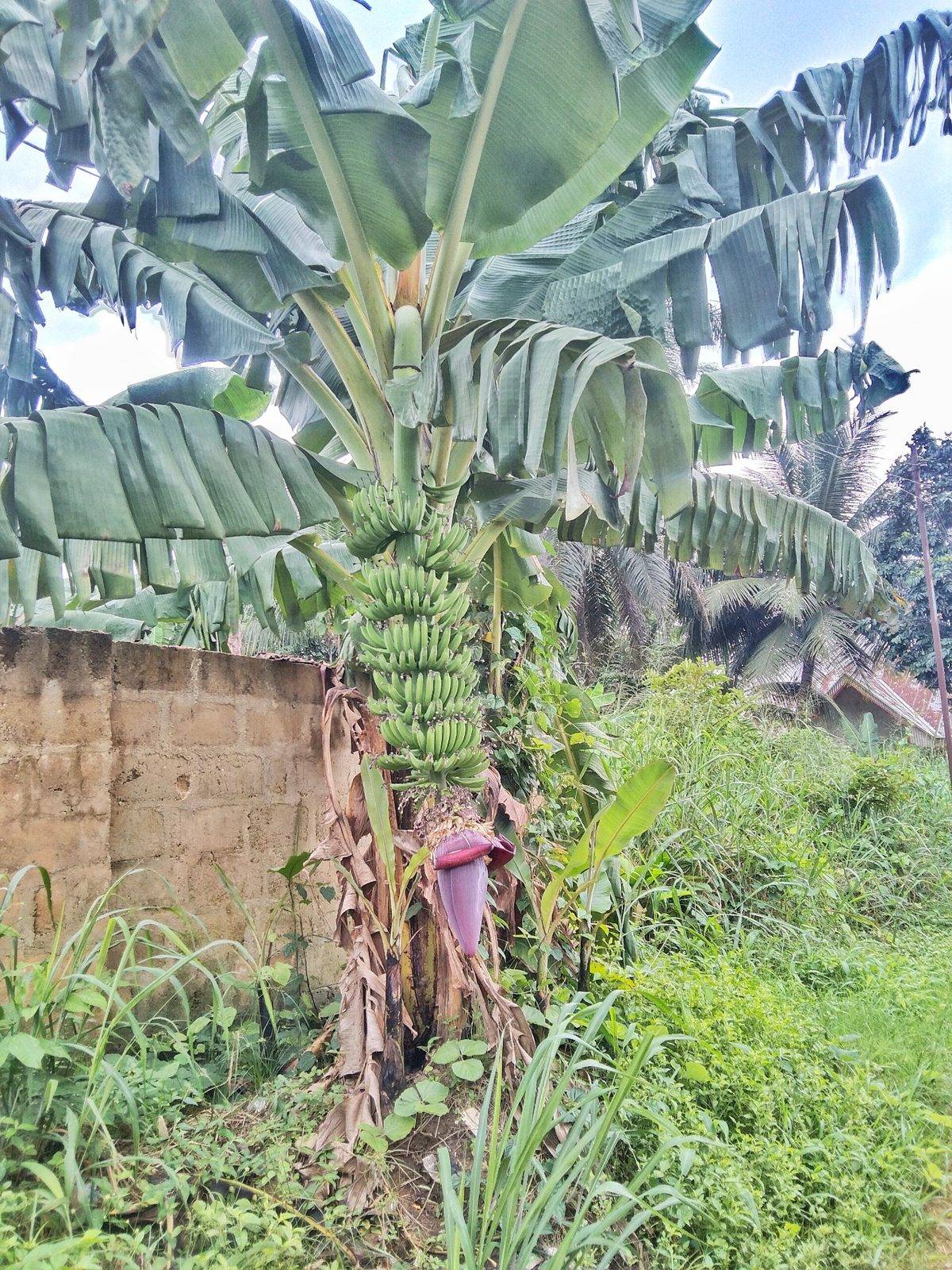
Dwarf Cavendish is the compact banana: CRFG says it is the smallest at 4 to 7 feet, and TAMU says it produces fruit typical of those in the supermarket. That makes it the easy choice for a small yard or a large pot. This page covers Dwarf Cavendish only. For planting and care, read our banana plant guide, and to compare it with other types, see the banana varieties guide.
- USDA zones
- 9–11 in the ground, as for bananas in general
- Sun
- Full sun
- Water
- High
- Difficulty
- Easy
- Lifecycle
- Perennial
- Origin
- Asia
- Container friendly
- Yes
- Height
- 4–7 ft (CRFG) · about 6 ft (TAMU)
- Fruit
- Large bunches of medium-sized fruit, typical of the supermarket (UF/IFAS, TAMU)
- Cold tolerance
- Fair (UF/IFAS)
- Panama disease
- Resistant (UF/IFAS)
- Black Sigatoka
- Susceptible (UF/IFAS)
- Time to fruit
- Flower stalk 10–15 months after planting (UF/IFAS) · fruit matures 3–6 months later (LSU)
Dwarf Cavendish fruit
TAMU describes Dwarf Cavendish as a short, compact variety that produces fruit typical of those in the supermarket, and UF/IFAS says it produces large bunches of medium-sized fruit. If you want to eat the banana you know, rather than something exotic, this is the plant.
Expect to wait. UF/IFAS says the flowering stalk of a banana emerges 10 to 15 months after planting, and LSU says fruit then takes three to six months to mature, depending on temperature, variety, moisture and culture. When the fingers look plump and rounded, cut the whole bunch and ripen it indoors, as our banana plant guide explains.
Why gardeners choose it
It stays small. CRFG says it is the smallest banana, at 4 to 7 feet, and TAMU says about 6 feet. That is a plant you can reach, prune and harvest from the ground.
It copes with wind better. UF/IFAS says winds above 25 mph may topple tall banana cultivars and winds above 45 mph may topple short ones. TAMU says that because of its size, wind damage on Dwarf Cavendish is less severe.
It resists Panama disease. UF/IFAS rates Dwarf Cavendish as resistant to Panama disease, the fungal disease that attacks the roots and the conducting tissue of the pseudostem and causes the plant to collapse. That makes it a safer pick than tall types such as Lady Finger, Blue Java and Apple, which UF/IFAS rates as susceptible.
It suits pots. CRFG says bananas, especially dwarf varieties, make good container specimens if given careful attention. See our banana plant in a pot guide.
The trade-offs
UF/IFAS lists one disadvantage: Dwarf Cavendish is susceptible to Black Sigatoka disease. UF/IFAS also says black Sigatoka is more of a problem in large commercial plantings than for isolated clumps of bananas in the home landscape, so a backyard plant is less exposed.
Cold is the other limit. UF/IFAS rates its cold tolerance as fair, and recommends it for south Florida, where in frost-free years and with good care it produces abundant fruit. That is a clue to how it behaves. It is a plant for zones 9–11, and the warmest part of that range gives the best chance of a crop. In a cooler spot, a potted plant you can shelter is the safer route.
Growing Dwarf Cavendish: what is different
Dwarf Cavendish follows the same routine as other bananas, with a few small differences.
Sun and soil. Full sun grows best (CRFG). Give it deep, well-drained soil that is high in organic matter, at a pH of about 5.5–6.5 (CRFG), and avoid standing water (TAMU).
Water and food. CRFG says regular deep watering is an absolute necessity during warm weather. UF/IFAS says the potash requirement is high, so feed with a high-potassium fertilizer in a 3-1-6 ratio, every 4 to 8 weeks through the year. The full schedule is in the fertilizing section of the banana plant guide.
The clump. UF/IFAS says to keep 3 to 4 pseudostems of different ages, with one fruiting, one about half to two-thirds its size, and one or two sword suckers. Each stalk fruits once and is then cut down (TAMU), and a younger one takes over.
Cold. Leaves are damaged near freezing, and below 28°F (−2°C) the plant may die to the ground (UF/IFAS). Mulch the base before cold weather. LSU says a good layer of mulch over the rhizomes can help them survive. Our banana overwintering guide has the full routine.
How Dwarf Cavendish compares
| Variety | Height | Panama disease | Fruit |
|---|---|---|---|
| Dwarf Cavendish | 4–7 ft (CRFG) | Resistant (UF/IFAS) | Medium-sized, typical of the supermarket (UF/IFAS, TAMU) |
| Lady Finger | 20–25 ft (CRFG) | Susceptible (UF/IFAS) | Thin-skinned, about 1 in. by 4 in. (TAMU) |
| Blue Java | 15–20 ft (CRFG) | Susceptible (UF/IFAS) | 7–9 in., aromatic, ice-cream texture (CRFG) |
| Goldfinger | — | Resistant (UF/IFAS) | An excellent dessert banana (UF/IFAS) |
Choose Dwarf Cavendish if you want a small plant with familiar fruit. Choose Goldfinger if disease resistance is the priority, and Lady Finger or Blue Java if you have room and want something different.
Where to buy a Dwarf Cavendish banana
Buy a container-grown plant or a rooted sucker from a nursery in your region, or from a plant sale run by your county extension office or a local fruit-growers club. Check that the label says Dwarf Cavendish. Plant after your last frost so it has a full warm season to settle in. If a friend has a clump, ask for a sword sucker, which is the planting material UF/IFAS describes as most common, and read our guide on how to grow a banana tree from a banana for how to divide one.
Once you have the plant, our banana varieties guide can help you decide whether a second type is worth the space.
Frequently asked questions
How tall does a Dwarf Cavendish banana get?
CRFG says the Dwarf Cavendish is the smallest banana, at 4 to 7 feet. TAMU puts it at about 6 feet. It is a short, compact variety, so it suits small yards and pots better than a tall type.
Is Dwarf Cavendish resistant to Panama disease?
UF/IFAS rates Dwarf Cavendish as resistant to Panama disease. It is susceptible to Black Sigatoka, which UF/IFAS lists as its one disadvantage, though Black Sigatoka is mostly a problem in large commercial plantings rather than for isolated home clumps.
Can you grow Dwarf Cavendish in a pot?
Yes. CRFG says bananas, especially dwarf varieties, make good container specimens if given careful attention. Use a large pot with drainage holes, give it full sun, water deeply and feed regularly.
Does Dwarf Cavendish taste like store-bought bananas?
Yes. TAMU says it produces fruit typical of those in the supermarket, and UF/IFAS says it produces large bunches of medium-sized fruit.
How cold hardy is Dwarf Cavendish?
Not very. UF/IFAS rates its cold tolerance as fair. Like other bananas, its leaves are damaged near freezing, and below 28°F (−2°C) the plant may be killed to the ground, though a protected corm usually regrows.
Sources
- Banana Growing in the Florida Home Landscape (HS10/MG040), UF/IFAS Extension
- Banana, Texas A&M AgriLife Extension
- Banana Fruit Facts, California Rare Fruit Growers