

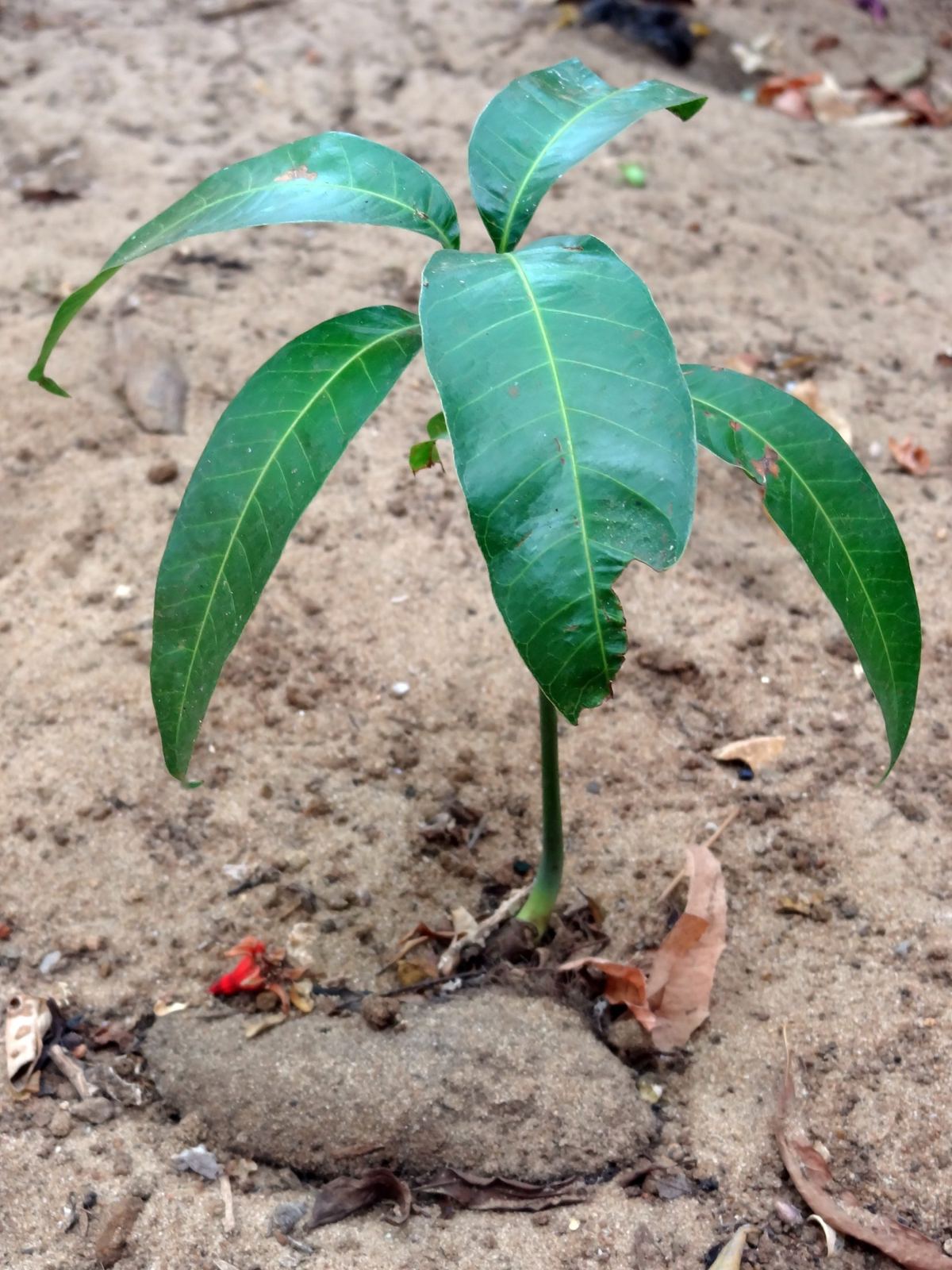
You can grow a mango tree from seed: pull the seed out of its husk, keep it warm and damp, and it sprouts in one to four weeks. Pot the sprout in free-draining mix, give it all the sun you can and you will have a leafy little tree by the end of the season. Fruit is the long game, though. A seedling usually takes 5–8 years to bloom and may not taste like its parent. This guide goes deeper than the seed steps in our mango tree guide, including the two sprouting methods, what to expect year by year and how to graft your seedling.
Will a mango seed grow true to the fruit you ate?
It depends on which kind of mango you ate. Mangoes come in two seed types, and the difference decides whether your tree is a copy or a surprise.
- Polyembryonic seeds hold several embryos. Most are clones of the mother tree, so the sprouts grow into trees that give fruit very like the parent. Ataulfo (also sold as honey or Champagne mangoes) and Nam Doc Mai are polyembryonic.
- Monoembryonic seeds hold one embryo, produced by cross-pollination. The seedling is a new, unpredictable variety. Most Florida and Indian types, including the supermarket staples Tommy Atkins, Kent and Keitt, are monoembryonic, and the seedling can be fibrous, small or bland.
Even a clone seedling is not quite a grafted tree. It keeps juvenile traits for longer and tends to grow big, so expect a standard-size tree, not a compact one. If the fruit matters more than the experiment, buy a grafted tree and grow seeds for fun. UF/IFAS notes that most commercial mango trees are grafted onto polyembryonic rootstocks for exactly this reason.
Choosing and preparing a mango seed
Start with a seed from a fully ripe mango that has not been frozen or stored in the fridge for weeks. Mango seeds are short-lived and do not tolerate drying out, so plant within a few days of eating the fruit.
Scrub off every scrap of flesh, which otherwise grows mold. Pat the husk dry and leave it for a day. The husk is the fibrous, flat, oval shell around the seed. It is not the seed itself.
Method 1: Open the husk and plant the seed
This is the fastest and most reliable route, and it is the one outlined in our mango tree guide.
- Open the husk. Use kitchen shears or a sturdy knife to cut along the thin curved edge, working slowly so you do not nick the seed. Pry the two halves apart.
- Lift out the seed. It is a plump, kidney-shaped bean, often with a thin brown skin. Throw away any seed that is gray, shriveled or soft and smelly. Do not worry if the skin tears.
- Plant it shallow. Lay the seed on its side in a 1-gallon pot of free-draining mix with the hump facing up and the top just showing. Mangoes grow a long taproot, so a tall nursery pot is better than a squat one.
- Warm it and keep it damp. Aim for 75–85°F (24–29°C) with mix as moist as a wrung-out sponge. A seedling heat mat is worth it indoors. Do not let the pot dry out and never leave it standing in water.
Method 2: The paper towel method
If you want to watch the roots appear, or you are not sure the seed is alive, sprout it first.
- Wrap the husked seed in a damp, not dripping, paper towel.
- Slide it into a zip-top bag, leave the bag slightly open and keep it somewhere warm, 75–85°F (24–29°C).
- Check every two or three days and re-wet the towel if it dries. A white root usually shows within 1–3 weeks.
- Move the seed to a pot as soon as the root is about 1–2 inches (2.5–5 cm) long. Lay it on its side, root pointing down, and cover it so only the top shows.
Do not leave a sprouted seed in the bag for more than a few days. The root tangles in the towel and tears when you move it.
Can you plant the whole seed without opening the husk?
Yes. Bury the entire husk on its side, an inch deep, and keep it warm and damp. It is less work, but the husk slows water uptake, so sprouting often takes 3–6 weeks and a few seeds rot before they emerge. The husk also hides what is happening inside. If you want the best odds, open it.
What to expect: the seedling timeline
Weeks 1–4: Sprout
Months 2–12: Flushes
Years 1–3: Pot up
Years 5–8: First fruit
If a polyembryonic seed sends up two or three shoots, you can leave them, but they will compete. Once they are 6–8 inches tall, gently tease the stems apart and pot them separately. The sexual seedling tends to be the weakest, so pick the strongest shoot if you want a clone of the parent. That is a rule of thumb, not a guarantee.
Move the seedling outside once nights stay above 55°F (13°C), hardening it off over a week or so because new leaves scorch in strong sun. Bring it back in when nights fall toward 40°F (4°C).
How to graft a mango seedling
Grafting turns an unpredictable seedling into a tree of a named variety, usually fruiting in 3–5 years instead of 5–8. UF/IFAS describes veneer grafting or budding on seedling rootstocks as the standard method. Think of your seedling as the rootstock.
- Wait until the seedling stem is pencil-thick, about ¼–½ inch (6–12 mm), usually in its first or second year, and grow it in warm weather when the tree is actively flushing.
- Get scion wood, a stick of the variety you want, from a friend’s tree or a nursery. Pick a firm, pencil-thick shoot with a swollen terminal bud, about 4–6 inches (10–15 cm) long.
- Cut a long, shallow slice down the seedling stem, then a matching slice on the scion, and press the cut faces together so the green cambium layers line up.
- Wrap the join tightly with grafting tape, then cover the scion with a loose plastic bag to hold moisture for a few weeks.
- When the scion buds push new leaves, you have a take. Remove the tape gradually and cut off any shoots below the graft that grow from the rootstock.
A beginner’s success rate can be low, so graft several seedlings and treat early attempts as practice. If that sounds like too much, a grafted nursery tree such as Carrie saves years.
Common seed-growing mistakes
- Letting the seed dry out. A dried seed rarely sprouts. Plant it within days of eating the fruit.
- Overwatering. Soggy mix rots the seed and the seedling’s taproot. Water when the top inch is dry.
- A pot that is too shallow. The taproot hits the bottom and circles. Use a tall pot.
- Too little light. A seedling in a dim corner turns leggy and drops leaves. Give it the sunniest window you have.
- Expecting fruit in three years. It takes longer, and may never taste right. Treat the tree as a gift, not an orchard.
Ready for a tree that fruits sooner? Browse the mango varieties guide to choose a grafted tree for your zone.
Frequently asked questions
How long does a mango seed take to sprout?
In warm conditions of 75–85°F (24–29°C), a husked seed sprouts in about 1–4 weeks. A seed planted inside its husk is slower, often 3–6 weeks or more, and some never emerge. Seeds from cold or dried-out fruit may not sprout at all.
Will a mango tree grown from seed produce fruit?
Usually, but not for years. Expect 5–8 years to first fruit, and the fruit may differ from the mango you ate. Seeds of polyembryonic varieties such as Ataulfo mostly produce clones of the parent, while seeds of monoembryonic varieties such as Tommy Atkins, Kent and Keitt give a one-of-a-kind seedling that can be fibrous or bland.
Can I grow a mango from a grocery store seed?
Yes. Choose a seed from a fully ripe fruit that was never frozen, and plant it within a few days. Ataulfo mangoes (also sold as honey or Champagne mangoes) are the best bet, because their seeds are polyembryonic and the tree is more likely to bear fruit like the one you ate.
Should I graft my mango seedling?
If you want named-variety fruit sooner, yes. Grafted trees fruit in 3–5 years and match the variety you picked. Grafting is a learnable skill but beginners often need several tries, so sprout a few seeds to practice on.
Sources
- Mango Growing in the Florida Home Landscape (HS2/MG216), UF/IFAS Extension
- Mangifera indica: Mango (ENH563/ST404), UF/IFAS Extension
- Mango Fruit Facts, California Rare Fruit Growers
- Nam Doc Mai, Mango Science, UF/IFAS