

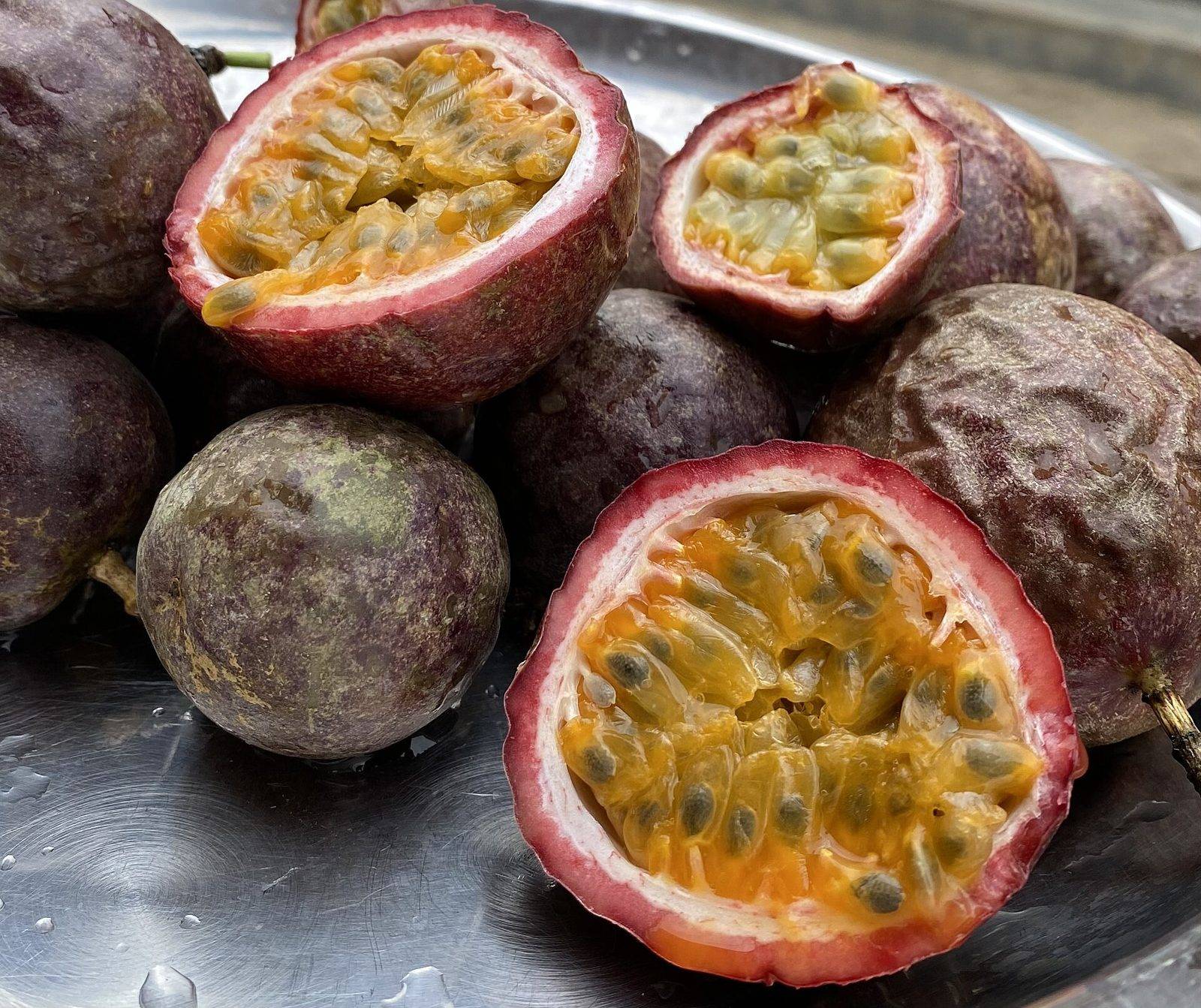
To eat a passion fruit, cut it in half and scoop out the pulp and seeds with a spoon. The rind is not eaten. The seeds are, and so is the juicy pulp around them. A wrinkled skin is fine. If you grow your own, our passion fruit vine guide explains how to get fruit like this at home. Below are three ways to eat it, plus ripeness cues and storage.
Before you cut: is it ripe?
UF/IFAS says mature fruit ripen into colors from dark purple or burgundy to yellow, depending on the type. Purple types turn dark, and yellow types turn yellow. A fruit that has not colored up yet is not ready. A fruit that has gone dull and wrinkled can still be good, so do not throw it out on looks alone.
For a sense of size, UF/IFAS gives the Possum Purple cultivar as 2.5 to 3.5 inches long and about 2 inches across. Wash the fruit and dry it, because you will be holding it by the skin.
You need a sharp knife, a cutting board and a spoon. A small bowl helps catch the juice.
Method 1: halve and scoop
This is the way most people eat it.
- Place the fruit on a board. Hold it steady and keep your fingers clear of the blade.
- Cut it in half. Cut across the middle with a sharp knife. A serrated knife grips the skin if it is hard.
- Scoop it out. Use a spoon to lift the pulp and seeds out of each half and into a bowl or straight into your mouth.
- Leave the rind. The shell is tough and not eaten. Compost it.
The seeds are eaten along with the pulp. They are small and crunchy, and most people swallow them with the juice. A spoon works well on the rind, because it lifts the pulp off the white pith without taking the pith with it.
Method 2: strain the juice
If you want juice without the crunch, press the pulp through a fine sieve.
- Scoop the pulp and seeds into a fine sieve set over a bowl.
- Press and stir with a spoon so the juice runs through and the seeds stay behind.
- Taste it. If it is sharp, stir in a little sugar or honey.
- Use it right away or chill it.
The juice is aromatic, and UF/IFAS describes the juice of Possum Purple as sweet with a moderately strong flavor. Flavor varies with the type and with ripeness, so taste a spoonful before you decide what to add.
Method 3: use the pulp in dishes and drinks
Passion fruit pulp works as a topping, sauce and flavoring. Scoop it, with seeds or strained, and use it in these ways:
- Spoon it over yogurt, oatmeal or ice cream.
- Pour it over a cake, cheesecake, pavlova or a bowl of fruit.
- Stir it into a smoothie, lemonade or sparkling water.
- Mix it into a vinaigrette or glaze for fish or chicken.
- Stir it into a cocktail or a simple syrup.
A single fruit gives a spoonful or two, so a few fruit go a long way as a flavoring. Passion fruit also pairs well with mango, banana and pineapple in fruit salads.
Wrinkled, smooth or dented: what to expect
A smooth, full fruit is fresh. A wrinkled one has been sitting a while, and it is fine to eat. Cut it open and use your nose. Fresh pulp smells fruity. A sour, fermented or musty smell, or any mold, means the fruit has gone off, and you should discard it.
Storing passion fruit
UF/IFAS says fresh fruit may be stored for up to two or more weeks in plastic bags at 41–54°F and 85–90% relative humidity. At home, a closed bag in the refrigerator crisper gets you close to that.
| What | How | Roughly how long |
|---|---|---|
| Whole fruit | Plastic bag at 41–54°F and 85–90% humidity (UF/IFAS) | Up to two or more weeks (UF/IFAS) |
| Scooped pulp | Covered container in the fridge | Use within a few days |
| Pulp for later | Freeze in an ice-cube tray, then bag the cubes | Keeps well in the freezer |
What about maypop fruit?
Maypop (Passiflora incarnata) is a different species. UF/IFAS describes its fruit as ovoid and green, produced abundantly along with the flowers (FP457), and as yellow to green with a flavor that is insipid to slightly sweet (HS1406). It is a milder fruit than the purple passion fruit you buy in shops. Our maypop page covers it in detail.
Eat what you grow
A passion fruit vine is a good plant to grow for the pulp alone. If you want to try, start with our passion fruit vine guide, then choose a type in our passion fruit varieties guide. For another fruit that rewards a spoon, see our dragon fruit guide, or browse the banana plant guide.
Frequently asked questions
What is the easiest way to eat a passion fruit?
Cut it in half across the middle and scoop out the pulp and seeds with a spoon. The pulp is the part you eat. The tough rind is a bowl and is thrown away.
Can you eat passion fruit seeds?
Yes. The seeds sit inside the juicy pulp and are eaten with it, and they add a slight crunch. If you want smooth juice, press the pulp through a sieve to leave the seeds behind.
Is a wrinkled passion fruit OK to eat?
A wrinkled skin is fine, and the fruit inside is usually good to eat. Judge the fruit by cutting it open. The pulp should look and smell fresh, and you should discard a fruit that smells off or has mold.
How do you know when a passion fruit is ripe?
UF/IFAS says mature fruit ripen into colors from dark purple or burgundy to yellow, depending on the type. A fruit that has taken on its full ripe color is ready to cut. Many fruit wrinkle as they sit, which is normal.
How long does passion fruit keep?
UF/IFAS says fresh fruit may be stored for up to two or more weeks in plastic bags at 41–54°F and 85–90% relative humidity. At home, a bag in the refrigerator is the closest match. Scooped pulp keeps best in a covered container in the fridge, or in the freezer.
Sources
- The Passion Fruit in Florida (HS1406), UF/IFAS Extension
- Passiflora incarnata: Wild Passion Flower, Maypop (FP457), UF/IFAS Extension