

A passion fruit vine that flowers but does not fruit usually has a pollination problem. UF/IFAS says yellow passion vines are not self-fertile and need pollen from a genetically different vine, and that purple-yellow hybrids vary. Too few bees, too much nitrogen, too little sun and cold can add to it. Work through the table below, and hand-pollinate while you fix the cause. For planting and care, see our passion fruit vine guide.
What a passion fruit flower looks like
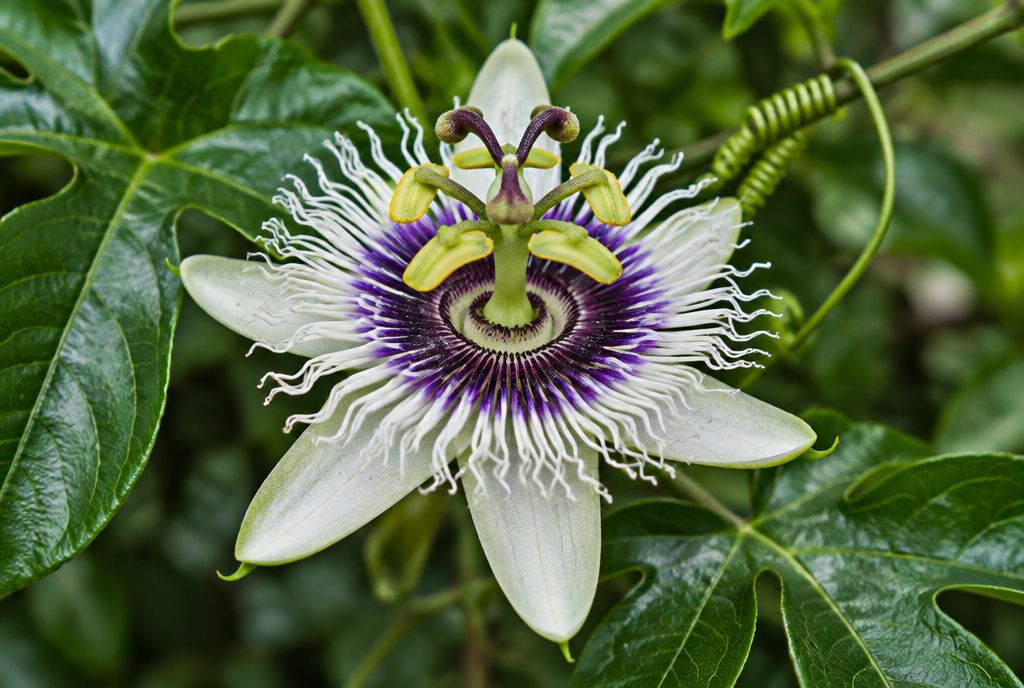
The passion fruit flower is one of the showiest in the garden. It has white petals and a wavy fringe of purple-and-white filaments, called the corona, and a green central column that carries the pollen-bearing anthers and, above them, the stigmas that receive pollen. Leaves are glossy and three-lobed. The flowers are large and easy to examine, which makes them easy to pollinate by hand.
Pollination happens when pollen from an anther lands on a stigma. That can be carried by a bee, or by you. UF/IFAS says the time from flowering to harvest is generally 70 to 75 days, so a flower that has been pollinated will turn into ripe fruit in about two and a half months.
Why a passion fruit flower does not set fruit: diagnosis
| What you see | Likely cause | What to do |
|---|---|---|
| A yellow vine with lots of flowers and no fruit | Yellow vines are not self-fertile and need pollen from a genetically different vine (UF/IFAS). | Plant a second yellow vine of a different origin, or hand-pollinate with pollen from another vine. |
| A purple-yellow hybrid that sets little | Hybrids vary in self-compatibility (UF/IFAS). | Treat it like a yellow vine: add a second vine or hand-pollinate. |
| A purple vine with flowers, but few bees about | Flowers need a carrier. Carpenter bees are the most effective pollinators but are rare in south Florida (UF/IFAS). | Hand-pollinate, and plant flowers nearby to attract bees. |
| A big, leafy vine with few flowers | Too much nitrogen. UF/IFAS says to cut nitrogen substantially after the first year so the vine flowers rather than growing leaves. | Switch to a lower-nitrogen fertilizer and stop feeding heavily. |
| Flowers on a shaded vine | Too little sun. Passion fruit grows best in full sun, or where the vine can reach full sun after climbing (UF/IFAS). | Prune shade, or train the vine to a sunnier trellis. |
| Flowers after a cold spell, and little set | Cold. Growth and fruiting are best between about 65°F and 90°F, and chilling injury is possible below about 59°F (UF/IFAS). | Protect the vine on cold nights and wait for warm weather. |
| A vine that dries out between waterings | Uneven moisture. UF/IFAS says passion fruit needs small, frequent watering to keep the soil moist but not saturated. | Water more often in smaller amounts, and mulch the roots. |
Purple, yellow or hybrid: does your vine need a partner?
This is the question to answer first. UF/IFAS says some purple varieties can be self-pollinated, while yellow varieties are not considered capable of self-pollinating, and hybrids vary. Purple passion fruit flowers are self-fertile. Possum Purple, the most widely grown and propagated cultivar in south Florida, has self-compatible flowers (UF/IFAS).
If you do not know what you have, watch what happens. A vine that sets fruit alone is behaving like a purple type. A vine that flowers every week and never fruits needs help. Two vines of a self-fertile type are fine, but if you have yellow vines, plant two that are genetically different. Two seedlings are genetically different from each other, but two cuttings from the same plant are clones, so they will not pollinate one another. Our passion fruit varieties guide lists which types are which.
The bees that pollinate passion fruit
UF/IFAS says the primary pollinators of passion fruit are honey bees and carpenter bees, and that the large carpenter bee (Xylocopa), which looks like a bumblebee, is the most effective insect pollinator. These bees are rare in south Florida (UF/IFAS), so many growers there cannot count on them.
You can help. Plant a mix of flowers near the vine so that bees visit your garden, and avoid spraying insecticide while the vine is in flower. If bees are scarce, hand pollination is the answer.
How to hand pollinate a passion fruit flower
UF/IFAS says hand pollination with a clean cotton glove or paintbrush is a labor-intensive but effective way to ensure fruit production.
- Choose open flowers. Work while the flowers are open and fresh. Skip any flower that has wilted.
- Collect pollen. Brush the anthers with a clean, dry paintbrush, or touch them with a clean cotton glove, so pollen sticks to it.
- Transfer it to the stigmas. Dab the pollen onto the sticky stigmas at the top of the central column of another open flower.
- Use a different vine if you have yellow vines. UF/IFAS says yellow vines need pollen from a genetically different vine, so carry pollen between plants.
- Repeat on more flowers. Pollinate as many open flowers as you can on each visit, and check again over the next few days.
Other reasons a passion fruit vine does not fruit
Too much nitrogen. UF/IFAS says that after the first year the amount of nitrogen fertilizer should be substantially reduced to favor flowering over vegetative growth. A vine fed like a lawn makes leaves, not fruit.
Not enough sun. Passion fruit grows best in full sun, or in a spot where it can reach full sun after climbing (UF/IFAS). A vine that is shaded at the base but climbs into light is fine. One that is shaded all over is not.
Cold or heat. The best range for growth and fruiting is about 65–90°F (UF/IFAS). Outside that range the vine does less well, and cold nights can hurt it.
Uneven water. UF/IFAS says passion fruit needs small but frequent irrigation, keeping the soil moist but not saturated. Shallow roots dry out fast.
A young vine. A brand-new vine may need time to settle in. UF/IFAS says a one-year-old vine can be expected to produce 5 to 15 lb of fruit, so a healthy vine that has been growing for a year or more should be flowering and setting fruit. If yours is not, look at pollination first.
When fruit sets
After a flower is pollinated, the time from flowering to harvest is generally 70 to 75 days (UF/IFAS). Mature fruit ripens into colors from dark purple or burgundy to yellow, depending on the type. When it is ready, our guide on how to eat a passion fruit shows you what to do with it. For another tropical plant that often needs a partner or a brush to set fruit, see our dragon fruit guide, or try the banana plant guide.
Frequently asked questions
Why does my passion fruit vine flower but not fruit?
The most common cause is pollination. UF/IFAS says yellow passion vines are not self-fertile and need pollen from a genetically different vine, and that purple-yellow hybrids vary. Too few bees, too much nitrogen, too little sun and cold weather can also stop fruit from setting.
Are passion fruit flowers self-pollinating?
Purple ones are. UF/IFAS says purple passion fruit flowers are self-fertile, and that the Possum Purple cultivar is self-compatible. Yellow vines are not, and purple-yellow hybrids may or may not be.
What pollinates passion fruit?
UF/IFAS says the primary pollinators are honey bees and carpenter bees, and that the large carpenter bee, which looks like a bumblebee, is the most effective insect. It adds that these bees are rare in south Florida, which is one reason hand pollination is used there.
How do you hand pollinate a passion fruit flower?
UF/IFAS says hand pollination with a clean cotton glove or a paintbrush is a labor-intensive but effective way to ensure fruit production. Pick up pollen from the anthers of an open flower and brush it onto the stigmas of another open flower, ideally from a different vine if yours is a yellow type.
How long after pollination does passion fruit take to ripen?
UF/IFAS says the time from flowering to harvest is generally 70 to 75 days. Count from the day the flower opens.
Sources
- The Passion Fruit in Florida (HS1406), UF/IFAS Extension
- Passion Fruit Problems in the Home Landscape (HS1397), UF/IFAS Extension