

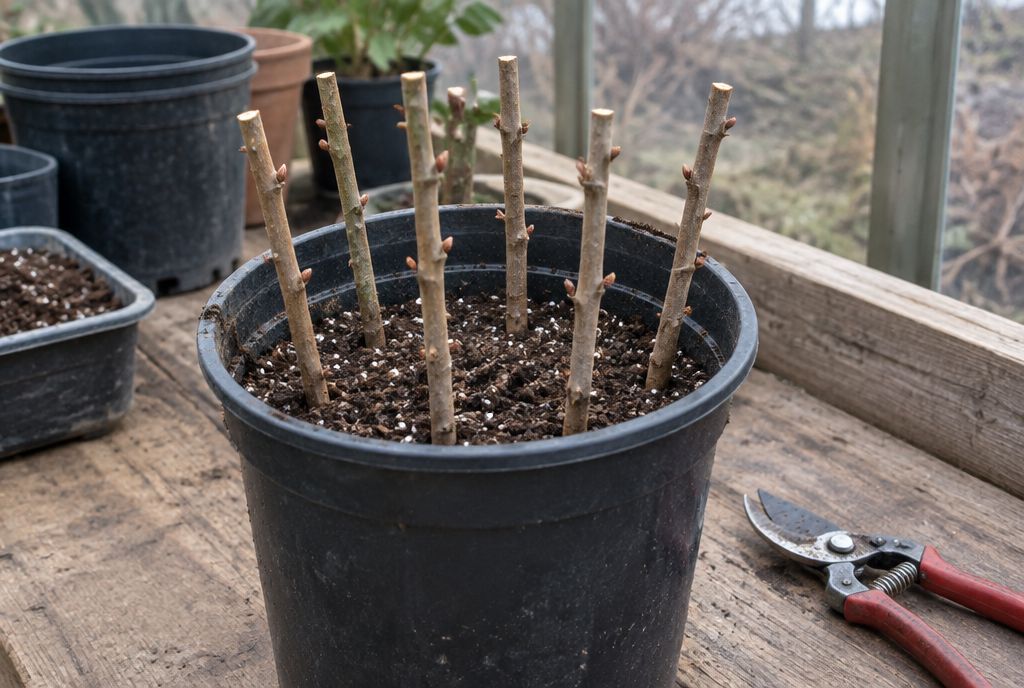
To grow a pomegranate from a cutting, take pencil-thick pieces of last season’s wood, about 10 inches long, in late fall or winter, and stick them deep in a pot of moist, free-draining mix. UGA says a tree from a hardwood cutting will bear fruit in year two after planting, while one from seed takes at least three years. This guide goes deeper than the quick start in our pomegranate tree guide, including when to cut, how long a cutting should be and what to expect as it roots.
Cuttings or seed?
Cuttings. Pomegranates can be grown from seed, but UGA says it takes at least three years to fruit, against year two for a hardwood cutting. A cutting is also a piece of a plant whose fruit you already know, so you get the variety you chose.
| Cutting | Seed | |
|---|---|---|
| Time to fruit | Year two after planting (UGA) | At least three years (UGA) |
| Fruit | The same variety as the parent plant | May differ from the parent |
| Effort | Cut, stick, water | Sow and wait |
When to take pomegranate cuttings
Take hardwood cuttings while the plant is dormant. UGA says late fall or early winter, and TAMU says winter. This fits neatly with your pruning, because UGA says pomegranates need pruning each year, and major pruning is done in winter before bud break. The prunings are free cutting wood.
Take them from a healthy plant that fruits well. A friend’s plant, a fruit-growers club swap or your own plant is the easiest source. Choose a variety that suits your climate. If your winters are cold, that might be Kazake or Salavatski, as our pomegranate varieties guide explains.
Choosing the wood and the length
Look for one-year wood, meaning the growth that came on last season. It should be firm, straight and about as thick as a pencil, with healthy buds along it. Avoid thin, weak shoots and old, woody trunks.
How long should the cutting be? The sources give a range:
| Source | Length |
|---|---|
| UF/IFAS | 6–8 inches |
| TAMU | 6–14 inches |
| UGA | About 10 inches |
| CRFG | 12–20 inches |
A length of about 10 inches (25 cm) sits in the middle of that range and gives you enough wood to bury and enough above the soil to leaf out.
Step by step: cut, stick, wait
- Cut a section of one-year wood. Use clean, sharp pruners. Cut a piece about 10 inches long and pencil-thick, with several buds along it.
- Shape the ends. Make the bottom cut straight just below a bud, and the top cut at a slant just above a bud. The slant tells you which end is up, and it sheds water.
- Fill a pot with free-draining mix. Use a deep pot with drainage holes and a light mix that drains well. Wet it so it is moist but not soggy.
- Stick the cutting deep. Push the bottom end into the mix, base end down, so that most of the cutting is buried and only the top couple of buds show. Firm the mix around it.
- Water, then keep it just moist. Water it in, put the pot in a bright, sheltered place and keep the mix evenly moist, without letting it sit wet. A rooting hormone is optional.
- Wait for growth. Buds break and leaves open in spring. That is a good sign, so keep watering through the season and leave the cutting undisturbed until it is growing well.
What to expect: the timeline
Late fall to winter: Cut and stick
Spring: Leaf out
First summer: Grow on
Year two after planting: First fruit
Planting out
Once the cutting has grown on and the weather is safely above freezing, plant it in a sunny, well-drained spot or move it to a bigger pot. TAMU says once established, pomegranates can be watered every 7 to 10 days. Pomegranates also do well in containers (CRFG), so you can keep the plant in a pot and shelter it in winter if you garden in a cold climate. Our pomegranate tree guide covers planting, care and training, and whether to grow a bush or a small tree.
Pollination: do you need a second plant?
No. UGA says pomegranates are self-fruitful, so one plant sets fruit. CRFG says cross-pollination increases fruit set, so two varieties near each other may give a bigger crop. If you want both, take cuttings from two different varieties.
Common cutting mistakes
- Using old or thin wood. Choose firm, one-year wood about as thick as a pencil.
- Planting it upside down. The base goes in the mix. Mark it before you stick it.
- Overwatering. A soggy mix rots the buried wood. Keep it moist, not wet.
- Cutting in the wrong season. Take hardwood cuttings in late fall or winter, while the plant is dormant.
- Letting the cutting dry out. Keep the mix moist and the cutting out of strong wind.
- Expecting fruit in year one. Count from planting. Fruit comes in year two (UGA), and a heavier crop follows as the plant grows.
Ready to grow on? Start with our pomegranate tree guide, then see how to tell if a pomegranate is ripe so you pick your first fruit at the right moment. For another fruit that does well in a pot, read our fig tree in a pot guide.
Frequently asked questions
When is the best time to take pomegranate cuttings?
Late fall or winter, while the plant is dormant. UGA says to take hardwood cuttings in late fall or early winter, and TAMU gives winter. Winter pruning is a handy source of cutting wood.
How long should a pomegranate cutting be?
About 10 inches (25 cm) is a good length. Sources vary, with UF/IFAS giving 6–8 inches, TAMU 6–14 inches, UGA about 10 inches and CRFG 12–20 inches. Choose pencil-thick, one-year wood.
How long does a pomegranate cutting take to fruit?
UGA says a tree from a hardwood cutting will bear fruit in year two after planting, while one from seed takes at least three years. Fruit also depends on sun, water and a healthy plant.
Can you grow a pomegranate from seed instead?
Yes, but it is slower. UGA says it takes at least three years from seed, against year two from a hardwood cutting. A cutting also gives you a copy of the plant it came from, so you know which variety you will get.
Do you need cuttings from more than one plant?
No. UGA says pomegranates are self-fruitful, so one plant sets fruit. CRFG says cross-pollination increases fruit set, so cuttings from a second variety can give a heavier crop.
Sources
- Pomegranate Production (C997), UGA Extension
- Pomegranate Fruit Facts, California Rare Fruit Growers
- Texas Fruit and Nut Production: Pomegranates, Texas A&M AgriLife Extension
- The Pomegranate (MG056), UF/IFAS Extension