

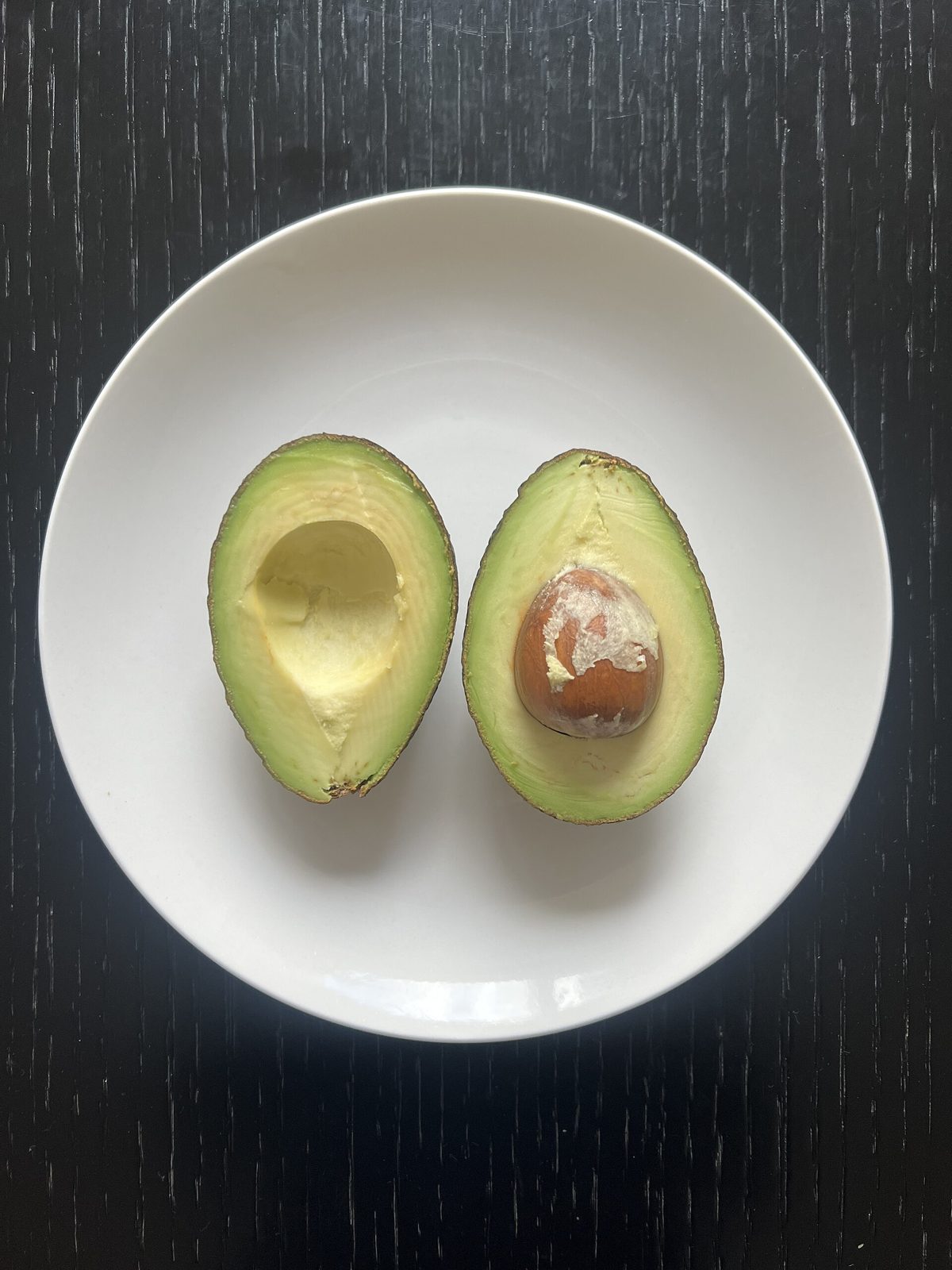
A ripe avocado yields slightly when you press it gently in your palm, and the stem cap flicks off to reveal yellow-green. Skin color helps with some varieties but is not reliable on its own. A hard avocado is not ready, and one that is mushy or dented is past its best. If yours is still firm, leave it on the counter for about 3–10 days. If you grow your own, our avocado tree guide explains how to harvest so the fruit ripens well indoors.
How to tell if an avocado is ripe: 4 cues
Use these together. No single sign is perfect, but the gentle press and the stem cap are the best two.
Press
Stem cap
Color
Weight and look
Is color a reliable sign of a ripe avocado?
Not always. Hass is the variety most shoppers see, and its pebbled skin darkens as it ripens. But many varieties stay green all the way through. Fuerte has a dark green skin with small pale spots, and Bacon has a smooth green skin (CRFG, UC Riverside). If you only look at color, you will leave good fruit on the counter or reject ripe fruit. Press and check the stem cap too.
| Variety | Skin | Better cue |
|---|---|---|
| Hass | Thick, pebbled, coppery purple (CRFG) | Darkening skin plus a gentle give |
| Mexicola | Paper-thin, purplish black (CRFG) | Gentle give and stem cap |
| Fuerte | Thin, dark green with small raised pale spots | Gentle give and stem cap |
| Bacon | Smooth, thin, green | Gentle give and stem cap |
| Reed | Thick, pebbled, green | Gentle give and stem cap |
Treat the table as a rough guide, because skin varies with the crop and the growing conditions. For varieties that stay green, rely on the press.
How to ripen an avocado on the counter
A mature avocado that is still firm will ripen on its own. UF/IFAS says a mature fruit ripens in 3–8 days after it is picked, and UC Riverside says 7–10 days at room temperature.
- Leave it out of the fridge. Keep firm avocados at room temperature, out of direct sun. Do not stack them.
- Speed it up with a paper bag. Put the avocado in a paper bag with a banana or apple, fold the top over and leave it. Ripening fruit gives off ethylene gas, and the bag holds it close, which can speed things up by a day or two. Use paper, because plastic traps moisture.
- Check every day. Press gently once a day, since the step from ready to overripe can be quick.
- Move it when it is ready. Eat the avocado, or put it in the fridge to hold it for a few days.
An avocado that was picked too early may shrivel instead of softening. That is the same effect UC IPM describes when a test fruit shrivels because its oil content is not yet high. If you have no way of telling, buy fruit that gives a little, or buy a firm one and plan ahead.
How to store avocados
Where you keep an avocado depends on whether it is ripe.
- Firm: Keep at room temperature. UF/IFAS gives a safe minimum of about 40°F (4°C) for most Florida varieties and 55°F (13°C) for West Indian types before the fruit ripens, so do not chill firm fruit below that.
- Ripe, whole: Move it to the fridge to slow things down. Let it sit out briefly before eating if you want it less cold.
- Cut: Keep the cut half in an airtight container in the fridge. See how to cut an avocado for ways to keep a cut half from browning.
Avocados from your own tree
Avocados do not ripen on the tree (UF/IFAS), and they keep best on it, so harvest only what you need (UC IPM). To know when fruit is mature, clip one fruit and see if it softens without shriveling. If it shrivels, the oil content is not yet high, so wait. Once picked, let it soften at room temperature as above. Harvest windows vary by variety and region. For example, UC Riverside records Hass from February through June or July at Irvine, California, while UF/IFAS lists Reed in Florida from mid-December to early March.
Common ripening problems
- Stays hard for over a week: it may have been picked too early or stored too cold. Give it a few more days in a warm spot, with a banana in a paper bag.
- Soft outside, hard inside: ripening can be uneven. Press in more than one spot, and check by cutting.
- Shriveled instead of softening: it was probably picked before the oil content was high enough (UC IPM). Leave the rest of the crop on the tree longer.
- Brown patches or a sour smell: it is overripe. If the fruit smells sour or fermented, throw it out.
Want to grow your own? Start with our avocado tree guide and choose a variety that suits your zone. For a similar project, see how to tell if a mango is ripe.
Frequently asked questions
How can you tell if an avocado is ripe without cutting it?
Cradle it in your palm and press gently. A ripe avocado yields slightly under even pressure, while a hard one is not ready and one that feels mushy is past its best. Then flick off the small stem cap if you can. Yellow-green underneath is a good sign, and brown means it is overripe.
How long does it take an avocado to ripen?
A mature avocado softens in about 3–10 days at room temperature after it is picked. UF/IFAS says 3–8 days, and UC Riverside says 7–10 days. Check it every day once it starts to give.
Do avocados ripen on the tree?
No. UF/IFAS says fruit does not ripen on the tree. It matures there, but softens only after it is picked, so the fruit keeps best hanging on the tree until you need it (UC IPM).
Should avocados go in the fridge?
Put ripe fruit in the fridge to slow it down. Do not chill firm fruit before it ripens. UF/IFAS gives a safe minimum of about 40°F (4°C) for most Florida varieties and 55°F (13°C) for West Indian types.
How do you know when to pick avocados from your own tree?
UC IPM suggests clipping one fruit and seeing whether it softens without shriveling. If it shrivels, the oil content is not high enough yet, so leave the rest on the tree longer.
Sources
- Avocado Growing in the Florida Home Landscape (CIR1034/MG213), UF/IFAS Extension
- Avocado FAQs, UC Riverside Avocado Variety Collection
- Cultural Tips for Growing Avocado, UC Statewide IPM Program