

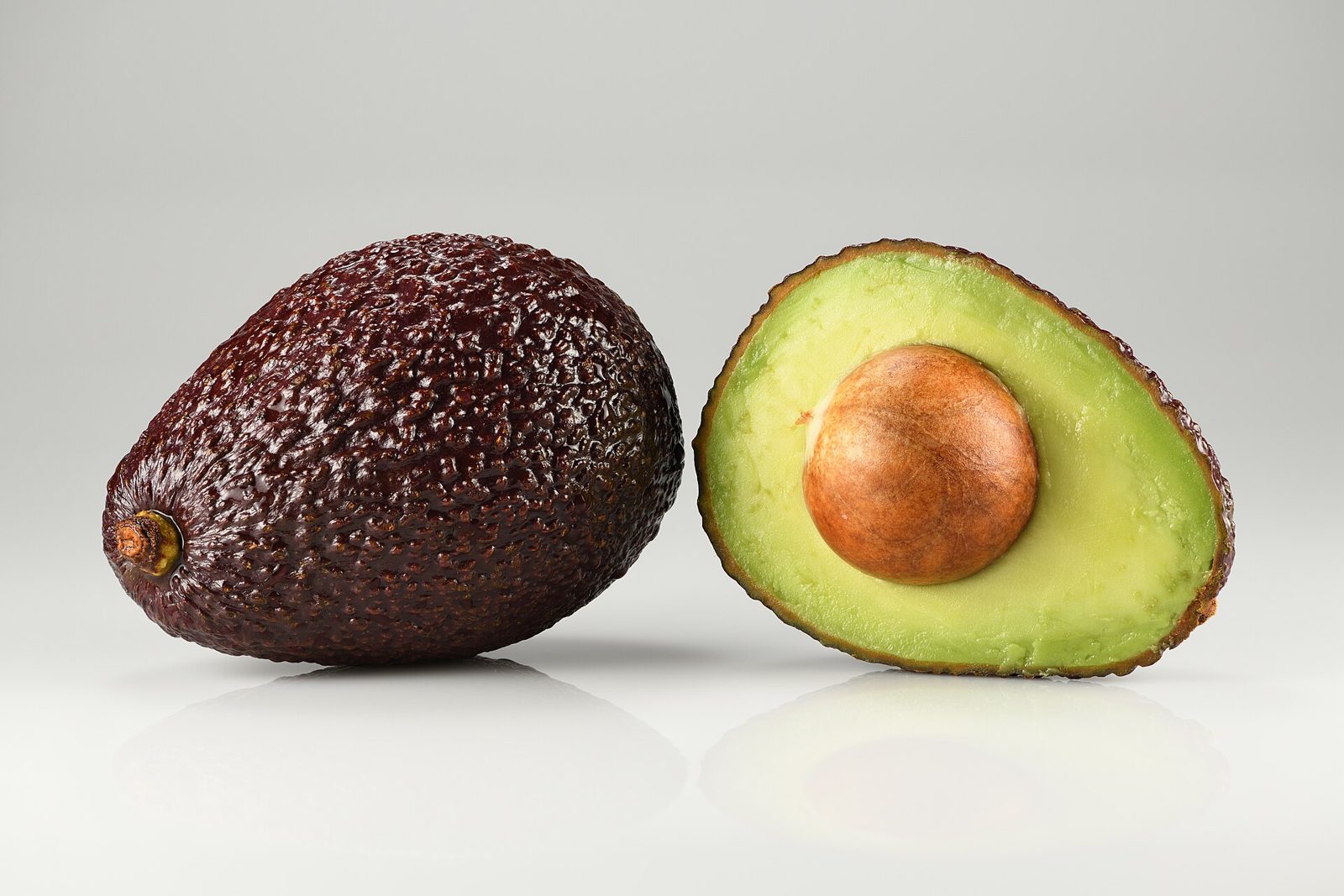
Hass is the avocado most people know, and the leading commercial variety in California (UC Riverside). The tree is mostly Guatemalan, hardy to about 26°F, and bears medium fruit with thick, pebbled, coppery-purple skin. It is an A-type flower and ripens from February through June or July at Irvine, California. This page covers Hass only. For planting and care, read our avocado tree guide, and to compare it with other types, see the avocado varieties guide.
- USDA zones
- 10–11 · zone 9 only at the warmest sites · pot elsewhere
- Sun
- Full sun
- Water
- Moderate
- Difficulty
- Medium
- Lifecycle
- Perennial
- Origin
- The Americas
- Container friendly
- Yes
- Cold limit
- Hardy to 26°F (−3°C) (CRFG)
- Race
- Mostly Guatemalan
- Flower type
- A (UC Riverside)
- Fruit size
- 6–14 oz (UC Riverside) · medium, to 12 oz (CRFG)
- Season
- February to June or July at Irvine, California
- Time to fruit
- Grafted tree about 3–4 yrs
Hass fruit
The California Rare Fruit Growers describe Hass as a medium-sized fruit, to 12 oz, with thick, pebbled, coppery-purple skin. UC Riverside lists fruit at 6–14 oz. The flesh is good, with about 19% oil (CRFG). The pebbled skin makes Hass easy to spot at the store, and it darkens as the fruit softens. See how to tell if an avocado is ripe for the other signs.
Like every avocado, Hass will not ripen on the tree (UF/IFAS). Pick mature fruit and let it soften at room temperature, which takes about 3–10 days (UF/IFAS 3–8, UC Riverside 7–10). Fruit keeps best on the tree, so harvest only what you need (UC IPM).
The Hass tree
CRFG describe the tree as rather open and not tall. Do not take that to mean small: Texas A&M says an unpruned avocado tree can reach 40–80 ft, so leave room for a big canopy, or prune lightly. UC IPM says pruning is not required for productivity, and that you can keep a tree smaller by pruning just before bloom or just after fruit set. UF/IFAS suggests after harvest, so timing depends on your region. Avoid heavy cuts.
Hass was found as a chance seedling by Rudolph Hass at La Habra Heights, California. It was found in the 1920s and introduced in the 1930s (CRFG, UC Riverside). Sources differ on its parentage. CRFG call it Guatemalan, while Texas A&M calls it a Guatemalan and Mexican hybrid. Either way, it is mostly Guatemalan.
Growing Hass: zones, pollination and pots
In the ground. Hass is hardy to 26°F (CRFG), which is warmer than the hardiest Mexican-race types, and young trees are less hardy than mature ones. That makes it a gamble in much of zone 9 and a better fit in zones 10–11. If you garden in zone 9 and want the surest fruit, choose a Mexican type such as Mexicola instead. Wherever you plant, choose full sun (UF/IFAS) and well-drained soil, because UC IPM warns that poorly drained soil may lead to root rots.
In a pot. A young grafted tree can live in a large pot, which lets you move it under cover before a freeze. Our avocado tree in a pot guide covers pot size, watering and pruning. A potted tree stays smaller, but a grafted tree still needs about 3–4 years before it fruits.
Pollination. UC Riverside lists Hass as an A type. UF/IFAS says varieties differ in how much self- or cross-pollination they need to set fruit, and names Waldin, Lula and Taylor as varieties that fruit well alone, not Hass. If you have room, plant a B-type tree such as Fuerte or Bacon within reach, so that the flowers open at complementary times.
How Hass compares with other avocado varieties
| Variety | Cold hardiness | Flower type | Fruit | Season |
|---|---|---|---|---|
| Hass | Hardy to 26°F (CRFG) | A | 6–14 oz, thick pebbled skin | February to June or July at Irvine |
| Mexicola | Hardiest known; low 20s°F (UF) | A | About 5 oz, paper-thin skin | September (CRFG) |
| Fuerte | Hardy to 26°F (CRFG) | B | 9–16 oz, thin green skin | December to March at Irvine |
| Bacon | Hardy to 25°F (CRFG) | B | 10–18 oz, smooth green skin | November to January in Orange County |
Choose Hass if you are in a warm, frost-free spot and want the best-known fruit. Choose Mexicola if cold is the worry, since the California Rare Fruit Growers call it the hardiest cultivar known. Choose Fuerte or Bacon if you want a B-type partner for Hass, or a different season. Bacon is described as columnar and taking less room than umbrella-shaped types (UC Riverside).
Where to buy a Hass avocado tree
Buy a grafted tree from a nursery in your region, or from a plant sale run by your county extension office or a local fruit-growers club. Check that the label says Hass, and ask whether the tree was grown in your zone. Plant in spring after your last freeze so the tree has a full warm season to settle in. A Hass tree from a seed will not match the fruit you ate, so a grafted tree is the way to get true Hass.
Once you have the tree, our avocado varieties guide can help you decide whether a second variety is worth the space.
Frequently asked questions
How cold hardy is a Hass avocado tree?
The California Rare Fruit Growers say Hass is hardy to 26°F (−3°C). That is warmer than the Mexican-race types, which UF/IFAS puts at about 18–26°F for mature trees. Young trees are less hardy than mature ones, so protect a small tree in any freeze.
Is Hass an A-type or B-type avocado?
UC Riverside lists Hass as an A type, so the flowers open female in the morning and male in the afternoon. UF/IFAS says varieties differ in how much cross-pollination they need, and it does not list Hass among the varieties that fruit well alone, so a nearby B-type tree is the safer bet.
When is Hass avocado season?
UC Riverside records fruit from February through June or July at its Irvine, California plot. Your own season will depend on your region and your tree.
How long until a Hass tree fruits?
A grafted tree begins to produce after about 3–4 years (UF/IFAS, UC Riverside). A Hass pit grown at home will not give you Hass, because avocados do not come true from seed (Texas A&M).
Can I grow a Hass avocado in a pot?
You can grow a young grafted tree in a large pot and prune it lightly to keep it small, then move it under cover in winter. Hass has a more open habit and is not a tall tree (CRFG), but it is still an avocado, so expect it to want more room as it ages.
Sources
- Variety List, UC Riverside Avocado Variety Collection
- Avocado FAQs, UC Riverside Avocado Variety Collection
- Avocado Fruit Facts, California Rare Fruit Growers
- Avocados, Texas A&M AgriLife Extension
- Avocado Growing in the Florida Home Landscape (CIR1034/MG213), UF/IFAS Extension