

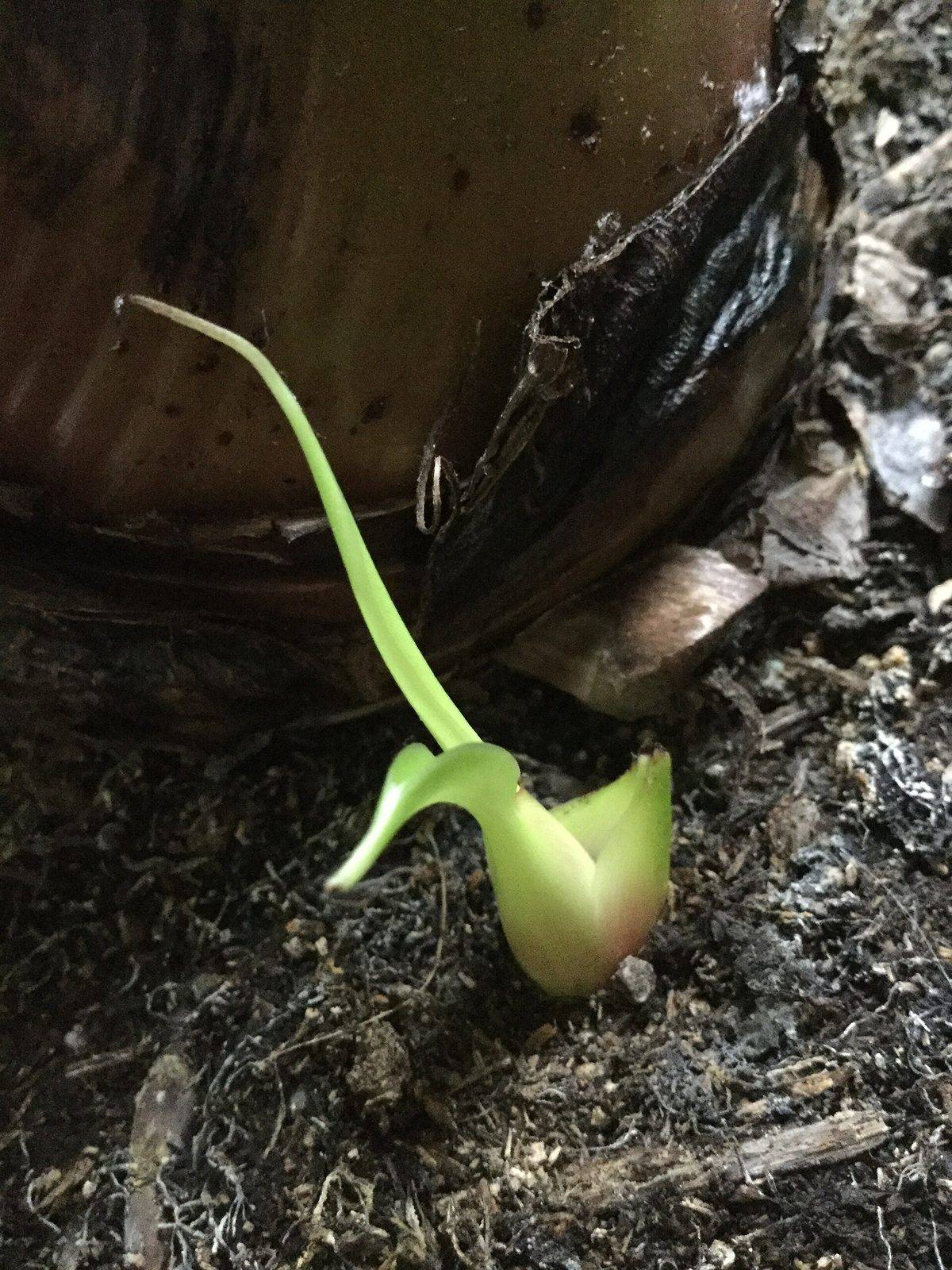
You can’t grow a fruiting banana plant from a store-bought banana, but you can grow one from a sucker, and that is easier than it sounds. The bananas in the supermarket come from seedless cultivars, so there is nothing in the fruit to plant. Gardeners get new plants from suckers, also called pups, which are shoots that rise from the underground corm. UF/IFAS says the most common propagation material is suckers, or pieces of the rhizome. This guide expands on the starting section of our banana plant guide with how to find, dig and plant one.
Why a store banana will not grow
A banana from the store is a seedless fruit. The plant that made it is a clone, grown from suckers and sold for generations without seed, so the fruit has no seeds to sprout. The tiny dark specks in the middle are not viable seeds, and burying a banana or its peel will only give you a rotting mess, not a plant.
Compare that with an avocado or a mango, where a seed project is at least possible. For bananas, the equivalent project is a sucker. If you want a seed experiment instead, our avocado from seed guide walks through one, and the mango from seed guide offers another.
What about banana tree seeds?
Banana tree seeds are a popular search, so here is the short version. Some wild and ornamental bananas do set seed, and a few of them are sold as seed packets. They are a collector’s project. Plants from seed are slow, the results vary, and the fruit of seeded kinds is packed with hard seeds, so it is not the banana you would peel and eat. If your goal is bananas you can eat, skip the seed and plant a sucker of a named variety such as Dwarf Cavendish.
The real routes: suckers, pups and nursery plants
There are three ways to get a plant that will fruit.
- Dig a sucker from a friend’s clump. The cheapest and most common route. A healthy mature clump makes more suckers than it needs.
- Divide a plant you already own. Same method, from your own clump.
- Buy a nursery plant. The easiest if you do not know a banana grower. Choose a named variety and check the label.
All three give you a plant of the same variety as the parent, which is the point.
Sword suckers and water suckers
Not every shoot is worth planting. UF/IFAS says water suckers are not well attached to the rhizome and generally produce weak plants and less fruit than sword suckers.
| Type | What it looks like | Plant it? |
|---|---|---|
| Sword sucker | Narrow, spear-like leaves; firmly attached to the corm | Yes |
| Water sucker | Broad leaves very early; loosely attached | No, it makes a weak plant |
Ask the clump’s owner to point out the sword suckers, or choose the ones with narrow leaves growing close to the parent.
How to dig and divide a banana sucker
Time it for warm weather, when the plant is growing, so the sucker roots quickly.
- Choose a sucker of the right size. UF/IFAS says to remove sword suckers when they are 4–5 ft (1.2–1.5 m) tall, and CRFG says at least 3 feet, so aim for about 3–5 ft. TAMU says suckers are taken when the stem diameter is 2 to 6 inches.
- Water the clump the day before. Moist soil makes digging easier and keeps the roots from drying out.
- Dig around the sucker. Use a sharp spade and cut down between the sucker and the parent, severing the connecting corm. UF/IFAS says to remove sword suckers from vigorous clumps with a spade.
- Lift it with roots and a piece of corm. Take as many roots as you can. A sucker with a chunk of corm and roots establishes much faster than one without.
- Trim the leaves. Cut the top growth back by about half so the new roots are not working to feed all the leaf.
- Plant it at once. Set it at the depth it grew, firm the soil and water deeply. Plant in the sunniest, most sheltered spot you have, following the planting advice in our banana plant guide.
Getting more plants from one sucker
Large suckers can give more than one plant. TAMU says large suckers can be decapitated at ground level and halved or quartered vertically to increase planting material. UF/IFAS describes maidenhead suckers, whose pseudostems are cut down to 8 inches (20 cm) high and the remaining rhizome cut into seed pieces for planting. That is a nursery method, so expect a slower start than a whole sucker, and give each piece its own pot with good drainage until it grows leaves.
Aftercare for a new sucker
- Water deeply. CRFG says regular deep watering is an absolute necessity during warm weather. Keep the soil moist but never soggy, because TAMU says bananas do not tolerate overly wet conditions.
- Give it sun and shelter. Full sun grows best (CRFG). Protect it from strong wind while it is small.
- Feed lightly at first. UF/IFAS says to start young plants with 1/2 lb (0.23 kg) of a 6-2-12 or similar high-potassium formula every 2 months. Our banana plant guide has the full schedule.
- Be patient. UF/IFAS says the flowering stalk emerges 10 to 15 months after planting, and LSU says fruit takes three to six months to mature after flowering.
Pups on a nursery plant
If you buy a potted banana from a nursery or garden center and it has produced pups, you can separate those the same way. Wait until a pup has several leaves of its own and a good root system before you cut it away.
Common mistakes
- Planting a banana or its peel. It will not grow.
- Choosing a water sucker. It makes a weak plant that fruits poorly.
- Digging a tiny shoot. A pup with no roots or corm struggles. Wait until it is big enough.
- Soggy soil. Poor drainage is the quickest way to lose a new plant.
- Expecting fruit in a few months. Plan on well over a year before the flower stalk emerges (UF/IFAS).
Ready to plant? Our banana plant guide covers site, soil, feeding and harvest, and the banana varieties guide helps you pick a variety worth digging.
Frequently asked questions
Can you grow a banana plant from a store-bought banana?
Not in any way that gives you fruit. Supermarket bananas come from seedless cultivars that are propagated by suckers, so the fruit contains nothing to plant. UF/IFAS says the most common propagation material is suckers, or pieces of the rhizome.
What are the little black dots inside a banana?
They are not viable seeds. Store bananas are seedless, and planting the specks will not give you a plant.
Can you grow a banana plant from banana seeds?
Some wild and ornamental bananas do set seed, and a few kinds are sold as seed. Seed-grown plants are slow, and the fruit of seeded types is full of hard seeds and is usually not worth eating. For fruit you want to eat, plant a sucker or a nursery plant.
How do you tell a sword sucker from a water sucker?
UF/IFAS says water suckers are not well attached to the rhizome and generally produce weak plants and less fruit than sword suckers. Sword suckers have narrow, spear-like leaves and are firmly attached. Pick sword suckers for planting.
How big should a banana sucker be before you dig it?
UF/IFAS says to remove sword suckers from vigorous clumps with a spade when they are 4–5 ft (1.2–1.5 m) tall, and CRFG says at least 3 feet. TAMU says suckers are taken when the stem diameter is 2 to 6 inches.
How long does a banana sucker take to fruit?
UF/IFAS says the flowering stalk of a banana emerges 10 to 15 months after planting, and LSU says fruit takes three to six months to mature after that.
Sources
- Banana Growing in the Florida Home Landscape (HS10/MG040), UF/IFAS Extension
- Banana, Texas A&M AgriLife Extension
- Banana Fruit Facts, California Rare Fruit Growers
- Louisiana Bananas, LSU AgCenter