

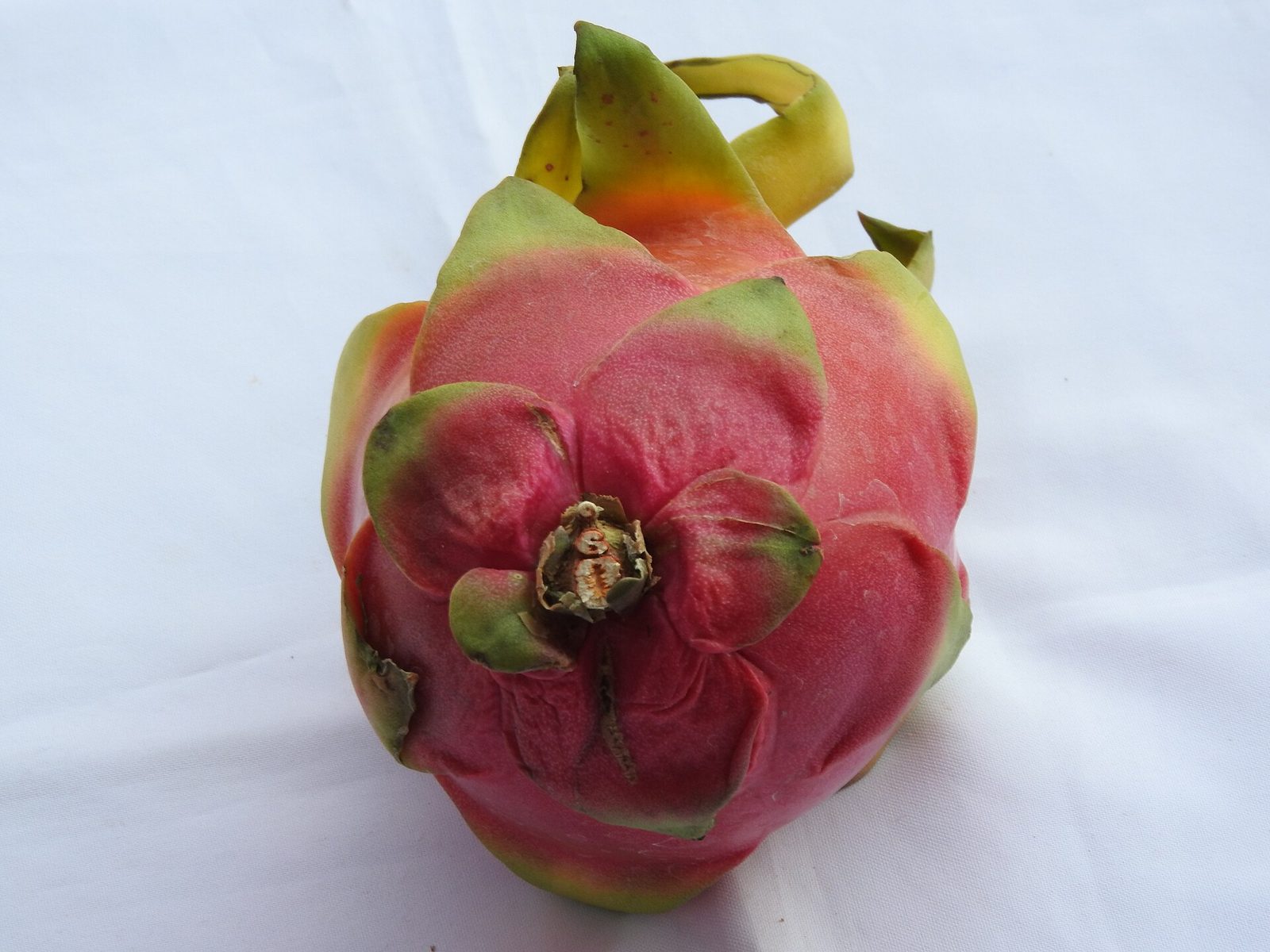
A ripe dragon fruit has fully colored skin and gives slightly when you press it gently. For the common pink types, UH CTAHR says the skin turns almost fully red when the fruit is mature. Fruit that is still green in places is not ready, and fruit that feels mushy or has dark, sunken patches is past its best. Yellow types turn yellow and drop their spines. If you grow your own, our dragon fruit guide explains how to get a plant to the point where you have ripe fruit to check.
How to tell if dragon fruit is ripe: 4 cues
Use these together. Color is the best single cue, and the gentle press is the second.
Skin color
Gentle press
The wings
Look and smell
What ripe looks like for each type
| Type | Skin when ripe | Better cue |
|---|---|---|
| White-fleshed (H. undatus) | Hot pink or reddish (CRFG), almost fully red (UH CTAHR) | Even color plus a gentle give |
| Red- or purple-fleshed | Red or pink skin (CRFG) | Even color plus a gentle give |
| Yellow (S. megalanthus) | Yellow, and the spines fall off (CRFG) | Spines gone plus a gentle give |
Skin color tells you the fruit is ripe, not what is inside. Flesh runs from white through red to very dark red depending on the species (UH CTAHR), so you cannot tell flesh color from the outside. Learn more about the types in our dragon fruit varieties guide.
Checking dragon fruit at the store
The same cues work for shop fruit. Choose fruit with even, fully developed color and a slight give when you press it, and skip fruit with dark sunken patches, leaking spots or a sour smell. Ripe fruit is not always sweet fruit. CRFG gives a sugar range of 12–21% across the Hylocereus group, so one ripe fruit can taste mild and another quite sweet, and color alone will not tell you which. Eat fruit within a few days of buying it, as the storage section below explains.
When to pick dragon fruit from your own plant
Fruit follows a clear timeline once a flower is pollinated.
- About 25–30 days after flowering: the skin begins to change color (UH CTAHR).
- About 45 days after pollination: Hylocereus fruit is ripe (CRFG).
- Up to 150 days after pollination: yellow Selenicereus fruit is ripe (CRFG).
If you hand-pollinate, as our pollination guide explains, write the date on a tag tied to the stem, and start checking color at about six weeks. UF/IFAS says to harvest only well-colored, mature fruit, using hand clippers. Cut the fruit off the stem rather than twisting, so you do not tear the plant. In an unusually wet spell, pick promptly, because heavy rain can cause fruit rot and splits (UH CTAHR).
When is dragon fruit in season?
| Where | Ripening |
|---|---|
| Florida, white-fleshed H. undatus | June to November (UF/IFAS) |
| Hylocereus types generally | Two or three crops from summer into fall (CRFG) |
| Yellow pitaya | Late summer or fall (CRFG) |
Your own plant’s schedule depends on when it flowers, which runs from June to October in Hawaii (UH CTAHR).
How to store dragon fruit
UH CTAHR recommends about 50°F (10°C) and says fruit keeps about 14 days at that temperature. It says temperatures near 43°F (6°C) can cause chilling injury. A home fridge is colder than that, so do not leave whole fruit in there for long, and eat it within a few days. At room temperature, expect less than 10 days (UH CTAHR).
- Whole, ripe: keep it in a cool spot, or in the fridge for a few days.
- Cut: wrap or seal the cut halves and keep them in the fridge, and eat them within a day or two.
Common problems
- Skin is red but the fruit is rock hard: if it is still on your plant, leave it a few more days and check again with a gentle press.
- Splitting skin: uneven watering or heavy rain (UH CTAHR). Water steadily, and pick as soon as it colors.
- Brown, sunken spots: fruit rot. UF/IFAS lists a fruit and stem rot caused by Colletotrichum gloeosporioides, so discard badly affected fruit.
- Sour or fermented smell: it is overripe. Throw it out.
Want to grow your own? Start with our dragon fruit guide, then see how to cut and eat dragon fruit. For a similar fruit-checking guide, see how to tell if a mango is ripe.
Frequently asked questions
How can you tell if dragon fruit is ripe?
Look at the skin first. For the common pink types, UH CTAHR says the usual maturity sign is a skin that has changed to almost full red. Then press gently. Ripe fruit gives slightly, while rock-hard fruit is not ready and mushy fruit is past it.
How long does it take dragon fruit to ripen?
About 45 days from pollination for Hylocereus types, and up to 150 days for yellow Selenicereus (CRFG). UH CTAHR says the skin begins to change color 25–30 days after flowering.
Should dragon fruit go in the fridge?
Only briefly. UH CTAHR recommends about 50°F (10°C) and says chilling injury can occur around 43°F (6°C). A home fridge is colder than that, so eat chilled fruit within a few days. At room temperature, fruit keeps for less than 10 days.
How do you know when to pick dragon fruit from your own plant?
Pick when the skin is well colored. UF/IFAS says to harvest only well-colored, mature fruit, and to cut it with hand clippers. If you hand-pollinated, count about 45 days from the pollination date for Hylocereus types and start checking then.
Why is my dragon fruit splitting?
Uneven soil moisture is the usual cause (UH CTAHR), as is heavy rain near ripening. Water steadily, and harvest fruit as soon as it is colored.
Sources
- Dragon Fruit: Postharvest Quality-Maintenance Guidelines (F_N-28), University of Hawaii CTAHR
- Pitaya (F_N-9), University of Hawaii CTAHR
- Pitaya (Dragonfruit) Growing in the Florida Home Landscape (HS303), UF/IFAS Extension
- Pitaya and Pitahaya (Dragon Fruit), California Rare Fruit Growers