

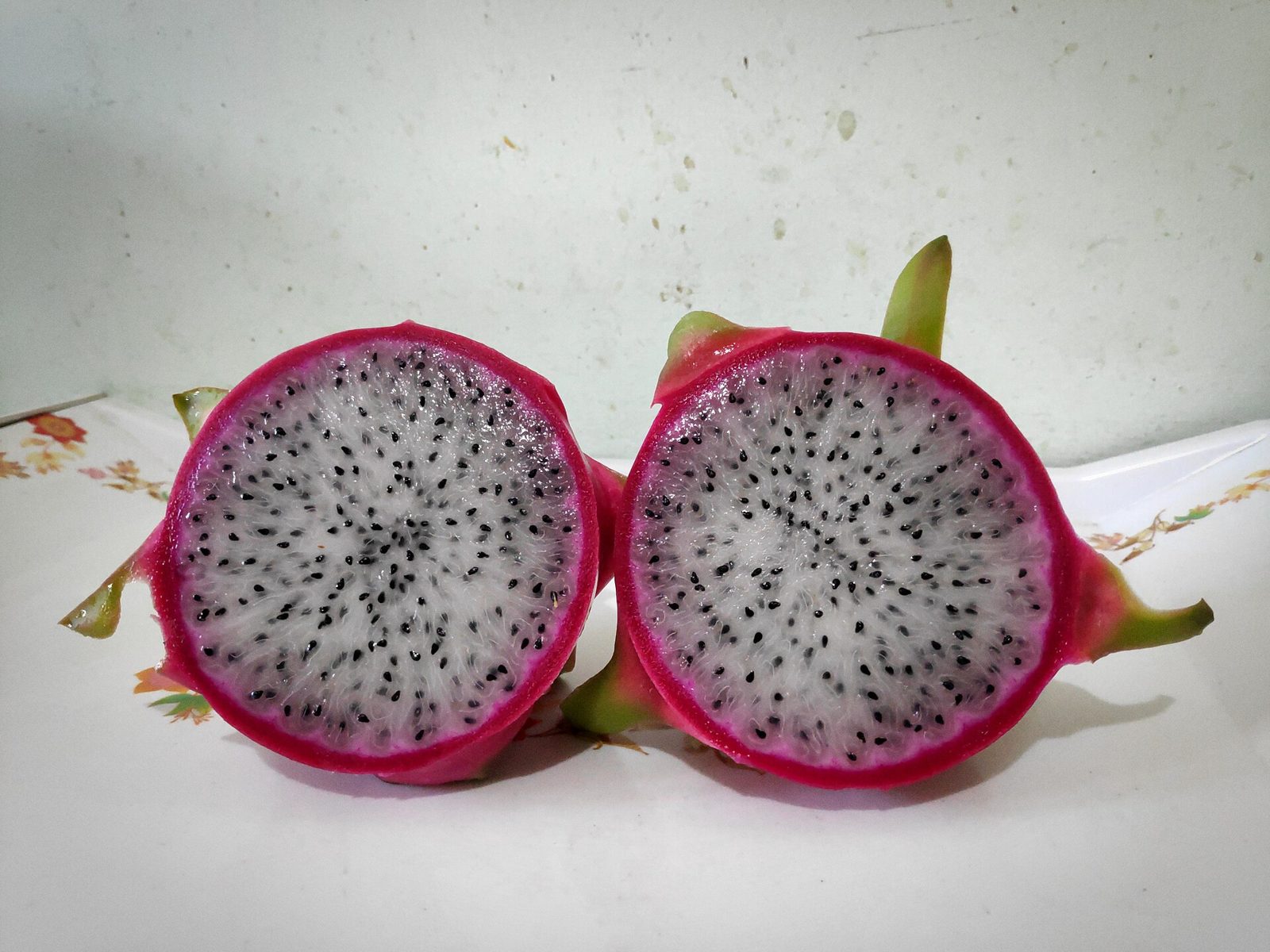
To cut a dragon fruit, slice it in half lengthwise with a sharp knife, then scoop the flesh out with a spoon, or peel the skin away and slice or cube it. The skin and wings are not eaten, but the seeds are, so there is nothing to remove. Below are three ways to cut one, what the different types look like inside and how to keep cut fruit. If you grow your own, our dragon fruit guide shows you how to get fruit like this at home.
Before you cut: check the fruit is ripe
A ripe dragon fruit has fully colored skin and gives slightly when pressed. UH CTAHR says the skin turns almost fully red when pink types are mature. If yours is rock hard or patchy green, wait, and see how to tell if dragon fruit is ripe for the full list of cues.
You need a sharp knife, a cutting board, a large spoon and a bowl. Wash the skin and dry it so the knife does not slip. Red-fleshed fruit stains, so use a board you do not mind marking and keep a cloth handy.
Method 1: Halve and scoop
This is the fastest way, and it works for every type.
- Halve it lengthwise. Rest the fruit on the board and slice from the stem end to the tip through the middle, all the way through the skin.
- Open it up. Pull the two halves apart and look at the flesh. It runs from white through red to very dark red, depending on the type (UH CTAHR), with small black seeds throughout.
- Scoop it out. Run a large spoon between the flesh and the skin, and lift the flesh out in one piece. Or leave it in the skin and eat it straight from the shell with a spoon.
Method 2: Peel and slice
For slices or half-moons, peel first.
- Halve the fruit lengthwise.
- Set a half cut side down on the board, and catch the skin at the edge with your thumb. On a ripe fruit the skin pulls away from the flesh in one or two strips.
- If the skin sticks, slide a spoon or the tip of a knife between flesh and skin.
- Lay the peeled half flat and cut it into half-moons about ½ inch (1 cm) thick.
Peeling is easier on ripe fruit, and a firm, underripe fruit’s skin clings to the flesh.
Method 3: Cube it
Cubes are the neatest for a salad, a bowl or a skewer.
- Halve the fruit lengthwise and leave the flesh in the skin.
- Cut lines about ½ inch (1 cm) apart through the flesh down to the skin, without piercing the skin.
- Turn the half and cut across the first lines to make a grid.
- Push the skin from the back so the cubes pop out, or run a spoon between flesh and skin and scoop the cubes into a bowl.
What the different types look like inside
| Type | Flesh | Notes |
|---|---|---|
| White-fleshed (H. undatus) | White | Pink or reddish skin (CRFG) |
| Red- or purple-fleshed | Red to purple | Stains boards, fingers and cloth |
| Yellow (S. megalanthus) | Translucent white | Small, and sweeter than other pitaya (CRFG) |
Yellow fruit is smaller, so a single fruit makes a smaller serving. CRFG says its spines fall off when the fruit is ripe, so a ripe one is smoother to handle. Learn more about the types in our dragon fruit varieties guide and yellow dragon fruit guide.
What to do with dragon fruit
Eat it fresh with a spoon, as a quick snack or a breakfast fruit. Cube it into a fruit salad, blend it into a smoothie or a smoothie bowl, or slice it onto yogurt. A squeeze of lime juice brings out the flavor. Sugar runs from 12% to 21% across the Hylocereus group (CRFG), so some fruit is mildly sweet and some is quite sweet. Taste a piece before you decide how to serve it.
Cut fruit can also be frozen in cubes for smoothies, though it will be soft once it thaws.
How to store dragon fruit
Whole fruit stores best at about 50°F (10°C), and UH CTAHR says temperatures near 43°F (6°C) can cause chilling injury. A home fridge is colder than that, so keep whole fruit in a cool spot and use it within a few days if you chill it. Cut fruit should be covered, kept in the fridge and eaten within a day or two. If the flesh smells sour or fermented, throw it out.
Cutting tips
- Use a sharp knife. A dull blade slips on the skin and crushes the flesh.
- Cut on a stable board. A damp towel under the board stops it sliding.
- Cut only what you need. If you will not use both halves, keep the second half in its skin and cover it.
- Do not worry about neatness. If the cuts are ragged, scoop and mix it into a salad.
Want to grow your own? Start with our dragon fruit guide, then pick a type that suits your zone. For another tropical fruit with a rind to work around, see how to cut a mango.
Frequently asked questions
What is the easiest way to cut a dragon fruit?
Set it on a cutting board and slice it in half lengthwise with a sharp knife. Then scoop the flesh out of each half with a large spoon, or leave it in the skin and eat it with a spoon, like a kiwi.
Do you eat the skin of a dragon fruit?
No. The skin and the scale-like wings are not eaten. Eat the flesh, which runs from white through red to very dark red depending on the type (UH CTAHR), along with its small black seeds.
Can you eat the seeds?
Yes. The small black seeds are part of the flesh and are eaten with it. There is no need to remove them.
How do you know if dragon fruit is ripe enough to cut?
Look for fully colored skin and a slight give when pressed. UH CTAHR says the usual maturity sign is skin that has changed to almost full red. Our [guide to how to tell if dragon fruit is ripe](/tropical/dragon-fruit/ripe/) covers the other cues.
How long does cut dragon fruit keep?
Cover it and keep it in the fridge, and eat it within a day or two. Whole fruit stores best at about 50°F (10°C), and temperatures near 43°F (6°C) can cause chilling injury (UH CTAHR), so do not leave whole fruit in a cold fridge for long.
Sources
- Dragon Fruit: Postharvest Quality-Maintenance Guidelines (F_N-28), University of Hawaii CTAHR
- Pitaya and Pitahaya (Dragon Fruit), California Rare Fruit Growers
- Pitaya (Dragonfruit) Growing in the Florida Home Landscape (HS303), UF/IFAS Extension