

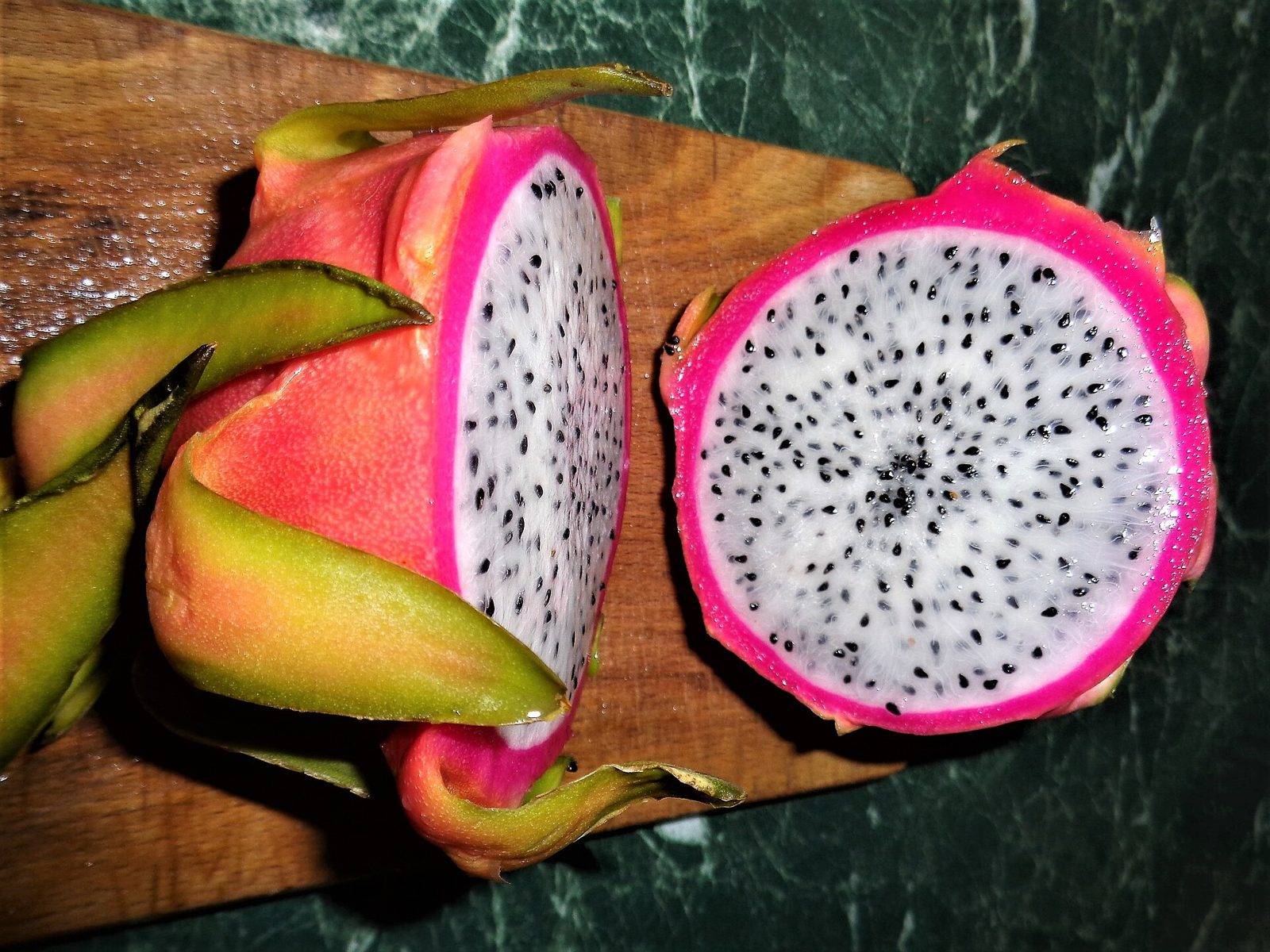
Dragon fruit comes in three main kinds: white-fleshed, red- or purple-fleshed, and yellow. Beyond those, nurseries sell named cultivars such as American Beauty, Physical Graffiti and Delight. All of them grow the same way, so choose on pollination, fruit size and how much cold you get. This guide compares the types we cover, and our dragon fruit guide covers planting and care.
Dragon fruit types compared
Fruit weights and Brix numbers below come from single trials, so treat them as a rough guide. CRFG gives a range of 12–21% sugar for dragon fruit as a whole, and fruit weighs from about ½ lb to over 3 lb across the Hylocereus group.
| Variety | Best for | Size | Flavor | Origin / notes |
|---|---|---|---|---|
| White flesh (H. undatus) | The classic dragon fruit · Florida ripening June–November (UF/IFAS) | Fruit ½ to over 3 lb across Hylocereus (CRFG) | White flesh, hot pink or reddish skin | Grows best with a second type nearby |
| Red or purple flesh (H. costaricensis, H. polyrhizus) | Deeper color · two or three crops from summer into fall (CRFG) | Fruit ½ to over 3 lb across Hylocereus (CRFG) | Red to purple flesh (UH CTAHR) | Cross-pollination gives better set and size |
| Yellow (S. megalanthus) | A single plant · a small, sweet fruit (CRFG) | Smaller than other pitaya | Yellow skin, translucent white flesh; sweeter than other pitaya (CRFG) | Self-fruitful · more cold sensitive |
| Vietnam 1 | A large, white-fleshed fruit | Averages 14 oz, plus or minus 3 oz (UH CTAHR) | White flesh · soluble solids 13–19% (UH CTAHR) | Large pink fruit |
| American Beauty | Flavor · top-rated in a UC blind test | About 13 oz (380 g) | Brix 18.5 in the UC trial | Florida · considered the same as Bien Hoa Red (UC) |
| Physical Graffiti | Looks · top external appearance in the UC trial | About 13 oz (374 g) | Brix 17.9 in the UC trial | Florida · closely related to Delight and Halley's Comet |
| Delight | Looks, and flavor when panelists could see the flesh | About 13 oz (371 g) | Brix 18.1 in the UC trial | San Diego · closely related to Physical Graffiti |
| Halley's Comet | A bigger fruit from the Delight family | About 17 oz (482 g) | Brix 16.7 in the UC trial | Florida · closely related to Delight |
| Lisa | Looks and blind-test flavor in the UC trial | About 16 oz (465 g) | Brix 17.0 in the UC trial | Nicaragua · may be the same as Rosa and Cebra (UC) |
| Valdivia Roja | A smaller, single-serving fruit | About 9 oz (250 g) | Brix 17.9 in the UC trial | Mexico · unique, closely related to El Grullo (UC) |
| Cosmic Charlie | Fruit quality rather than yield | — | Higher soluble solids in a USDA trial, averaging 17.4% (USDA ARS) | Lowest fruit yield in the USDA Puerto Rico trial |
Yellow is a different plant from the rest. The Colombiana cultivar in UC’s trial weighed under 200 g (about 7 oz), and the trial gave it a Brix of 20.9 and 150–180 days to harvest. Our yellow dragon fruit guide has the details, and our American Beauty page covers the best-known red type.
Species and flesh color
Three species cover most of what you will grow. Hylocereus undatus is the white-fleshed dragon fruit, with pink or reddish skin, and it is the type most people mean when they say dragon fruit. H. costaricensis and H. polyrhizus have red or purple flesh, and UH CTAHR says flesh across the group runs from white through various hues of red to very dark red. Selenicereus megalanthus is the yellow pitaya. Skin color does not tell you the flesh color, so check the name on the label before you buy.
Most named cultivars sit inside the Hylocereus group, and the UC trial grew them side by side in one place. That makes its numbers useful for comparing cultivars, but they are results from one trial, not a forecast for your garden.
Pick by situation
One plant, or a small space: yellow
Yellow dragon fruit is self-fruitful (CRFG), so a single plant can set fruit without a partner. The trade-offs are cold and time. CRFG says yellow types are more cold sensitive than Hylocereus, and fruit takes up to 150 days from pollination (CRFG), against about 45 for Hylocereus.
The best chance of fruit: two or three types
UF/IFAS reports self-incompatibility in several nursery cultivars and recommends 2 or 3 genetic types, because cross-pollination assures better fruit set and size. If you have room for two plants, buy two different cultivars, not two cuttings of the same one. Our pollination section explains hand-pollinating at night.
The best-looking and best-tasting fruit
In UC’s 2013 trial, Sin Espinas, Lisa, Physical Graffiti, Delight, American Beauty and Bien Hoa Red were all rated highest in external appearance. In blind flavor tests, American Beauty, Lisa, Bien Hoa Red and Sin Espinas were rated highest, and Delight when panelists could see the flesh color. These are results from one trial, so ask your nursery which cultivars do well locally.
A bigger or smaller fruit
Halley’s Comet averaged 17 oz (482 g) in the trial, and Lisa 16 oz (465 g). Valdivia Roja averaged 9 oz (250 g), and yellow dragon fruit is smaller still. Fruit size varies with the season and the plant, so use these as a guide, not a promise.
Colder gardens
Cold decides your zone more than the cultivar does. CRFG says plants are hardy to brief dips near 28°F, and UF/IFAS says long freezes damage stems. Yellow types are more cold sensitive, with a minimum growth temperature of about 45°F (UH CTAHR). In zone 9b and colder, grow any type in a pot you can bring inside, as our dragon fruit in a pot guide explains.
Why the names are confusing
Dragon fruit names are not tidy. UC’s DNA work considers American Beauty and Bien Hoa Red the same plant, even though its trial table lists them separately (380 g and 360 g, Brix 18.5 and 18.9). It says Lisa, Rosa and Cebra could be the same cultivar, and that Bien Hoa White, Vietnamese Giant and Mexicana are very closely related. Physical Graffiti, Delight and Halley’s Comet are another close family.
Practically, that means a name on a plant tag is a guide, not a guarantee. Buy from a nursery that propagates from a known mother plant, and judge by how the fruit behaves in your garden.
Next steps
Once you have chosen, start with how to grow dragon fruit from cuttings, and learn the signs in how to tell if dragon fruit is ripe. For more tropical fruit, browse the tropical section.
Frequently asked questions
What are the main types of dragon fruit?
Three species cover most plants. Hylocereus undatus has white flesh, H. costaricensis and H. polyrhizus have red or purple flesh, and Selenicereus megalanthus is the yellow pitaya (CRFG, UH CTAHR). Named cultivars such as American Beauty, Physical Graffiti and Delight sit within the red-fleshed and related groups.
Which dragon fruit variety is best for beginners?
Choose by pollination, not flavor. Yellow dragon fruit is self-fruitful (CRFG), so one plant can set fruit, but it is slower and more cold sensitive. For other types, plant two or three different cultivars (UF/IFAS), so flowers have a compatible partner.
Is red dragon fruit sweeter than white?
CRFG gives a sugar range of 12–21% for the Hylocereus group as a whole, so color alone does not tell you. In UC's trial, Brix varied widely from cultivar to cultivar. Yellow dragon fruit is described as smaller but sweeter than other pitaya (CRFG).
Are American Beauty and Bien Hoa Red the same dragon fruit?
UC's DNA work considers them the same plant, although its trial table lists them separately with slightly different numbers. Lisa, Rosa and Cebra could also be one cultivar sold under three names. Check the label, and buy from a nursery you trust.
Sources
- Pitaya and Pitahaya (Dragon Fruit), California Rare Fruit Growers
- 2013 Pitahaya Production Seminar and Field Day, UC Cooperative Extension, San Diego
- Pitaya (F_N-9), University of Hawaii CTAHR
- Dragon Fruit: Postharvest Quality-Maintenance Guidelines (F_N-28), University of Hawaii CTAHR
- Pitaya (Dragonfruit) Growing in the Florida Home Landscape (HS303), UF/IFAS Extension
- Yield and Fruit Quality Traits of Dragon Fruit Cultivars Grown in Puerto Rico, USDA Agricultural Research Service