

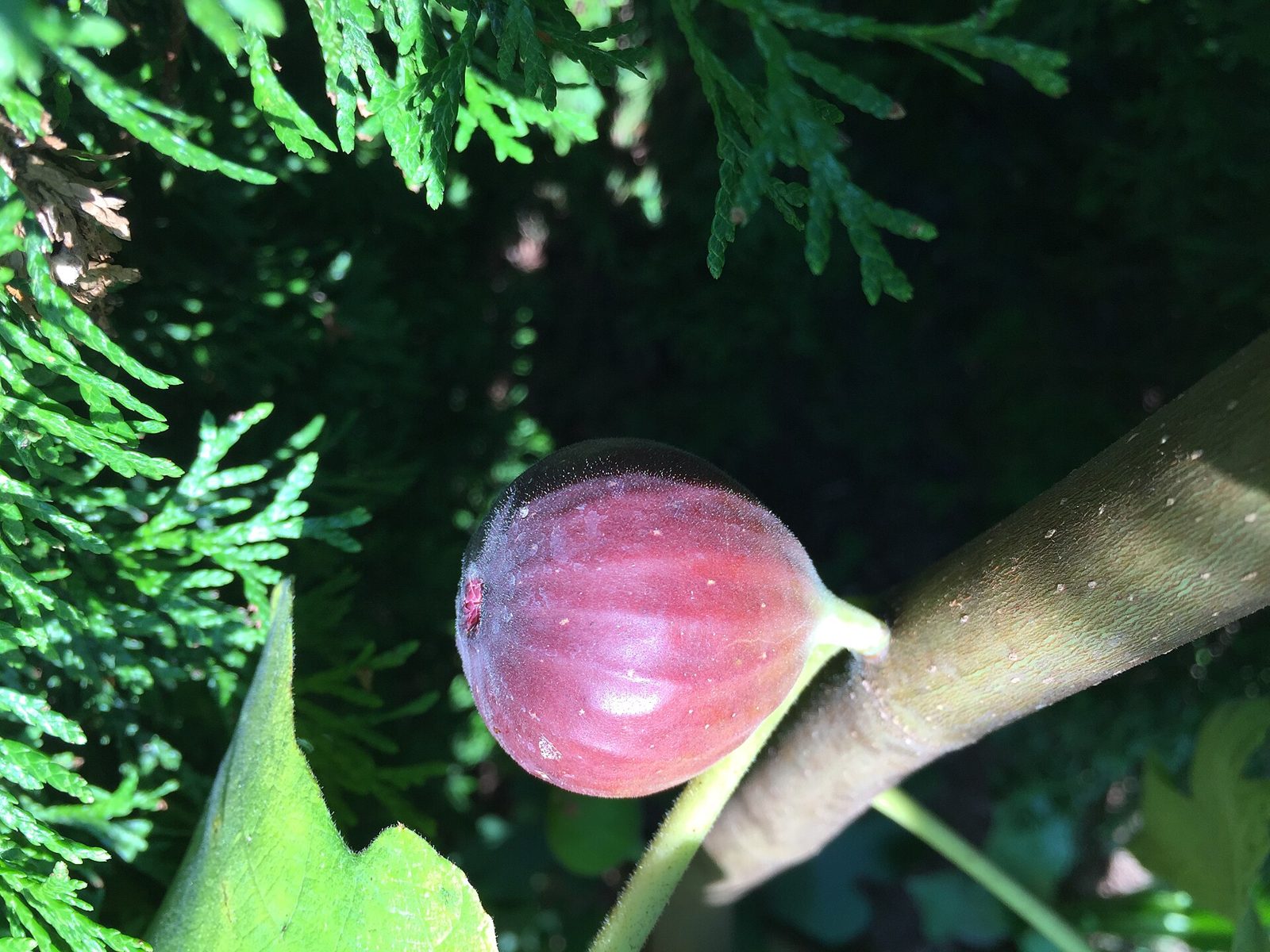
Chicago Hardy is the fig to grow if your winters are cold. Illinois Extension calls it the most cold-weather tolerant of fig trees, and Iowa State lists it for zones 5–10. It grows 10–15 ft (3–4.5 m) tall and 9–12 ft (2.7–3.7 m) wide, and it can be kept at 6 ft (1.8 m) with pruning. In the coldest zones it may die back to the ground in winter and regrow from its roots. This page covers Chicago Hardy only. For planting and care, read our fig tree guide, and to compare it with other types, see the fig varieties guide.
- USDA zones
- 5–10 (Iowa State) · zone 5a may not always overwinter
- Sun
- Full sun
- Water
- Moderate
- Difficulty
- Easy
- Lifecycle
- Perennial
- Origin
- Middle East
- Container friendly
- Possible; can be kept at 6 ft (1.8 m)
- Tree size
- 10–15 ft tall, 9–12 ft wide (3–4.5 × 2.7–3.7 m)
- Kept small
- Can be pruned to 6 ft (1.8 m)
- Ripe skin
- Deep purple or brown
- Time to fruit
- Can fruit in year one (Illinois)
Chicago Hardy fruit
Ripe Chicago Hardy figs are a deep purple or brown and yield slightly to the touch (Illinois Extension). That is the cue to pick: a fig that is still firm is not ready, and figs will not ripen once they are off the tree. See how to tell if a fig is ripe for the other signs, such as a stem that bends downward and an eye that opens.
What sets Chicago Hardy apart is the tree, not the fruit. It is the most cold-tolerant fig, it freezes back and regrows in cold winters, and it can fruit on new growth in the very first year. Flavor varies with climate and how ripe the fig is when you pick it, so leave the fruit on the tree until it is soft. If sour figs are a worry in humid weather, ask the nursery about the eye, because Clemson says the only control for souring is a tight or closed eye.
The Chicago Hardy tree and how big it gets
Illinois Extension gives a mature size of 10–15 ft tall and 9–12 ft wide, and says it can be pruned and maintained at a height of 6 ft. That makes it manageable in a small yard or a large pot. In the ground, leave room for that 9–12 ft spread.
Where the top freezes back, the tree regrows from below. UF/IFAS notes that fig trees often freeze back and regrow in bush form. Fruit then comes on new shoots, which suits Chicago Hardy because it can fruit the first year. Because the spring breba crop forms on last year’s wood, a tree that is cut to the ground loses its brebas but can still set a main crop.
Growing Chicago Hardy: zones, pots and the ground
In the ground, Chicago Hardy is listed for zones 5–10. In zones 8–10 it needs the same care as any fig. In zones 5–7 expect dieback in a cold winter. Iowa State notes that most of Iowa is zone 5a, where Chicago Hardy may not always overwinter, so plan on protection there: mulch the base 6–12 inches (15–30 cm) deep with leaves or straw, and wrap the dormant branches in breathable material, never plastic (Penn State Extension). Our guide to overwintering a fig tree covers each method.
In a pot, Chicago Hardy can be grown in any zone, since it can be kept at 6 ft. Use a pot at least 18 inches (45 cm) wide with a sterile potting mix and compost, and move it into an unheated garage or shed for winter. Our fig tree in a pot guide has the details.
Sun and soil. Choose a spot with full sun and well-drained soil. Several extension services recommend 8 or more hours of direct sun.
Pollination. UF/IFAS says the common-type figs recommended for Florida are parthenocarpic, which means the fruit develops without pollination. Expect one tree to be enough, and ask the nursery if you want to be sure before you buy.
How Chicago Hardy compares with other fig varieties
| Variety | Cold hardiness | Tree | Fruit | Eye |
|---|---|---|---|---|
| Chicago Hardy | Most cold-tolerant fig (Illinois) · zones 5–10 (Iowa State) | 10–15 ft tall, 9–12 ft wide; can be kept at 6 ft | Deep purple or brown when ripe | — |
| Brown Turkey | Reported more hardy than many figs (UF) | Small, hardy, vigorous | Medium, purplish brown, pinkish amber flesh | — |
| Celeste | Fairly cold hardy (UF) | Small, productive, hardy | Small to medium, light violet to violet-brown | Closed (UF) |
| Black Mission | — | Very large | Large, black-purple, reddish-pink flesh | — |
Choose Chicago Hardy over Brown Turkey if your winters are cold, since UF/IFAS says only that Brown Turkey is reported to be more hardy than many figs, while Illinois Extension calls Chicago Hardy the most cold-tolerant. Choose Celeste if you garden in the humid Southeast and want a closed eye. Black Mission is a very large tree and the California Rare Fruit Growers say to plant it at maximum spacing, so it is the opposite of a pot variety.
Where to buy a Chicago Hardy fig tree
Buy a potted plant from a nursery in your region, or from a plant sale run by your county extension office or a local fruit-growers club. Clemson warns of considerable confusion over fig variety names, so check that the label says Chicago Hardy and ask whether the plant was grown in your zone. Order in spring so the tree has a full warm season to settle in before its first winter.
Once you have the tree, our fig varieties guide can help you decide whether a second variety is worth the space.
Frequently asked questions
How cold hardy is Chicago Hardy fig?
Illinois Extension calls it the most cold-weather tolerant of fig trees, and Iowa State lists a hardiness range of zones 5–10. In cold winters the top can freeze back and the tree regrows from the roots. Iowa State notes that in zone 5a it may not always overwinter, so protect it there.
Will Chicago Hardy fruit in its first year?
It can. Illinois Extension says Chicago Hardy figs can produce fruit the very first year. Other sources say young figs may take 3–4 years before they bear reliable crops (Clemson), so treat a first-year fig as a bonus.
How big does a Chicago Hardy fig tree get?
Illinois Extension gives 10–15 ft (3–4.5 m) tall and 9–12 ft (2.7–3.7 m) wide, but says it can be pruned and maintained at a height of 6 ft (1.8 m).
Can you grow Chicago Hardy fig in a pot?
Yes. Because Illinois Extension says it can be kept at 6 ft, a pot is a sensible way to grow it where winters are cold. Use a pot at least 18 inches (45 cm) wide and move it into an unheated garage or shed for winter.
Sources
- Go Figure: Figs Are a Great Addition to Home Gardens, University of Illinois Extension
- Growing Hardy Figs in Iowa, Iowa State University Extension
- Winterizing Your Fig Tree, Penn State Extension
- The Fig (HS27/MG214), UF/IFAS Extension