

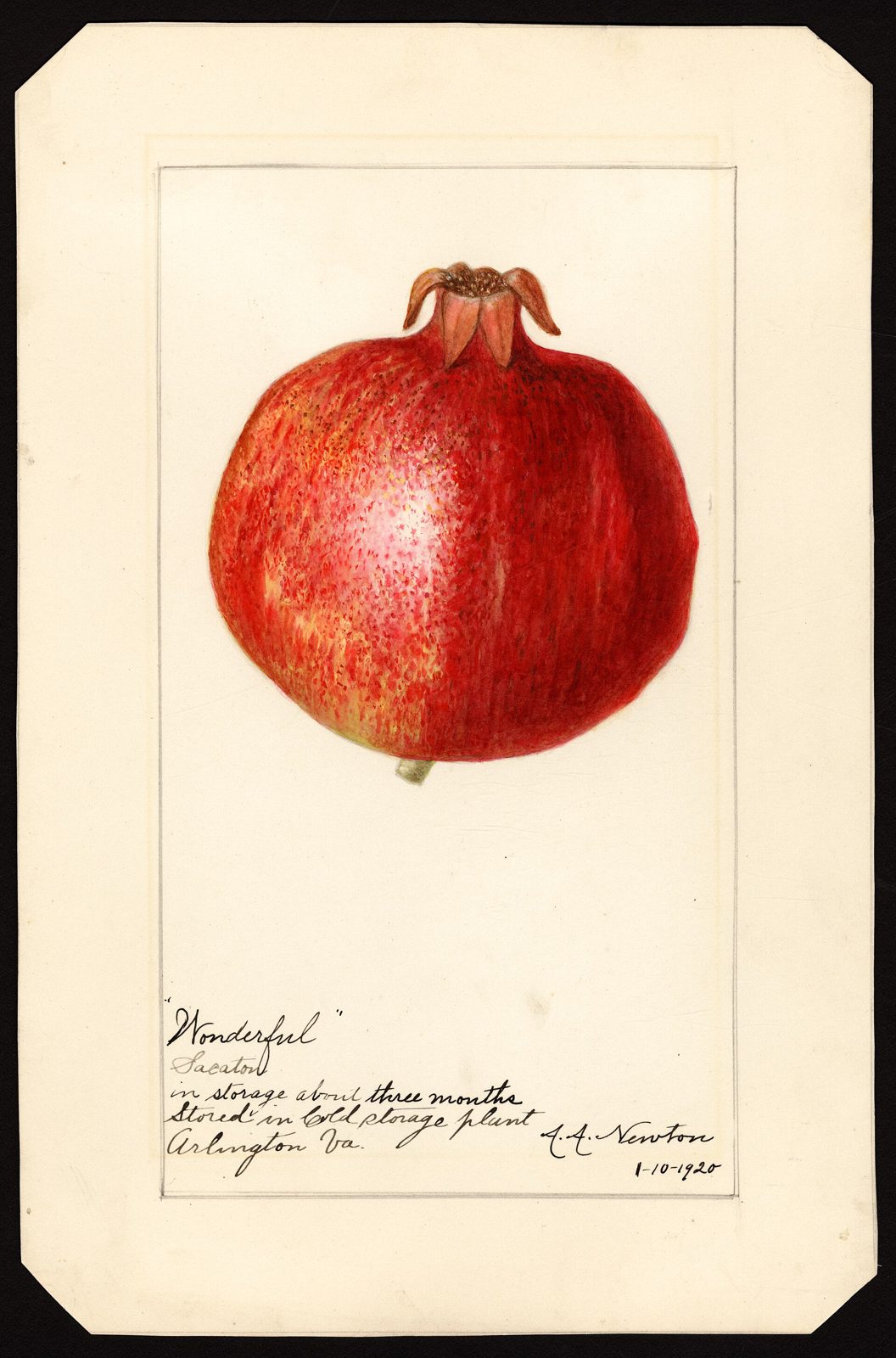
Wonderful is the best-known pomegranate: CRFG calls it the leading commercial variety in California, and it is a late ripener. One tree sets fruit on its own, because pomegranates are self-fruitful (UGA). This page covers Wonderful only. For planting and care, read our pomegranate tree guide, and to compare it with other types, see the pomegranate varieties guide.
- USDA zones
- 7–10 for pomegranates in general (NMSU)
- Sun
- Full sun
- Water
- Moderate
- Difficulty
- Easy
- Lifecycle
- Perennial
- Origin
- Originated in Florida (CRFG)
- Container friendly
- Yes
- Pollination
- Self-fruitful, as pomegranates are (UGA)
- Seeds
- Not very hard (CRFG)
- Use
- Better for juicing than for eating out of hand (CRFG)
- Season
- Late · NMSU lists maturity September 8 to October 13
- Time to fruit
- Year 2 from a cutting · 3+ yrs from seed (UGA)
Wonderful pomegranate fruit
CRFG says Wonderful’s seeds are not very hard, which matters if you eat the arils whole. It also says the variety is better for juicing than for eating out of hand. That is a useful steer: if you want something to eat by the spoonful, Granada is less tart, and NMSU calls Eversweet one of the sweetest varieties.
When the fruit is ready, it shows a distinctive color and makes a metallic sound when tapped (CRFG). Our guide on how to tell if a pomegranate is ripe covers the signs, and how to cut a pomegranate shows how to get the arils out.
Where Wonderful grows
Wonderful originated in Florida (CRFG), yet it is best known today as the leading commercial variety in California. In Florida itself, UF/IFAS says the late-ripening Wonderful might not be the suitable cultivar.
NMSU lists Wonderful maturity from September 8 to October 13, which fits the wider pattern UGA describes, with early cultivars ripening from the end of August and late ones into October or early November.
Growing Wonderful: zones, pollination and pots
In the ground. NMSU says pomegranates grow best in zones 7–10. UGA says most cultivars are hardy to 12°F and the hardier types survive down to 7°F, while UF/IFAS warns that 12°F may severely injure dormant trees. Zone 7 is therefore the edge. If your winters are colder, consider a cold-hardy type such as Kazake or Salavatski, or grow Wonderful in a pot.
Sun and soil. Full sun gives the best flower and fruit formation (TAMU). Good drainage matters most. UGA gives a pH of about 5.5–7.2, and TAMU says pomegranates grow very well in moderately alkaline soils in South Texas.
In a pot. CRFG says pomegranates adapt well to container culture. A large pot with drainage holes in full sun suits a young Wonderful, and you can shelter it in winter.
Pollination. One tree is enough (UGA). A second variety nearby may increase fruit set (CRFG).
Fruit problems. Splitting follows irregular watering (UF/IFAS, UGA). See why pomegranates split for the fix.
How Wonderful compares
| Variety | Season | Fruit |
|---|---|---|
| Wonderful | Late (UF/IFAS) · maturity September 8 to October 13 (NMSU) | Seeds not very hard; better for juicing than for eating out of hand (CRFG) |
| Granada | One month earlier than Wonderful (CRFG) | Bud mutation of Wonderful; darker red and less tart |
| Eversweet | — | One of the sweetest varieties (NMSU) |
| Kazake | — | A cold-hardy type, grown as far north as zone 5 (NMSU) |
Choose Wonderful if you want the best-known pomegranate, and you have a long enough season for a late ripener. Choose Granada if you want an earlier, less tart fruit. Choose Eversweet if sweetness is the goal, and Kazake or Salavatski if your winters are cold.
Where to buy a Wonderful pomegranate tree
Buy a container-grown plant from a nursery in your region, or from a plant sale run by your county extension office or a local fruit-growers club. Check that the label says Wonderful. Plant after your last hard freeze so the tree has a full season to settle in. You can also take hardwood cuttings from a Wonderful you know, as our guide to growing a pomegranate from cuttings explains.
Once you have the tree, our pomegranate varieties guide can help you decide whether a second variety is worth the space.
Frequently asked questions
Is Wonderful pomegranate self-fertile?
Yes, in the sense that matters. UGA says pomegranates are self-fruitful, so one Wonderful tree sets fruit on its own. CRFG says cross-pollination increases fruit set, so a second variety nearby can give a heavier crop.
When does Wonderful pomegranate ripen?
Late. NMSU lists Wonderful maturity from September 8 to October 13, and UF/IFAS calls it late-ripening. Granada, a bud mutation of Wonderful, ripens one month earlier (CRFG).
Where does Wonderful pomegranate grow best?
CRFG calls it the leading commercial variety in California. UF/IFAS says its late ripening might make it unsuitable for Florida. In general, NMSU says pomegranates grow best in USDA zones 7–10.
Is Wonderful good for eating fresh?
CRFG says Wonderful is better for juicing than for eating out of hand, though its seeds are not very hard. If you want fruit to eat by the handful, compare it with Granada, which is less tart, or Eversweet, one of the sweetest (NMSU).
How long until a Wonderful pomegranate fruits?
A tree from a hardwood cutting fruits in year two after planting, and one from seed takes at least three years (UGA). TAMU says 3 to 4 years after planting.
Sources
- Pomegranate Fruit Facts, California Rare Fruit Growers
- The Pomegranate (MG056), UF/IFAS Extension
- Pomegranates, NMSU Extension, Doña Ana County
- Pomegranate Production (C997), UGA Extension