

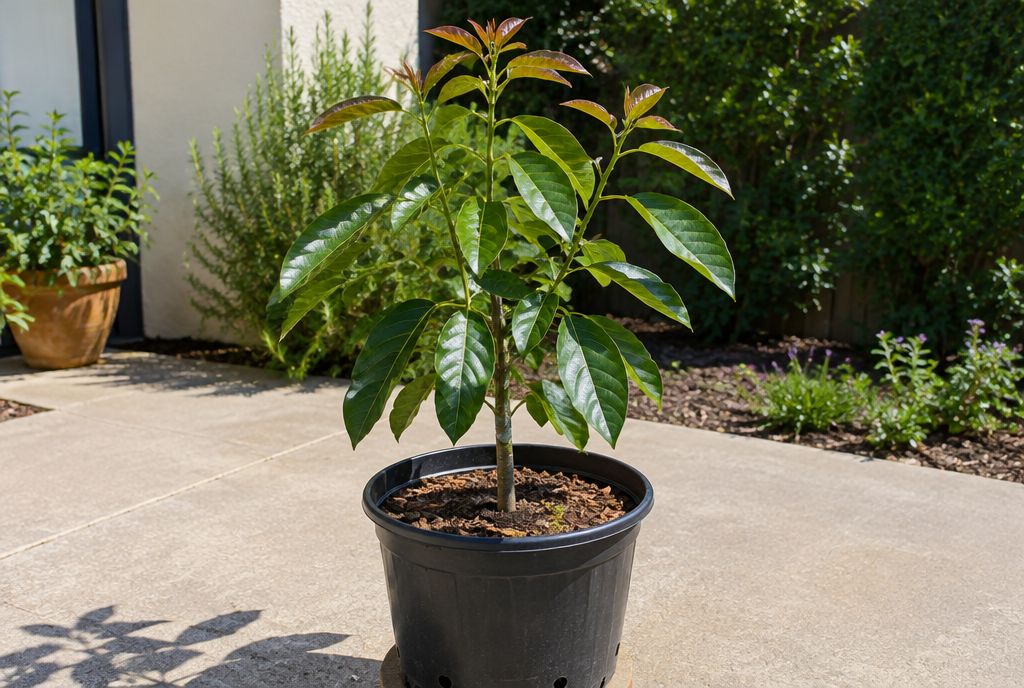
You can grow an avocado tree in a pot in any USDA zone if you start with a grafted tree, give it a big pot with drainage holes and keep it in full sun all summer. Move it under cover before a freeze, and prune it lightly to keep it manageable. A potted avocado is a medium-difficulty project: it is easy to keep alive and slower and less certain to fruit. This guide expands on the container section of our avocado tree guide with pot size, soil, watering and a winter plan for your zone.
Which avocado to grow in a pot
Buy a grafted tree rather than a pit seedling, because a grafted tree gives you the variety on the label and begins to produce after about 3–4 years (UF/IFAS, UC Riverside). A tree from a pit takes 5–13 years or more and may give poor fruit.
Avocados are big trees: Texas A&M says an unpruned tree can reach 40–80 ft (12–24 m). In a pot you keep it small with the pot and the pruning saw. No variety stays small on its own, but a variety’s habit helps. UC Riverside describes Bacon and Reed as columnar trees that take less room than umbrella-shaped types. Hass has an open habit and is not tall (CRFG), while Mexicola is tall, spreading and vigorous, so it needs firmer pruning. Pick for your winter first: our avocado varieties guide compares cold hardiness.
What size pot does an avocado tree need?
Step up gradually. A pot that is far too big holds wet soil around a small root system, and avocados are prone to root rot. UC IPM says poorly drained soils may lead to root rots, and UF/IFAS says Phytophthora root rot is likely where soil is poorly drained.
- Start: a pot a size or two larger than the nursery pot. A 10-gallon (38 L) fabric pot is a workable first home for a small tree.
- Move up when roots fill the pot or water runs straight through.
- Finish in the largest pot you can still move. Put it on a wheeled plant caddy, because a wet pot is heavy.
Every pot needs drainage holes. Fabric pots breathe, drain well and are lighter to move than plastic or ceramic. When the tree outgrows its final pot, slide it out, trim a little off the sides of the root ball and refresh the top of the mix, so it keeps its size without a bigger pot.
What soil mix is best for a potted avocado?
Drainage matters more than anything else. CRFG says to use a planting mix combined with topsoil. In practice that means a quality potting mix cut with coarse material such as pine bark fines or perlite, so water runs through quickly. A bagged citrus or cactus mix also works. Avoid heavy garden soil on its own and any pot that stays wet.
How much sun does a potted avocado need?
Full sun for best growth and fruit production (UF/IFAS). Put the pot where it gets the most direct light you can offer, such as a south- or west-facing wall. Indoors, even a south window is dimmer than outdoors, so a tree kept inside all year will grow slowly. Put it outside in summer once nights are warm. Harden it off over a week or so, starting in shade, because leaves grown indoors sunburn in direct sun.
Watering and feeding an avocado in a pot
Water
Feed
Watch the leaves
How to prune an avocado tree to stay small
Pruning is not required for productivity (UC IPM), but a potted tree needs it to stay a manageable size. UC IPM says to prune just before bloom or just after fruit set to keep a tree smaller. UF/IFAS suggests pruning after harvest, so the best time depends on your region. Whenever you do it, keep cuts light.
- Take back the tallest shoots by a little, cutting just above a leaf node.
- Cut out crossing branches and thin the center so light and air reach the tree.
- Avoid heavy cuts, which leave bark exposed to the sun. Paint exposed trunks with a 50:50 mix of white latex paint and water (UC IPM).
How to overwinter a potted avocado by zone
Inside, put the tree in your brightest spot, and keep it away from heating vents. Water less, but do not let the mix dry out completely. Avocados are evergreen and keep their leaves, so a dark garage is only a short-term shelter on cold nights. Move the tree back outside once the danger of freeze has passed, hardening it off over a week or so.
How potted avocados set fruit
Avocado flowers are A type or B type, which open female and male at opposite times of day (UC Riverside). UF/IFAS says varieties differ in how much cross-pollination they need, and that Waldin, Lula and Taylor fruit well planted alone. A pot has room for one tree, so ask your nursery about the variety you are buying. When fruit does come, remember that it does not ripen on the tree (UF/IFAS). Learn the signs in how to tell if an avocado is ripe. For a related project, see our guide to growing a mango tree in a pot.
Frequently asked questions
What size pot does an avocado tree need?
Start a small grafted nursery tree in a pot a size or two larger than its nursery pot, and a 10-gallon (38 L) fabric pot is a workable first home. Move up when roots fill the pot, and stop at the largest pot you can still move. Every pot needs drainage holes.
Will a potted avocado tree produce fruit?
It can, but not quickly. A grafted tree begins to produce after about 3–4 years (UF/IFAS, UC Riverside), and a tree from a pit takes 5–13 years or more. Full sun is best for fruit production (UF/IFAS), so a tree kept in a dim room is unlikely to do well.
Can an avocado tree live indoors all year?
It can survive in your brightest window, but avocados want full sun (UF/IFAS), so it will do better outdoors in summer. Treat indoors as a winter shelter, not a permanent home.
When should I bring my avocado tree inside?
Bring it in before a freeze is forecast. Mature trees are damaged at about 18–30°F depending on the race (UF/IFAS), and young trees are less hardy than mature ones, so do not wait until the last night.
Do I need two avocado trees to get fruit in a pot?
A pot only has room for one, so choose carefully. UF/IFAS says varieties differ in how much cross-pollination they need, and names Waldin, Lula and Taylor as varieties that fruit well planted alone. Ask your nursery about the variety you are buying.
Sources
- Avocado Growing in the Florida Home Landscape (CIR1034/MG213), UF/IFAS Extension
- Avocado Fruit Facts, California Rare Fruit Growers
- Cultural Tips for Growing Avocado, UC Statewide IPM Program
- Avocado FAQs, UC Riverside Avocado Variety Collection
- Avocados, Texas A&M AgriLife Extension