

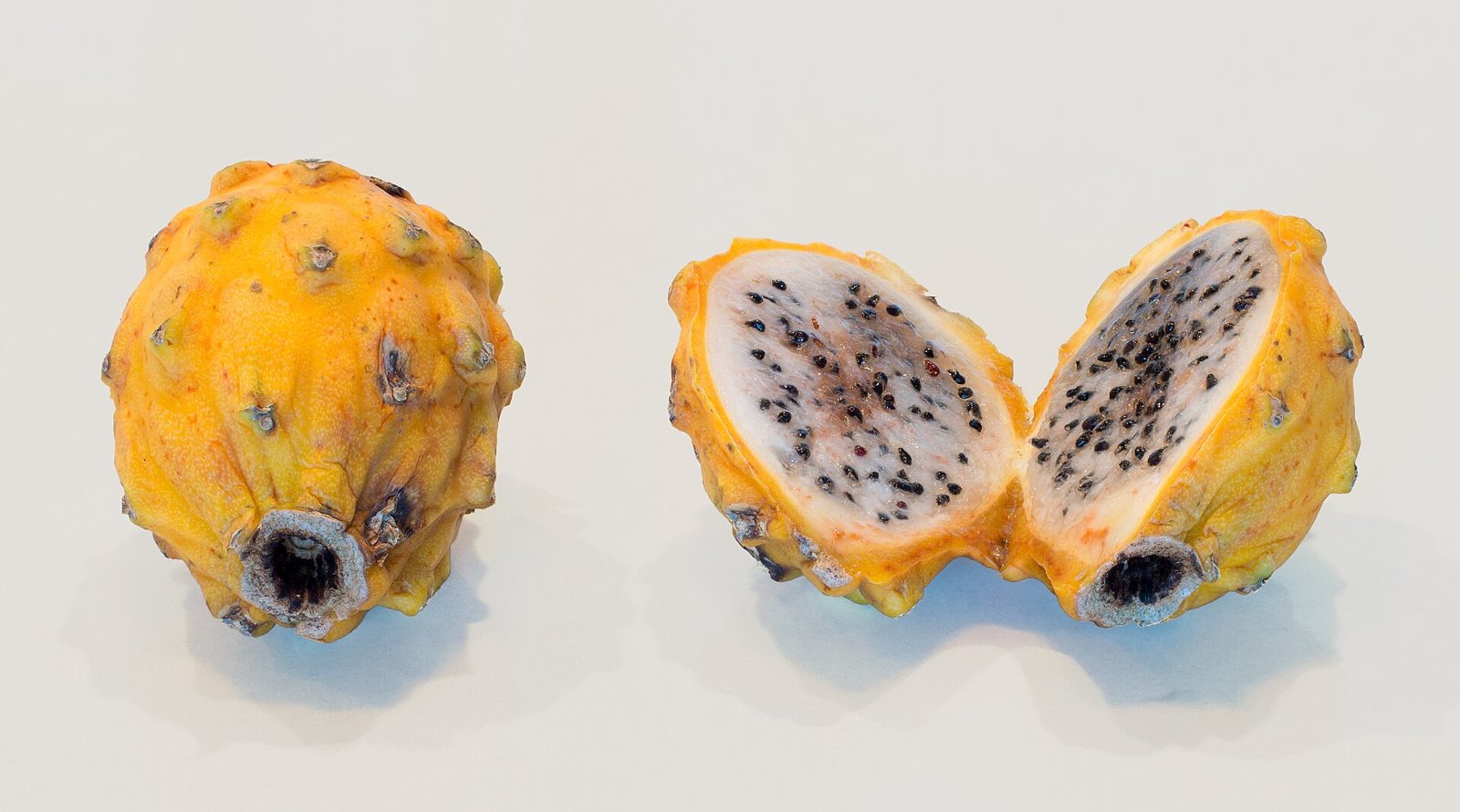
Yellow dragon fruit is a small, sweet, spiny-skinned pitaya that sets fruit on its own, but it ripens slowly and does not like cold. It is a different species from the pink-skinned fruit in shops (Selenicereus megalanthus), and it is the one to pick if you have room for only one plant. This page covers yellow dragon fruit only. For planting and care, read our dragon fruit guide, and to compare it with red and white types, see the dragon fruit varieties guide.
- USDA zones
- 10–11 outdoors · colder: in a pot
- Sun
- Full sun
- Water
- Moderate
- Difficulty
- Easy
- Lifecycle
- Perennial
- Origin
- The Americas
- Container friendly
- Yes
- Species
- Selenicereus megalanthus
- Pollination
- Self-fruitful (CRFG)
- Fruit
- Small · yellow, thorny skin · translucent white flesh (UC)
- Time to ripe
- Up to 150 days from pollination (CRFG)
- Season
- Late summer or fall (CRFG)
- Cold
- More sensitive than Hylocereus · growth minimum about 45°F (UH CTAHR)
The yellow dragon fruit
The skin is yellow and thorny, and the flesh is white and translucent (UC). The fruit is smaller but sweeter than other pitaya (CRFG). In UC’s trial the Colombiana cultivar, which UC considers the same as Yellow Dragon, weighed under 200 g (about 7 oz) and scored a Brix of 20.9. That is a single trial, but it fits CRFG’s range of 12–21% sugar for dragon fruit overall.
The spines are part of the package. CRFG says the fruit’s spines fall off when the fruit is ripe, so you can use the spines as a ripeness cue and wear gloves to handle the fruit before then. Our how to tell if dragon fruit is ripe guide covers the other signs, and how to cut and eat dragon fruit works for yellow fruit too.
Yellow vs red and white dragon fruit
| Yellow | Red or white (Hylocereus) | |
|---|---|---|
| Species | Selenicereus megalanthus | H. undatus (white), H. costaricensis and H. polyrhizus (red or purple) |
| Skin | Yellow and thorny | Hot pink or reddish (CRFG) |
| Flesh | White, translucent (UC) | White to very dark red (UH CTAHR) |
| Size | Smaller | ½ to over 3 lb (CRFG) |
| Pollination | Self-fruitful (CRFG) | Many need a second type (CRFG, UF/IFAS) |
| Pollination to ripe | Up to 150 days | About 45 days |
| Cold | More sensitive | Brief dips near 28°F (CRFG) |
| Season | Late summer or fall | Summer into fall, two or three crops |
Choose yellow if you want one plant that fruits by itself and you like a small, sweet fruit. Choose red or white if you have the space for two or three plants and want bigger fruit in a shorter time. If you go with red or white, the pollination section of our guide explains how to plan for a partner plant or hand-pollinate at night.
Growing yellow dragon fruit
Everything in the main guide applies: full sun, well-drained soil, a sturdy post with a frame on top, and a feed plan by age. Three things differ.
- Cold. Yellow pitaya is more cold sensitive than Hylocereus (CRFG), and UH CTAHR gives a minimum growth temperature of 44.6°F (7°C). Zones 10–11 are the safe outdoor range. In zone 9b and colder, grow it in a pot and bring it inside before nights drop near that figure.
- Time. Fruit takes up to 150 days from pollination to ripe (CRFG). Plan for a long season, and mark the pollination date on a tag.
- Pests. UF/IFAS lists the yellow pitaya flower-bud fly, Dasiops saltans, as a major pest of yellow pitaya in Colombia. Check flower buds if they drop for no clear reason.
Colombia is the top producer of yellow pitahaya (UC), which is why many cultivar names, including Colombiana, point to it.
Where to buy yellow dragon fruit
Buy a rooted plant or cuttings from a nursery that names the plant as yellow pitaya or Selenicereus megalanthus, and ask for a cultivar name if there is one. UC treats Yellow Dragon and Colombiana as the same, so either label points to the same plant. Because yellow is self-fruitful, you do not need a second type, but a local fruit-growers club or extension plant sale is a good place to find cuttings from plants that already survive your winters. Our dragon fruit from cuttings guide explains how to start them, and a pot guide covers growing one in a container.
Once you have it, our dragon fruit varieties guide can help you decide whether a red or white type is worth the space too.
Frequently asked questions
Is yellow dragon fruit sweeter than red?
CRFG describes yellow pitaya as smaller but sweeter than other pitaya. In UC's trial, the yellow Colombiana scored a Brix of 20.9, near the top of the 12–21% sugar range CRFG gives for dragon fruit overall. Treat it as a guide, since single trials vary.
Is yellow dragon fruit self-fruitful?
Yes. CRFG describes yellow pitaya as self-fruitful, so one plant can set fruit on its own. A second plant can still help, since UF/IFAS says cross-pollination assures better fruit set and size in dragon fruit generally.
How cold can yellow dragon fruit get?
Less than red or white types. CRFG says yellow pitaya is more cold sensitive than Hylocereus, and UH CTAHR gives a minimum growth temperature of about 45°F (7°C). In zone 9b and colder, grow it in a pot you can bring inside.
How long does yellow dragon fruit take to ripen?
Much longer than red or white. CRFG gives about 45 days from pollination to ripe fruit for Hylocereus, but up to 150 days for Selenicereus. In UC's trial the yellow Colombiana took 150–180 days to harvest.
Sources
- Pitaya and Pitahaya (Dragon Fruit), California Rare Fruit Growers
- 2013 Pitahaya Production Seminar and Field Day, UC Cooperative Extension, San Diego
- Dragon Fruit: Postharvest Quality-Maintenance Guidelines (F_N-28), University of Hawaii CTAHR
- Pitaya (Dragon Fruit) (Hylocereus undatus) Pests and Beneficial Insects (IN1292), UF/IFAS Extension
- Pitaya (Dragonfruit) Growing in the Florida Home Landscape (HS303), UF/IFAS Extension