

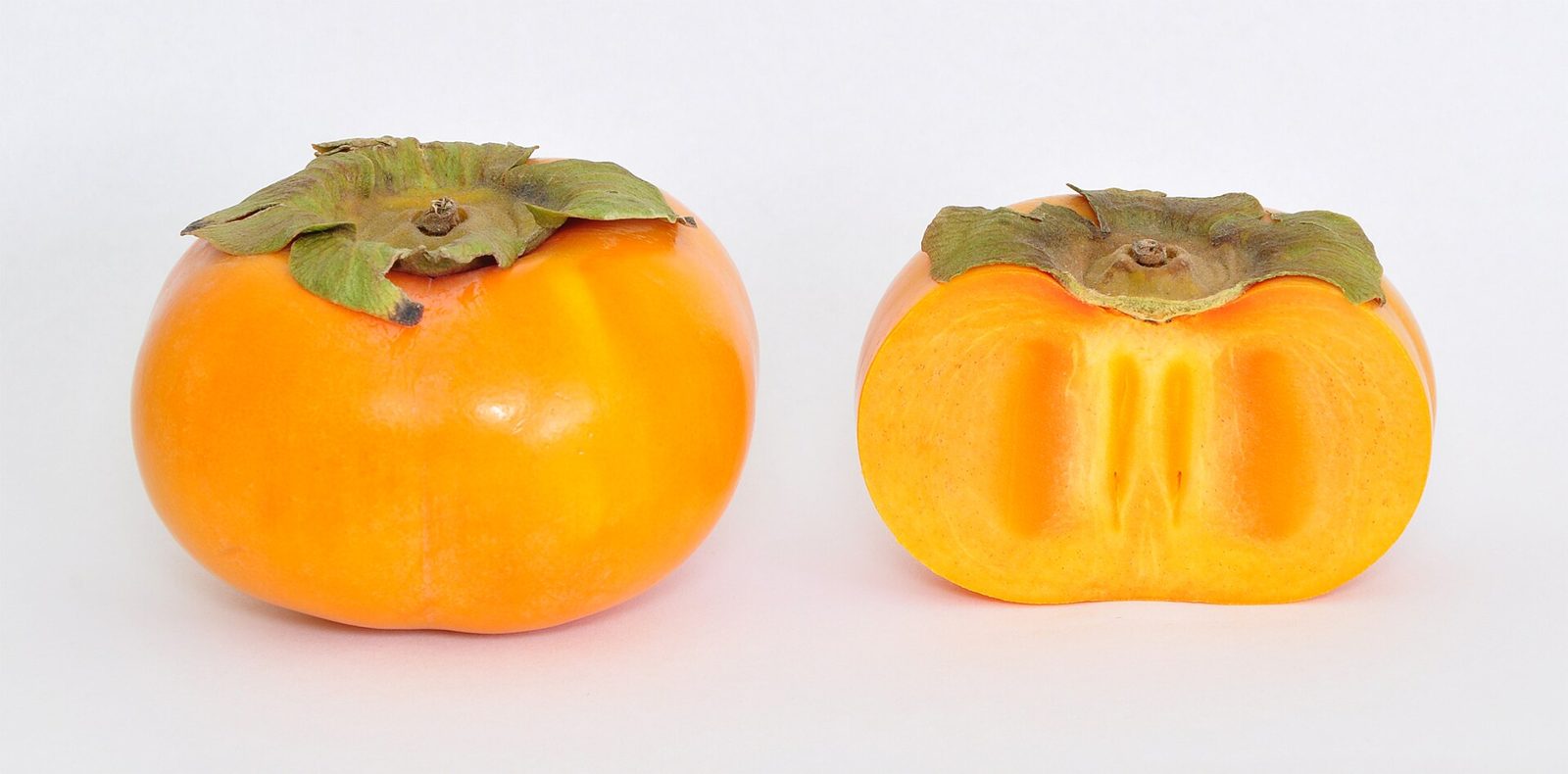
Which persimmon to grow comes down to one choice first: non-astringent or astringent. Fuyu and Jiro are non-astringent, so you can eat them firm. Hachiya, Saijo and Tanenashi are astringent, so you wait for them to go soft. After that, pick by winter, season and tree size. This guide compares eight types of persimmons grown in US gardens. For planting and care, see our persimmon tree guide.
Persimmon varieties compared
| Variety | Best for | Size | Flavor | Astringency |
|---|---|---|---|---|
| Fuyu | Eating firm · late season · highly recommended for north and north central Florida (UF/IFAS) | Vigorous, spreading tree; medium-large oblate fruit | Sweet and mild; deep orange skin, light orange flesh | Non-astringent, self-fruitful (UGA, Clemson) |
| Jiro | Eating firm · ripens late October and early November; most popular non-astringent in California (CRFG) | Moderate vigor; large fruit, more squarish than Fuyu | Excellent quality; orange-red skin (CRFG) | Non-astringent (Clemson) |
| Ichi-ki-kei-jiro | Smaller trees · a bud sport of Jiro (UF/IFAS) | Low to moderate vigor; comparatively smaller than most (UGA) | Good quality; oblate fruit that matures seedless | Non-astringent (UGA) |
| Izu | The earliest crop · end of September to mid-October (CRFG) | Somewhat dwarf tree; medium-sized fruit | Soft flesh with a good amount of syrup, fine texture | Non-astringent per UF/IFAS · not reliably so per CRFG |
| Hachiya | Soft, jelly-ripe fruit · commercial in California (UF/IFAS) | Vigorous, upright-spreading; large conical fruit | Sweet and rich, dark yellow flesh; glossy deep orange skin | Astringent until soft |
| Saijo | Colder sites · cold hardy to −10°F (CRFG) | Medium-height tree that bears consistently; small, elongated fruit | One of the sweetest persimmons (UF/IFAS) | Astringent · traces may remain when soft |
| Tanenashi | Early crop · the most popular astringent in Florida (UF/IFAS) | Vigorous, rounded, prolific; large cone-shaped fruit | Sweet, yellow flesh; seedless | Astringent until ripe (Clemson) |
| American | Zones 4–6 · ripens after a frost (UF/IFAS) | 40–60 ft tree; round fruit 1½–2 in. long | Killen: good flavor, firm fruit (Clemson) | Astringent until ripe · most cultivars need male and female trees |
The last column is the one that matters most. Dig deeper into the two most popular types on our Fuyu and Hachiya pages.
Pick by situation
To eat firm like an apple: Fuyu or Jiro
Fuyu is non-astringent while firm and self-fruitful (UGA, Clemson), and it is the most popular non-astringent type in Japan (CRFG). Jiro looks like a more squarish Fuyu and is the most popular non-astringent in California (CRFG). Both are ready when fully colored, though CRFG says a little softening after harvest improves flavor.
For colder winters: Saijo or an American persimmon
The California Rare Fruit Growers list Saijo as cold hardy to −10°F, which is hardier than the roughly 0–10°F range for most dormant Asian trees. In zones 4–6, the American persimmon is the realistic choice, since UF/IFAS lists it for zones 4B–9B and Clemson says it survives −20°F to −25°F. Be honest with yourself about the fruit, which is decidedly astringent before it ripens.
For a smaller tree or a pot: Ichi-ki-kei-jiro or Izu
No persimmon stays small without pruning, but vigor differs. UF/IFAS says Ichi-ki-kei-jiro is low to moderate in vigor, UGA calls it comparatively smaller than most and says it regulates its crop load well, and CRFG says Izu is somewhat dwarf. See our persimmon tree in a pot guide for how to grow one in a container.
For soft, jelly-ripe fruit: Hachiya, Tanenashi or Saijo
Astringent types ripen to a soft, sweet fruit on the counter. Hachiya is large and conical with sweet, rich flesh (CRFG), and Tanenashi is seedless and sets heavy crops without pollination (UF/IFAS). Saijo is small and elongated, but UF/IFAS calls it one of the sweetest persimmons.
For the earliest and latest fruit
Izu ripens from the end of September to mid-October (CRFG), and UF/IFAS calls it the choice for the early season. Tanenashi also ripens early (Clemson). Jiro ripens late October and early November, and Fuyu ripens late (CRFG).
By region
In Florida, UF/IFAS highly recommends Fuyu for north and north central Florida and recommends Ichi-ki-kei-jiro there too. It calls Tanenashi the most popular astringent cultivar in the state and Izu the choice for the early season. Hachiya is a commercial cultivar in California (UF/IFAS), and Texas A&M calls it an outstanding Texas variety. Jiro is the most popular non-astringent in California (CRFG).
Tree size and time to fruit
Whatever you choose, plan on about 3 years to the first fruit and 8–10 years to full production (LSU AgCenter, UF/IFAS). Some trees reach 30 ft tall and 15–25 ft wide (LSU AgCenter), with vigorous types such as Fuyu, Hachiya and Tanenashi at the large end and Izu and Ichi-ki-kei-jiro smaller. The American persimmon is bigger still, at 40–60 ft tall and 20–35 ft wide (UF/IFAS).
Pollination and the odd ones out
Many Asian persimmons are parthenocarpic, meaning they set seedless fruit without pollination (CRFG). Tanenashi is one, and it seldom sets seed even when pollinated (UF/IFAS). Nishimura Wase works differently. UF/IFAS says it is pollination variant and must be fully seeded to be non-astringent, and it is a common pollinator for its abundant male flowers, with its first fruit in early August in Florida. That makes it a poor pick if you want a firm, eat-now fruit from a single tree.
Rootstock and why sources disagree
Rootstock matters for variety choice. CRFG and UF/IFAS say Diospyros lotus is the California standard but is incompatible with Fuyu, Jiro and Izu, while Florida’s Japanese persimmons are nearly all grafted onto D. virginiana (UF/IFAS). Ask your nursery what the tree is on.
Sources also disagree on a few details. Izu is non-astringent in UF/IFAS’s description but not reliably so in CRFG’s. Clemson and UGA warn of injury below about 10°F for Asian types, while CRFG says a fully dormant tree tolerates about 0°F. Treat these as ranges, and go by the nursery’s description of the tree you buy.
Next steps
Once your tree fruits, learn the signs in how to tell if a persimmon is ripe and then how to eat a persimmon. If fruit is falling in summer, read why a persimmon tree drops fruit. For more fruit that survives real winters, browse temperate and unusual fruit.
Frequently asked questions
What is the best persimmon tree for beginners?
Fuyu is the usual first choice. It is non-astringent while firm and self-fruitful (UGA, Clemson), so one tree gives fruit you can eat like an apple. UF/IFAS highly recommends it for north and north central Florida.
What is the difference between astringent and non-astringent persimmons?
Non-astringent types such as Fuyu and Jiro are edible while firm. Astringent types such as Hachiya and Saijo must be soft-ripe before you eat them (CRFG). Eat an astringent persimmon too early and it is intensely puckery.
Which persimmon is the most cold hardy?
Among Asian types, the California Rare Fruit Growers list Saijo as cold hardy to −10°F (−23°C). For zones 4–6, the native American persimmon is hardier still, surviving −20°F to −25°F according to Clemson, though its fruit is astringent.
Is there a small persimmon tree for a pot or small yard?
Choose a low-vigor type. UF/IFAS describes Ichi-ki-kei-jiro as low to moderate in vigor, UGA says it is comparatively smaller than most, and CRFG calls Izu somewhat dwarf. Any persimmon still needs pruning to stay small.
Is Izu a non-astringent persimmon?
Sources disagree. UF/IFAS calls Izu the earliest ripening non-astringent cultivar, but the California Rare Fruit Growers say it is not reliably non-astringent. Treat it as an early type that may need to soften, and ask your nursery.
Sources
- Persimmon Fruit Facts, California Rare Fruit Growers
- Japanese Persimmon Cultivars in Florida (MG242), UF/IFAS Extension
- Japanese Persimmon Cultural Practices (HS1389), UF/IFAS Extension
- Diospyros virginiana, Common Persimmon (ST231), UF/IFAS Extension
- How to Grow Persimmons in South Carolina, Clemson Cooperative Extension
- Persimmons, UGA Extension, Colquitt County
- Persimmons, Texas A&M AgriLife Extension