

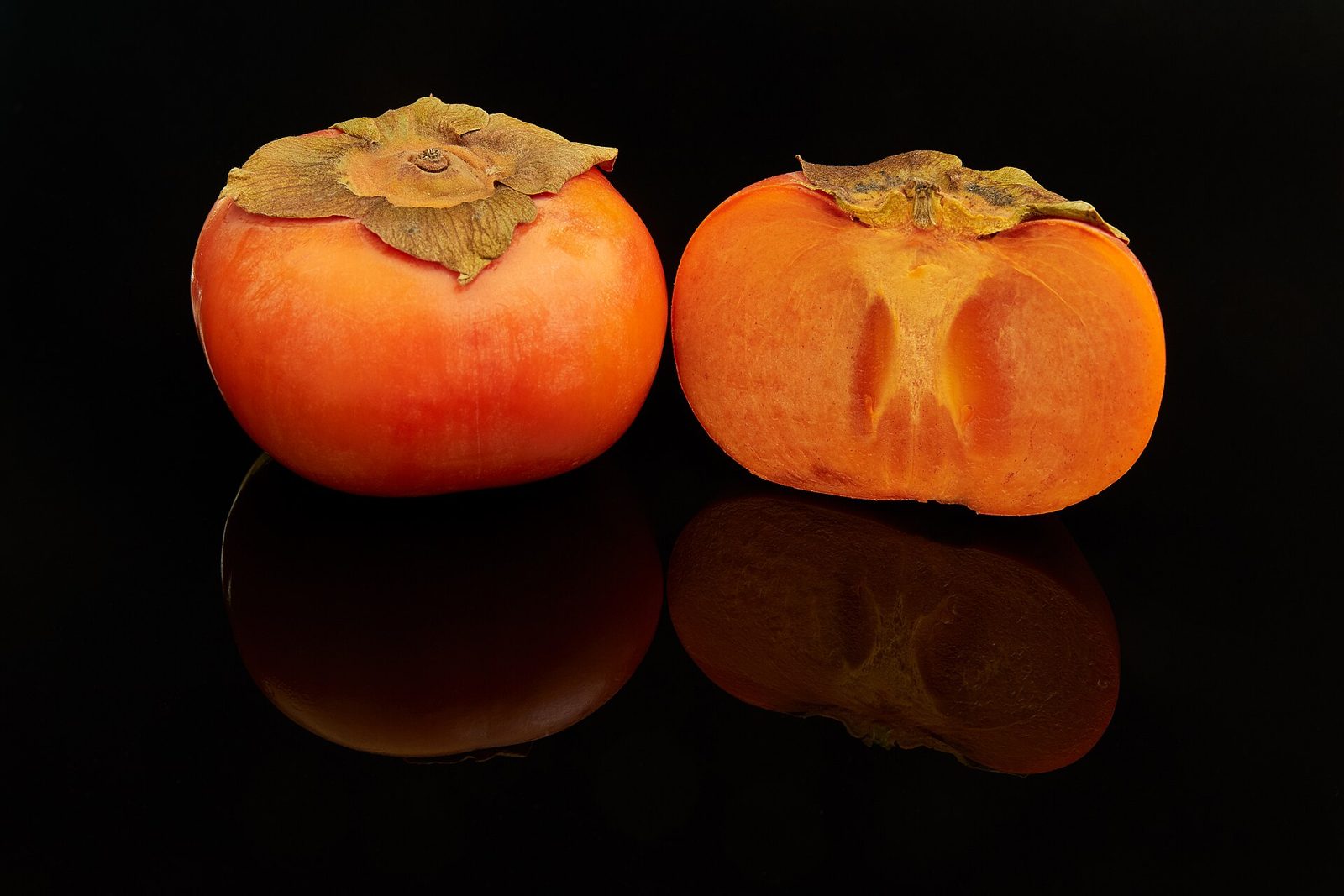
Fuyu is the persimmon you can eat firm, like an apple. It is non-astringent while firm and self-fruitful (UGA, Clemson), so one tree can give you crisp, sweet fruit without any waiting for it to go soft. The tree is vigorous and spreading, and CRFG says it ripens late. This page covers Fuyu only. For planting and care, read our persimmon tree guide, and to compare it with other types, see the persimmon varieties guide.
- USDA zones
- 7–10, the range CRFG gives for Asian persimmons
- Sun
- Full sun
- Water
- Moderate
- Difficulty
- Easy
- Lifecycle
- Perennial
- Origin
- Asia
- Container friendly
- Yes
- Astringency
- Non-astringent · edible firm (UGA, Clemson)
- Pollination
- Self-fruitful (Clemson, UGA)
- Tree
- Vigorous, spreading, productive (CRFG)
- Fruit
- Medium-large, oblate, faintly four-sided · deep orange skin (CRFG)
- Season
- Ripens late (CRFG)
- Time to fruit
- About 3 yrs · full production at 8–10 yrs
Fuyu fruit
CRFG describes Fuyu as a medium-large, oblate fruit that is faintly four-sided, with deep orange skin. Clemson and UGA call it medium-sized and somewhat square. The flesh is light orange, sweet and mild (CRFG), and UF/IFAS says the fruit can be picked firm from yellow-orange through full color.
You eat Fuyu while it is still firm, so there is no jelly stage to wait for. CRFG says non-astringent types are ready when fully colored, but for the best flavor, let them soften slightly after harvest. UF/IFAS says Fuyu lasts up to 30 days at room temperature. Our guide to how to eat a persimmon covers slicing and peeling, and how to tell if a persimmon is ripe covers color and give.
The Fuyu tree
CRFG calls the tree vigorous, spreading and productive. That means it wants room, so do not squeeze it against a wall. Like other persimmons, some varieties reach 30 ft tall and 15–25 ft wide (LSU AgCenter), and Fuyu is on the vigorous side, so plan to prune it to a framework of main branches while it is young. CRFG says heavy pruning is often not needed.
Fuyu is the most popular non-astringent persimmon in Japan (CRFG), and UF/IFAS highly recommends it for north and north central Florida. Rootstock matters: CRFG and UF/IFAS say Diospyros lotus, the California standard, is incompatible with Fuyu, so a nursery should graft it on a rootstock that suits it. Ask what yours is on.
Growing Fuyu: zones, pollination and pots
In the ground. CRFG gives zones 7–10 for Asian persimmons, and a fully dormant tree tolerates about 0°F, though Clemson and UGA warn of injury below about 10°F. Zone 7 is therefore the edge, and a late frost after bud break is the real risk, with UF/IFAS reporting damage at 27°F for an hour. Choose full sun and well-drained soil with a pH around 6–7.5.
In a pot. A young grafted tree can live in a large pot, which lets you move it out of a hard freeze. Our persimmon tree in a pot guide covers pot size, mix, watering and winter. A potted Fuyu still takes about 3 years to fruit.
Pollination. Clemson and UGA say Fuyu is self-fruitful, so you do not need a second tree. CRFG notes that fruit from a tree that does not need pollination will have seeds if it is pollinated, and may be larger and differ in flavor and texture.
Fruit drop. Expect some. A first drop after petal fall and lighter drops in June are normal (UF/IFAS). If a lot of fruit falls, see why a persimmon tree drops fruit.
How Fuyu compares with other persimmons
| Variety | Astringency | Fruit | Tree |
|---|---|---|---|
| Fuyu | Non-astringent, edible firm | Medium-large, oblate, deep orange | Vigorous, spreading |
| Jiro | Non-astringent (Clemson) | Large, more squarish than Fuyu, orange-red | Moderate vigor (UF/IFAS) |
| Ichi-ki-kei-jiro | Non-astringent (UGA) | Oblate | Low to moderate vigor, smaller than most |
| Hachiya | Astringent until soft | Large, oblong-conical, glossy deep orange | Vigorous, upright-spreading |
Choose Fuyu if you want fruit you can pick and eat firm. Choose Jiro if you want a close alternative, which CRFG calls the most popular non-astringent in California. Choose Ichi-ki-kei-jiro if you want a smaller tree, since UGA says it is comparatively smaller than most. Choose Hachiya if you want a soft, sweet, spoonable fruit.
Where to buy a Fuyu persimmon tree
Buy a grafted tree from a nursery in your region, or from a plant sale run by your county extension office or a local fruit-growers club. Check that the label says Fuyu and ask what rootstock it is on. Plant after your last hard freeze so the tree has a full season to settle in. A tree from a Fuyu seed will not match the fruit you ate, so a grafted tree is the way to get true Fuyu.
Once you have the tree, our persimmon varieties guide can help you decide whether a second variety is worth the space.
Frequently asked questions
Is Fuyu persimmon astringent?
No. Fuyu is non-astringent while firm and self-fruitful (UGA, Clemson), so you can eat it crisp like an apple. It is the main reason gardeners choose it over astringent types such as Hachiya.
Do you need two Fuyu trees?
No. Clemson and UGA both describe Fuyu as self-fruitful, so one tree fruits on its own. CRFG adds that fruit from trees that do not need pollination will contain seeds if it is pollinated, and may be larger and differ in flavor and texture.
How long until a Fuyu persimmon tree fruits?
About 3 years to the first fruit, with full production after 8–10 years (LSU AgCenter, UF/IFAS). Buy a grafted tree, because a tree grown from seed will not match the variety.
When is Fuyu persimmon season?
Fuyu ripens late in the season (CRFG), which UF/IFAS also describes for Florida. The exact dates depend on your region and year, so judge by color rather than the calendar.
Can you grow a Fuyu persimmon in a pot?
Yes, in a large pot you can move, with free-draining mix and full sun. A Fuyu is a vigorous, spreading tree (CRFG), so expect to prune it, and shelter the pot in winter.
Sources
- Persimmon Fruit Facts, California Rare Fruit Growers
- Japanese Persimmon Cultivars in Florida (MG242), UF/IFAS Extension
- Japanese Persimmon Cultural Practices (HS1389), UF/IFAS Extension
- How to Grow Persimmons in South Carolina, Clemson Cooperative Extension
- Persimmons, UGA Extension, Colquitt County
- Persimmons, LSU AgCenter