

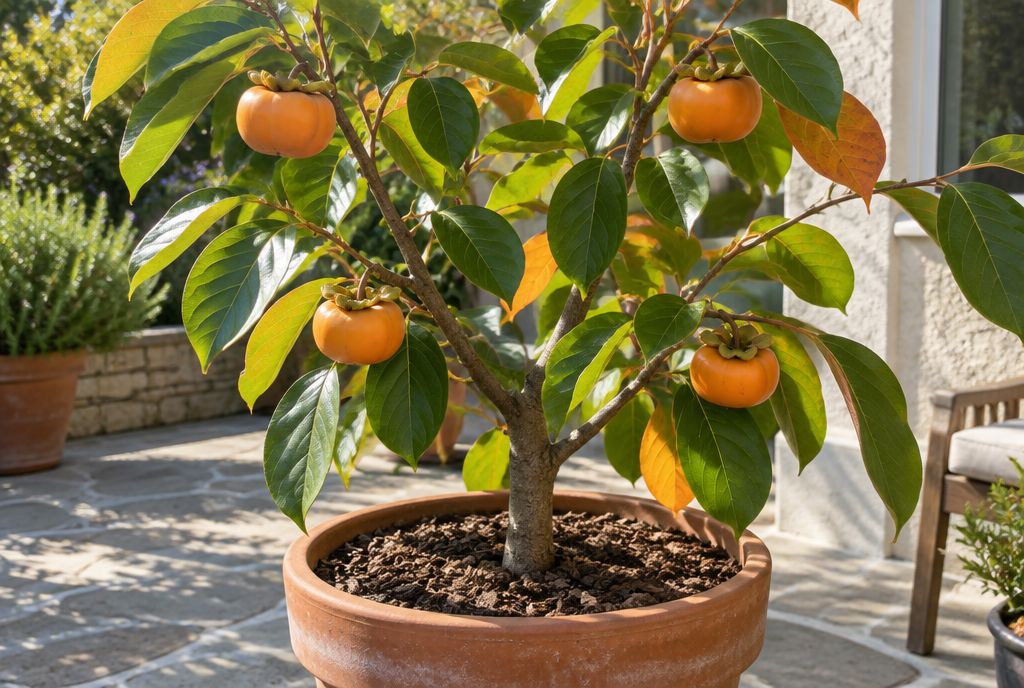
You can grow a persimmon tree in a pot in any USDA zone if you start with a grafted tree, use a large container with drainage holes and give it full sun. A pot also lets you shelter the tree from a hard winter freeze and protect it from a late frost after bud break. A potted persimmon is a medium-effort project: easy to keep alive, slower to fruit. This guide expands on the container section of our persimmon tree guide with pot size, soil, watering, pruning and a winter plan.
Which persimmon to grow in a pot
Buy a grafted tree, because it gives you the variety on the label and begins to fruit after about 3 years (LSU AgCenter, UF/IFAS). A pot keeps a tree smaller, but no persimmon stays small on its own, so a variety’s vigor helps. As general advice, pick a low-vigor or dwarfing type, and prune to hold it.
- Ichi-ki-kei-jiro is a bud sport of Jiro with low to moderate vigor (UF/IFAS). UGA says the tree is comparatively smaller than most and regulates its crop load well. It is non-astringent.
- Izu is described as somewhat dwarf (CRFG), and it ripens early, from the end of September to mid-October. Sources disagree on whether it is reliably non-astringent.
- Fuyu is non-astringent and self-fruitful (UGA, Clemson), so a single pot works. The tree is vigorous and spreading (CRFG), so prune it.
- Skip the American persimmon for a pot. UF/IFAS gives 40–60 ft for the tree, and most cultivars need male and female trees to fruit.
Compare the types in our persimmon varieties guide. Buy from a regional nursery or an extension plant sale, and check the label for the variety name.
What size pot does a persimmon tree need?
Step up gradually. A pot that is far too big holds wet soil around a small root system, and CRFG lists root rot from waterlogging as a persimmon problem.
- Start: a pot a size or two larger than the nursery pot. A 10-gallon (38 L) fabric pot is a workable first home for a small tree.
- Move up when roots fill the pot or water runs straight through.
- Finish in the largest pot you can still move. Put it on a wheeled plant caddy, because a wet pot is heavy.
Every pot needs drainage holes. Fabric pots breathe, drain well and are lighter to move than plastic or ceramic. When the tree outgrows its final pot, slide it out, trim a little off the sides of the root ball and refresh the top of the mix, so it keeps its size without a bigger pot.
What soil mix is best for a potted persimmon?
Drainage matters more than anything else. CRFG prefers a deep, well-drained loam with a pH of 6.5–7.5, and UF/IFAS gives 6–7, so aim for a pH of about 6–7.5. Use a quality potting mix, and cut it with a coarse material such as pine bark fines or perlite so water runs through quickly. Avoid heavy garden soil on its own. UF/IFAS says persimmons are sensitive to salinity, so flush the pot with plain water now and then to wash out built-up salts.
How much sun does a potted persimmon need?
Full sun. CRFG recommends full sun with some air movement inland, and says the tree tolerates some partial shade. Put the pot where it gets the most direct light you can offer, such as a south- or west-facing patio or wall. A tree kept in a dim room will grow poorly, so keep it outside through the growing season.
Watering and feeding a persimmon in a pot
Water
Feed
Watch the leaves
How to prune a potted persimmon
Pruning keeps a potted persimmon to a size you can move and harvest. CRFG says to cut young trees back to about half height, or about 3 feet, at planting, and to build a strong framework of main branches. Heavy pruning is often not needed (CRFG, UF/IFAS), so keep it light after that.
- Cut out dead, crossing and weak branches first.
- Shorten the tallest branches to hold the tree at a height you can reach.
- Thin the center so light and air reach the fruit. UF/IFAS lists lack of light in the canopy as one cause of fruit drop.
How to overwinter a potted persimmon
A persimmon is deciduous, so it does not need light while it rests. It also needs some winter cold, because UF/IFAS says it does well with 100–200 hours below 45°F, so an unheated space suits it better than a warm room. Check the soil every few weeks and water lightly if it is bone dry. Move the tree back outside after the hardest freezes pass, harden it off over a week, starting in shade, and protect it if a late frost follows bud break, since UF/IFAS reports damage at 27°F for an hour.
How potted persimmons set fruit
Many Asian persimmons set seedless fruit without pollination (CRFG), and Fuyu is self-fruitful (Clemson, UGA), so one pot can fruit. When it does, you will need to know which type you grew. Learn the signs in how to tell if a persimmon is ripe, and see why a persimmon tree drops fruit if young fruit falls in summer. For a related project, see our guide to a fig tree in a pot.
Frequently asked questions
Can you grow a persimmon tree in a pot?
Yes. Use a grafted tree, the largest pot you can still move, a free-draining mix and full sun. A pot lets you shelter the tree from a hard winter freeze and keeps it smaller than a ground-planted tree, though it still needs pruning.
Which persimmon is best for a pot?
Pick a low-vigor type. UF/IFAS describes Ichi-ki-kei-jiro as low to moderate in vigor, UGA says it is comparatively smaller than most, and CRFG calls Izu somewhat dwarf. Fuyu is self-fruitful (Clemson, UGA), so one potted tree can fruit, but it is a vigorous, spreading tree (CRFG), so expect to prune it.
Will a potted persimmon tree fruit?
Yes, once it is old enough. Expect about 3 years to the first fruit (LSU AgCenter, UF/IFAS). Many Asian cultivars set seedless fruit without pollination (CRFG), so a single tree is fine. An American persimmon is the exception, because most cultivars need male and female trees (UF/IFAS).
How do you overwinter a potted persimmon?
Persimmon is deciduous. Once the leaves drop and the tree is dormant, move the pot to an unheated, sheltered spot such as a garage or shed in cold zones, and water lightly so the mix does not dry out. Move it back outside after the hardest freezes, and protect it from a late frost after bud break.
Sources
- Persimmon Fruit Facts, California Rare Fruit Growers
- Japanese Persimmon Cultural Practices (HS1389), UF/IFAS Extension
- Japanese Persimmon Cultivars in Florida (MG242), UF/IFAS Extension
- Persimmons, UGA Extension, Colquitt County