

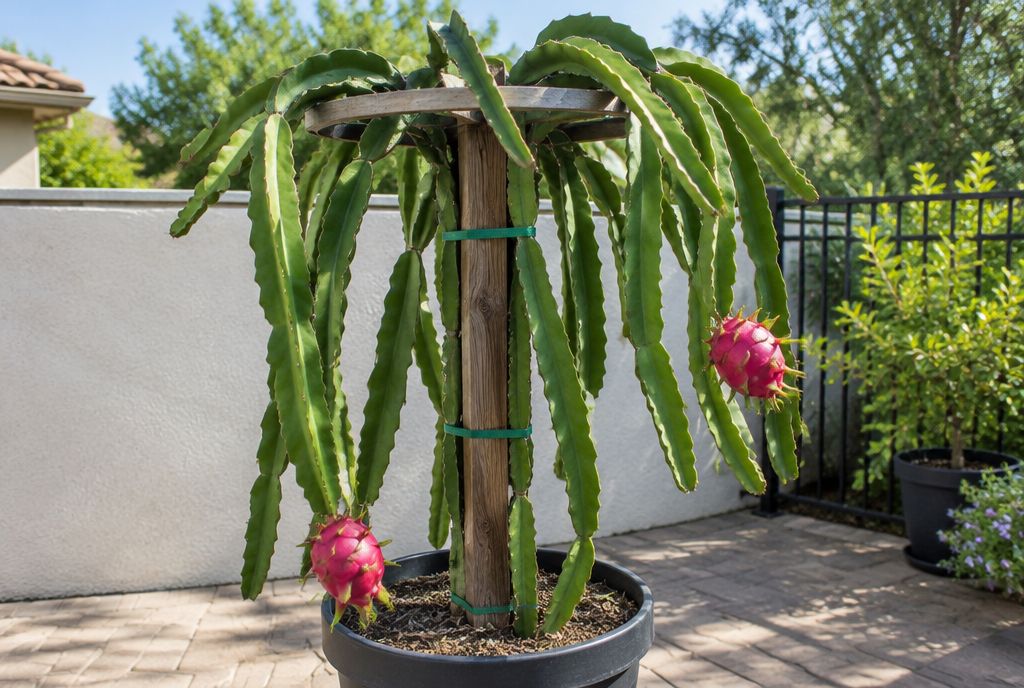
You can grow a dragon fruit plant in a pot in any US zone if you give it a large container, a tall post with a frame on top and as much sun as you can find. UF/IFAS recommends exactly that structure for home plants, a post with a support at the top, and a potted plant can be moved indoors when the weather turns. The plant is a climbing cactus, so a pot keeps it small enough to move and protect. This guide expands on the container section of our dragon fruit guide with pot sizes, a soil mix, support, pollination and a winter plan.
Which dragon fruit suits a pot?
Choose by pollination and cold, because the plant’s size is controlled by pruning.
- Yellow dragon fruit is self-fruitful (CRFG), so one pot can set fruit by itself. It is more cold sensitive than the others (CRFG), which is easy to manage in a pot you bring inside. See our yellow dragon fruit guide.
- Red and white types often need a second plant for cross-pollination (CRFG, UF/IFAS). Grow two cultivars in two pots, or plan to hand-pollinate. American Beauty is a well-documented red cultivar to start with.
Compare more in the dragon fruit varieties guide. Start with a rooted plant or a cutting you have cured and rooted, as explained in how to grow dragon fruit from cuttings.
What size pot does dragon fruit need?
UF/IFAS describes rooting cured cuttings in pots for 4–6 months before they go out, and also describes planting in containers with artificial media. Step up as the plant grows. A pot that is too big for a small root system holds wet soil, and too much water causes root rot (UF/IFAS).
| Plant stage | Pot | Notes |
|---|---|---|
| Cured cutting | A small pot, about 1 gallon (4 L) | Roots form over 4–6 months (UF/IFAS) |
| Rooted plant | About 10 gallons (38 L) | A 10-gallon fabric pot is a good first home |
| Established, fruiting plant | A larger, heavy or wide pot | Holds a tall post and a top-heavy plant upright |
Every pot needs drainage holes. Fabric pots drain well and are lighter to move than ceramic, but a large plant on a tall post can still tip, so set the pot against a wall or fence in a windy spot. A wheeled plant caddy makes it easy to move a heavy pot indoors for winter.
What soil mix is best for a potted dragon fruit?
UF/IFAS says dragon fruit is adapted to a wide range of soils as long as they drain well, and CRFG says it thrives in well-drained soil high in organic matter. In a pot, that means a free-draining mix with compost in it. Cut regular potting soil with perlite or coarse sand if it stays wet, and avoid heavy garden soil in a container.
How to support a potted dragon fruit
Support is not optional. UF/IFAS describes a post with a structure at the top, which is the shape in the photo above. UH CTAHR also lists horizontal trellises, galvanized fencing and T-trellises, and CRFG says trellises are generally 5–8 ft high.
- Set a sturdy post in the pot at planting, so you do not damage roots later. Use a rot-resistant post.
- Tie the main stem to the post as it grows, and remove side stems until it reaches the top (UF/IFAS).
- Add a ring, a wheel or a small frame at the top of the post.
- When the plant reaches the top, cut the tips to induce branching, then train and tie the new stems so they drape from the frame (UF/IFAS).
How much sun does a potted dragon fruit need?
UF/IFAS says plants grow and fruit best in full or almost full sun, so aim for a south- or west-facing spot. In hotter areas, CRFG says 5–30% shade may be needed to prevent sunburn, and UF/IFAS reports severe stem sunburn in some regions with low humidity or high altitude. A pot on hot paving beside a reflective wall can cook the stems, so give it light shade in the hottest part of the afternoon.
Watering and feeding dragon fruit in a pot
Water
Feed
Watch the stems
Pollinating a potted dragon fruit
A patio plant faces the same pollination problem as one in the ground. Flowers open in the evening, starting about 6:40 to 7:00 p.m., and are done by about 10:00 p.m. (UH CTAHR). Hand-pollinate during the night and early morning, as UF/IFAS describes: collect pollen, or a whole stamen, from one flower and apply it to the stigma of another flower. That is easy to do on a patio with a flashlight and a soft brush. Our pollination guide has the full steps.
Pruning and keeping it small
Prune soon after harvest (UF/IFAS). Cut out damaged, diseased or dead stems and any stems that reach the soil. Shorten or remove stems that grow beyond the frame so the plant stays at a size you can move. Wear gloves, because the wings have short spines (UH CTAHR).
How to overwinter a potted dragon fruit
Inside, put the plant in the brightest spot you have, such as a south window or a greenhouse, and water only enough to keep the mix from drying out completely. UH CTAHR says bloom needs a dry winter and early spring, so a drier rest period helps. Yellow types are more sensitive, with a minimum growth temperature of about 45°F (UH CTAHR), so bring them in sooner. Move the plant back outside after the last frost, starting in light shade for a week. Then read how to tell if dragon fruit is ripe so you pick your first crop at the right moment.
Frequently asked questions
What size pot does a dragon fruit plant need?
Start a rooted cutting in a 10-gallon (38 L) pot such as a fabric pot, and move up as the roots fill it. Any pot needs drainage holes and enough weight or width to hold a tall post and a top-heavy plant upright in the wind.
Will a potted dragon fruit plant fruit?
Yes, if the flowers are pollinated. UF/IFAS says many cuttings fruit 6–9 months after planting, and UH CTAHR describes production in the second year. Many types need a second plant or hand pollination, which you can do on a patio at night.
Can dragon fruit grow indoors all year?
It can survive, but it fruits poorly. UF/IFAS says plants grow and fruit best in full or almost full sun, and most windows are too dim. Keep the plant outside in summer and bring it into a bright spot for winter in cold zones.
What do you do with a potted dragon fruit in winter?
In zone 9b and colder, move it inside before the first frost, since young plants need protection from any frost. Put it in the brightest spot you have, and water sparingly. UH CTAHR says bloom needs a dry winter and early spring.
Sources
- Pitaya (Dragonfruit) Growing in the Florida Home Landscape (HS303), UF/IFAS Extension
- Pitaya (F_N-9), University of Hawaii CTAHR
- Pitaya and Pitahaya (Dragon Fruit), California Rare Fruit Growers
- Dragon Fruit: Postharvest Quality-Maintenance Guidelines (F_N-28), University of Hawaii CTAHR