

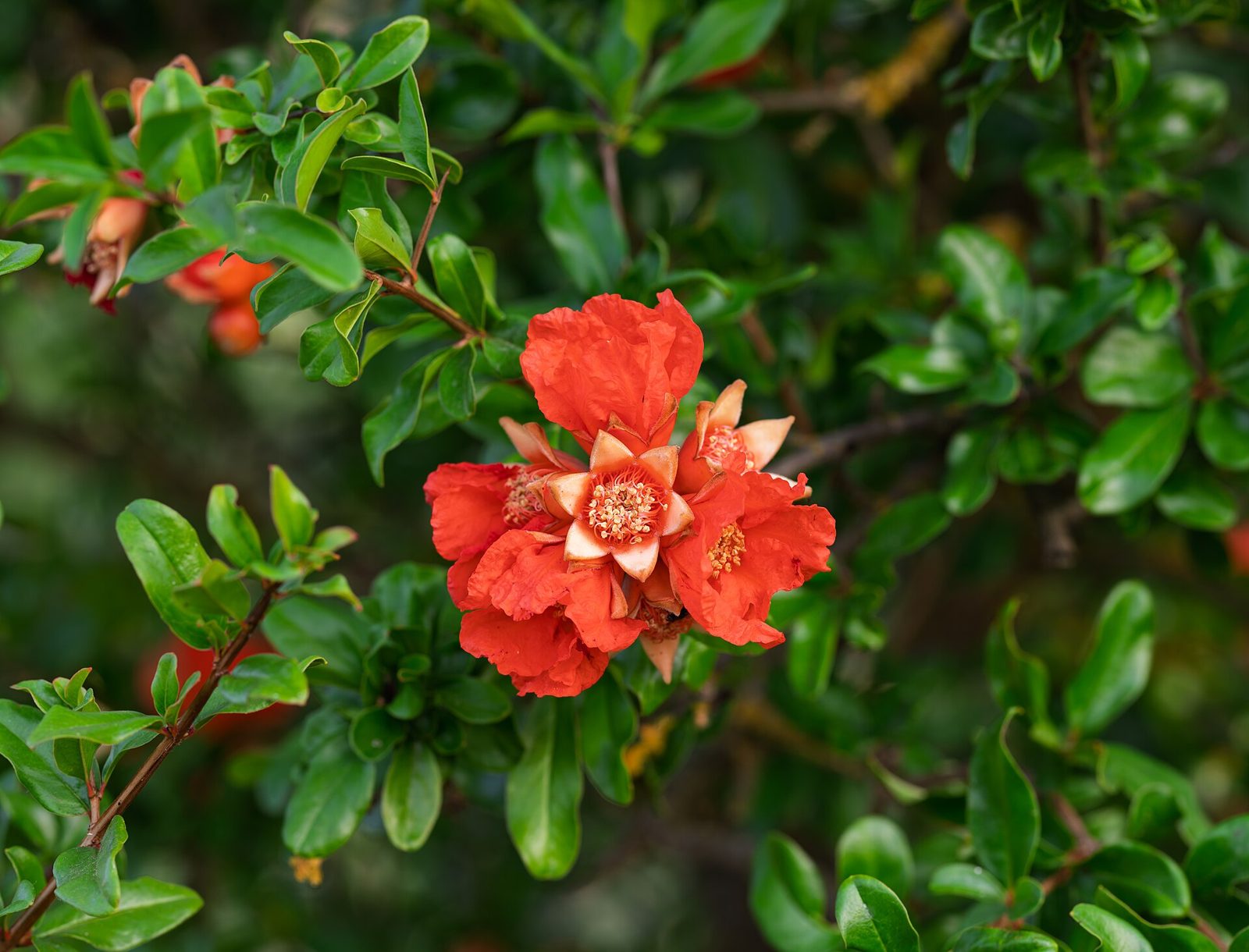
Fig, Meyer lemon, pomegranate and mango will fruit from a single tree, and many Asian persimmons will too, while avocado, dragon fruit and yellow passion fruit are the ones to plan a partner for. If you have room for one tree, that is the list to buy from. If you have room for two, the second tree is cheap insurance on the fruit that is not fully self-pollinating. Below is the answer for each of the ten fruit we cover, with notes on helping pollination along by hand.
Which fruit trees are self-pollinating
“Self-pollinating” is a spectrum. Some trees need no pollinator at all, some set fruit alone but give more with a partner, and some flatly need a second plant.
| Fruit | One tree enough? | What our pages say |
|---|---|---|
| Fig | Yes | Common types need no pollination. The fruit develops without it, and no fig wasp is needed (UF/IFAS) |
| Meyer lemon | Yes | Lemon does not require cross-pollination to set fruit (UF/IFAS) |
| Pomegranate | Yes | Self-fruitful (UGA). Two varieties nearby can give a heavier crop (CRFG) |
| Mango | Yes | Self-fertile. Flies and small insects do the work, so set is poor indoors |
| Persimmon | Usually | Many Asian types set seedless fruit without pollination (CRFG). Fuyu is self-fruitful |
| Passion fruit | Purple yes, yellow no | Purple flowers are self-fertile. Yellow vines need pollen from a genetically different vine (UF/IFAS) |
| Dragon fruit | Depends on type | Some types are self-fruitful, many need a second type. Yellow pitaya is self-fruitful (CRFG) |
| Avocado | Depends on variety | A and B flower types. Some varieties fruit alone, others set better with a partner |
| Banana and pineapple | See below | Our pages do not cover pollination for these two |
Self-pollinating fruit trees for your zone
Pollination needs matter less than winter, so pick by zone first.
- Zones 5–6: Chicago Hardy fig and a cold-hardy pomegranate such as Kazake fruit alone. The native American persimmon is the exception, because most cultivars need both male and female trees.
- Zone 7: fig (choose a hardy type such as Chicago Hardy), pomegranate and Asian persimmon all fruit alone. Zone 7 is the edge for pomegranate and persimmon, so choose a hardier pomegranate and shelter a young persimmon.
- Zone 9: add Meyer lemon, which needs no second tree, and mango in a pot or protected spot. Avocado grows here too, with zone 9 as its risky edge. See fruit trees by zone.
- Zones 10–11: everything above fruits alone except the fruit on the “needs a partner” list below. Check chill for persimmon, since UF/IFAS says it does well with only 100–200 hours below 45°F.
- Any zone, in a pot: one tree per pot is the rule, so choose a self-fruitful type. Our container fruit tree guide covers pollination in a pot.
Fruit that needs a partner, or your help
Avocado: A and B flowers
Avocado flowers open twice. An A-type tree opens female in the morning and male in the afternoon, and a B-type tree the reverse (UC Riverside). That timing is why a partner can help. From our variety table, Hass, Mexicola, Reed and Choquette are A types, and Fuerte and Bacon are B types. Waldin, Lula and Taylor fruit well alone (UF/IFAS). For any other variety, plant a second tree of the other flower type if you have room.
Dragon fruit: pollinate at night
Flowers open once, in the evening, and wilt by daybreak (UH CTAHR). UF/IFAS recommends planting two or three genetic types, since cross-pollination gives better fruit set and size. If you only have one plant, hand-pollinate during the night and early morning: take pollen or a whole stamen from one flower and apply it to the stigma of another. Hylocereus fruit takes about 45 days from pollination to ripe (CRFG), so tag the date.
Passion fruit: purple or yellow
Buy purple if you have one vine. For a yellow vine, add a genetically different vine nearby. UF/IFAS says carpenter bees and honey bees are the main pollinators, and that hand pollination with a clean cotton glove or paintbrush is labor-intensive but effective. Our guide to why passion fruit does not set fruit goes deeper.
Persimmon: pick a pollination-constant type
Pollination-constant types, such as Fuyu, are edible when firm without it. Pollination-variant types are edible firm only if the fruit has been pollinated, so they want a pollinator with abundant male flowers. UF/IFAS lists Nishimura Wase as a common pollinator. Most American persimmon cultivars need both male and female trees.
How to check pollination before you buy
A few seconds at the nursery label saves a season of flowers with no fruit.
- Check the exact variety. A tag that says only “avocado” or “dragon fruit” tells you nothing. Ask for the name, then look up the flower type or whether it is self-fruitful.
- For passion fruit, choose purple if you have one vine. A yellow vine needs a partner, and so do many purple-yellow hybrids, which may or may not be self-fertile.
- For persimmon, ask whether the type is pollination-constant or pollination-variant, and skip the American persimmon unless you can plant both a male and a female tree.
- For dragon fruit, buy two or three different types if you can. UF/IFAS reports self-incompatibility in several nursery cultivars, and cross-pollination between different types assures better set and size.
- For avocado, check the A or B flower type on the label, and plan a second tree of the other type unless the variety is one UF/IFAS lists as fruiting well alone.
Even self-fruitful pomegranates can give more with a neighbor. CRFG says cross-pollination increases fruit set, so two varieties planted near each other may give a heavier crop. It is a bonus, not a need.
Hand-pollinating indoors
Self-pollinating does not mean insect-free. A mango or Meyer lemon kept indoors has few insects to move pollen. Brush open mango flowers gently every few days, and dab each open Meyer lemon flower in turn with a soft paintbrush. If a healthy tree still will not fruit, check light, too much nitrogen and the tree’s age before blaming pollination. Our fertilizing guide covers the nitrogen side.
For a first tree that needs no partner, start with our best fruit trees for beginners.
Frequently asked questions
What fruit trees are self-pollinating?
Among the fruit we cover, fig (common types), Meyer lemon, pomegranate and mango fruit from a single tree, and many Asian persimmons set seedless fruit without pollination. Purple passion fruit and yellow-skinned dragon fruit are also self-fruitful.
Do avocado trees need a second tree?
Not always. UF/IFAS says varieties differ in how much cross-pollination they need, and names Waldin, Lula and Taylor as varieties that fruit well planted alone. For others, a second tree of the other flower type, A or B, is the safer bet.
Does a self-pollinating tree still need bees?
Often a little help. Mango flowers are pollinated mostly by flies and small insects, and a Meyer lemon or mango kept indoors has few insects, so brush open flowers with a soft paintbrush.
How do you hand-pollinate dragon fruit?
UF/IFAS says to hand-pollinate during the night and early morning. Collect pollen, or a whole stamen, from one flower and apply it to the stigma of other flowers. The flowers open after dark and wilt by daybreak (UH CTAHR).
Sources
- Pomegranate Production (C997), UGA Extension
- The Fig (HS27/MG214), UF/IFAS Extension
- The Lemon Tree: Lemon Growing in the Florida Home Landscape (HS402), UF/IFAS Extension
- Avocado Growing in the Florida Home Landscape (CIR1034/MG213), UF/IFAS Extension
- Pitaya (Dragonfruit) Growing in the Florida Home Landscape (HS303), UF/IFAS Extension
- The Passion Fruit in Florida (HS1406), UF/IFAS Extension
- Persimmon Fruit Facts, California Rare Fruit Growers