

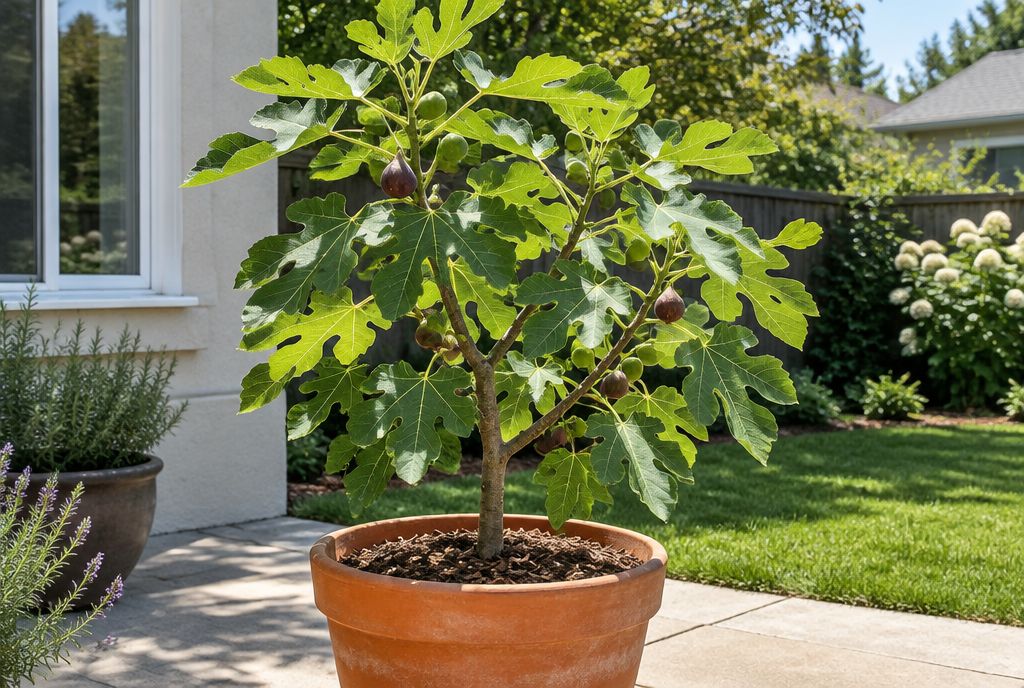
Every fruit we cover can live in a pot in any USDA zone, if you give it a big pot with drainage holes, a fast-draining mix, full sun and a plan for winter. The pot limits the tree’s size and lets you carry it indoors, but it does not make a big tree small by itself. Avocado, persimmon and mango all need pruning to stay manageable. This guide pulls the container advice from each plant’s page into one place, with a link to the full pot guide for each fruit. To browse the fruit by theme, see fruit trees for pots and patios.
Which fruit suits a pot
Choose the type of tree before you choose the pot. The right variety gives you a head start.
| Fruit | Best pick for a pot | Pot | Full guide |
|---|---|---|---|
| Mango | A grafted compact “condo” type such as Carrie | 7–10 gal, then 15 gal, finishing at 20–25 gal | Mango in a pot |
| Avocado | A grafted tree. Bacon and Reed are columnar, and Hass is open and not tall | 10-gal fabric pot as a first home, then the largest you can move | Avocado in a pot |
| Meyer lemon | Improved Meyer, a naturally small citrus | About 10 gal for an established tree | Meyer lemon in a pot |
| Fig | Chicago Hardy, which can be pruned to 6 ft | At least 18 in (45 cm) across | Fig in a pot |
| Persimmon | A grafted tree, such as Fuyu. Skip the American persimmon | 10-gal fabric pot to start | Persimmon in a pot |
| Pomegranate | Any variety. CRFG says it adapts well to containers | A large pot, such as a 10-gal fabric pot | Pomegranate pillar |
| Banana | A dwarf type such as Dwarf Cavendish, 4–7 ft | About 10 gal, then the largest you can move | Banana in a pot |
| Pineapple | A crown, slip or sucker | 3–7 gal (UF/IFAS) | Pineapple in a pot |
| Dragon fruit | A rooted cutting. Yellow types are self-fruitful | About 10 gal, then a heavier, wider pot for the post | Dragon fruit in a pot |
| Passion fruit | Purple, which is self-fertile | A big pot or grow bag on a stand, plus a trellis | Passion fruit in a pot |
For compact picks and their real sizes, see our post on dwarf fruit trees for small yards.
Pot size: step up, don’t jump
A pot that is far too big for a small root system holds wet soil around it and invites root rot. Our mango, avocado, banana, fig, persimmon and pineapple pages all say the same thing. Step up in stages, and finish in the largest pot you can still move.
- Drainage holes are not optional. Every pot needs them.
- Fabric pots breathe, drain well and are lighter to move than plastic or ceramic.
- Move up when roots fill the pot or water runs straight through.
- Put a big pot on a wheeled plant caddy. A wet 25-gallon pot can weigh well over 100 lb (45 kg).
Once the tree reaches its final pot, root-prune instead of upsizing:
- Slide the tree out of the pot. Do it every 2–3 years once the tree is in its largest pot (mango page), or every few years (fig page).
- Shave the sides of the root ball. Take 1–2 inches (2.5–5 cm) off the sides.
- Refresh the top third of the mix and replant. The tree keeps its size without a bigger pot.
Potting mix
Drainage matters more than any recipe. Use a free-draining mix, and skip heavy garden soil on its own. If water pools on the surface for more than a few seconds, add coarse bark or perlite.
| Fruit | Mix on our pot page |
|---|---|
| Mango | 2 parts potting mix, 1 part pine bark fines, 1 part perlite or coarse sand. A citrus or palm mix also works. pH roughly 5.5–7.5 |
| Meyer lemon | Texas A&M AgriLife says an adequate mix is one part sand, one part peat moss and one part composted bark. Avoid heavily limed mixes: lemons prefer pH 5.5–6.5 |
| Fig | A sterile potting mix with compost, cut with one-third pine bark fines or perlite if it stays soggy. pH 6.0–6.5 (Penn State) |
| Pineapple | A cactus or palm mix, or potting soil with plenty of coarse sand or perlite. pH 4.5–6.5 (CRFG) |
| Banana | A loose, rich mix: compost with a free-draining potting mix, plus coarse bark or perlite. pH about 5.5–6.5 |
| Avocado | A quality potting mix cut with pine bark fines or perlite, or a citrus or cactus mix |
| Persimmon | A quality potting mix cut with pine bark fines or perlite. pH about 6–7.5 |
| Dragon fruit | A free-draining mix with compost, cut with perlite or coarse sand if it stays wet |
Sun
All ten want full or almost full sun, and a pot lets you put it where the sun is. A south- or west-facing patio, deck or wall is the best spot. Indoors, even a south window is dim, so a tree kept inside all year grows slowly and rarely fruits. Put the pot outside for the warm months.
Harden a tree off when it goes out. Start in shade, and move into sun over a week or two: the mango page says 7–10 days, and the avocado page notes that leaves grown indoors sunburn in direct sun. Hot spots matter too: a pot on hot paving beside a reflective wall can cook dragon fruit stems, and CRFG says 5–30% shade may be needed in hotter areas.
Watering and feeding
Water
Feed
Flush and watch
For amounts by fruit, see our post on how to fertilize fruit trees.
Pruning to keep a pot manageable
- Mango: prune right after harvest, finishing by the end of July in Florida, because flowers form on the tips of shoots that mature in fall. Keep it at 6–8 ft (1.8–2.4 m).
- Fig: prune in late winter before growth starts, lightly on varieties that bear a breba crop. Chicago Hardy can be held at 6 ft.
- Avocado: prune lightly, and avoid heavy cuts that expose bark to the sun. Timing depends on your region.
- Persimmon: cut a young tree back to about half height at planting, then prune lightly.
- Meyer lemon: prune lightly to remove water sprouts and dead wood and to shape the tree.
- Banana: keep one stalk and one sucker coming up behind it. Each stalk fruits once.
- Dragon fruit: prune soon after harvest and trim any stems that grow beyond the frame.
Pollination in a pot
A pot has room for one tree, so pick for pollination. A fig needs no pollinator, and a pomegranate is self-fruitful (UGA), so one pot fruits. Fuyu persimmon is self-fruitful too. Indoors, a mango or Meyer lemon needs a soft paintbrush on open flowers, because there are few insects to move pollen. Dragon fruit flowers open in the evening, and many types need a second plant or hand pollination at night. Yellow passion fruit is not self-fertile and needs a second vine, while purple is.
Our post on self-pollinating fruit trees lists which fruit need one tree and which need two.
Moving the pot in and out
The pot’s best feature is that it travels. Bring each one in before cold arrives: our guide to overwintering fruit trees indoors has a table of when to move each fruit and what it needs. To see which of these fruit can stay in the ground where you live, read fruit trees by zone.
When you buy, start with a tree that is the right size and variety for a pot. Our guide on where to buy fruit trees in the US explains what to look for on the label.
Frequently asked questions
What is the best fruit tree for a pot?
For a beginner, the Meyer lemon and the fig. Our Meyer lemon page calls the Meyer one of the best citrus for containers, and a potted fig is an easy project. Pomegranate adapts well to container culture (CRFG). Mango, avocado and persimmon work too, but they need firmer pruning, because no variety stays small on its own.
What size pot does a fruit tree need?
Start in a pot a size or two above the nursery pot, and a 10-gallon (38 L) fabric pot is a workable first home for many trees. Step up when roots fill the pot, and finish in the largest pot you can still move. A fig wants at least 18 inches (45 cm) across, and UF/IFAS recommends a 3- to 7-gallon pot for pineapple.
Do potted fruit trees need hand pollination?
Some do. Figs need no pollination, pomegranates are self-fruitful and Fuyu persimmon is self-fruitful, so one pot fruits. A mango or Meyer lemon kept indoors has few insects to move pollen, so brush open flowers with a soft paintbrush. Dragon fruit flowers open at night, and many types need a second plant or hand pollination.
Sources
- Citrus, Texas A&M AgriLife Extension
- Figs in the Home Garden, Penn State Extension
- Pineapple Growing in the Florida Home Landscape (HS7/MG055), UF/IFAS Extension
- Mango Growing in the Florida Home Landscape (HS2/MG216), UF/IFAS Extension