

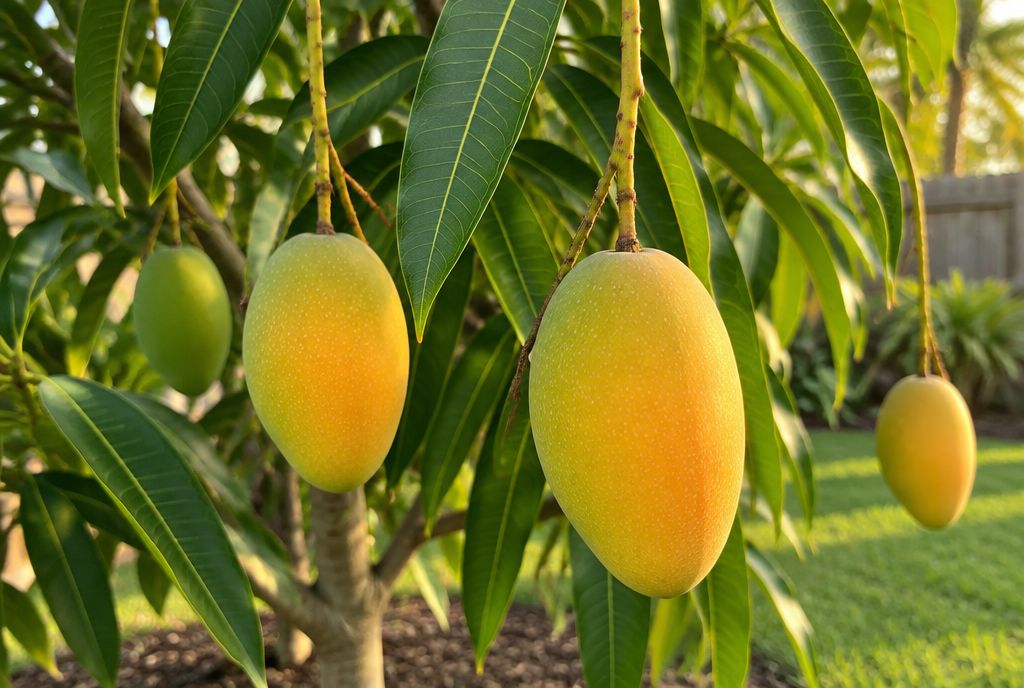
The best dwarf fruit trees for small yards are Carrie mango, Improved Meyer lemon, Chicago Hardy fig and Dwarf Cavendish banana, but no fruit we cover stays small on its own, so plan on light yearly pruning or a pot. “Dwarf” on a tag is a head start, not a guarantee. This post names the compact choice for each fruit, gives the real sizes from our pages, and shows how to hold a tree where you want it. For the pot side of the story, see our guide to fruit trees in containers.
Compact fruit trees by fruit
Pick the compact type of each fruit, then check it against your zone.
| Fruit | Compact pick | Size you can expect | Where it grows |
|---|---|---|---|
| Mango | Carrie | 6–10 ft with yearly pruning · 6–8 ft in a pot | Ground in zones 10–11 · pot anywhere |
| Banana | Dwarf Cavendish | 4–7 ft (CRFG) | Ground in zones 9–11 · pot anywhere |
| Meyer lemon | Improved Meyer | A naturally small citrus (UC ANR) | Ground in zones 9–11 · pot anywhere |
| Fig | Chicago Hardy | 10–15 ft tall, 9–12 ft wide · can be held at 6 ft | Zones 5–10 · pot anywhere |
| Persimmon | A grafted Asian type · Izu is “somewhat dwarf” (CRFG) | Up to 30 ft tall, 15–25 ft wide for big varieties (LSU) | Zones 7–10 · pot anywhere |
| Pomegranate | Any variety | A bushy shrub or small tree, pruned each year | Zones 7–10 · pot anywhere |
| Avocado | Bacon or Reed (columnar) | 40–80 ft unpruned, so prune firmly | Ground in zones 9–11 · pot while young |
What “dwarf” really means for our fruits
Be wary of the word. Sources disagree even about Carrie mango: CRFG calls the tree dwarf, UF/IFAS Mango Science describes low vigor and a compact canopy, and the UF/IFAS landscape guide rates its vigor high. Our Carrie page says plainly not to expect it to stay small by itself.
The same goes for the others. Our pages on mango, avocado and persimmon all say no variety stays small on its own. What a compact habit gives you is a lower starting point:
- Columnar avocados. UC Riverside describes Bacon and Reed as columnar trees that take less room than umbrella-shaped types. Hass has an open habit and is not tall (CRFG).
- Condo mangoes. Compact “condo” types stay 6–10 ft with yearly pruning, against 30–40 ft for standard varieties.
- Varieties to skip. Black Mission fig is a very large tree that CRFG says to plant at maximum spacing, and the American persimmon grows 40–60 ft (UF/IFAS).
Dwarf versus standard fruit trees
The gap between a compact and a standard type is large, and it shows in the numbers on our pages.
- Mango: a compact condo type stays 6–10 ft with yearly pruning, while seedlings and standard varieties such as Tommy Atkins, Kent and Keitt grow to 30–40 ft.
- Banana: Dwarf Cavendish is 4–7 ft, against 20–25 ft for Lady Finger and 15–20 ft for Blue Java (CRFG). UF/IFAS adds that winds above 25 mph can topple tall banana types and winds above 45 mph short ones, so a dwarf also copes better on a windy patio.
- Fig: Chicago Hardy reaches 10–15 ft but can be held at 6 ft, while Black Mission is very large.
- Persimmon: Asian types can reach 30 ft, and the native American persimmon 40–60 ft.
Compact types are also easier to harvest from the ground and to net against birds.
Pot sizes for compact fruit trees
If the yard is tiny or the winter is cold, a pot is the simplest way to cap size and move a tree under cover. These are the starting points from our container pages:
| Fruit | Pot |
|---|---|
| Mango | 7–10 gal, then 15 gal, finishing at 20–25 gal |
| Meyer lemon | About 10 gal for an established tree |
| Fig | At least 18 in (45 cm) across, or about 10 gal for a small plant |
| Persimmon | A 10-gal fabric pot to start |
| Banana | About 10 gal, then the largest you can move |
| Avocado | A 10-gal fabric pot as a first home |
Every pot needs drainage holes. A wet 25-gallon pot can weigh well over 100 lb (45 kg), so put it on a wheeled plant caddy. See our guide to overwintering fruit trees indoors for the move inside.
Spacing for small yards
In the ground, give each tree room for its mature size, not the size of the nursery pot.
- Compact mango: 10–15 ft from buildings and other trees, against 25–30 ft for a standard variety.
- Chicago Hardy fig: leave room for a 9–12 ft spread, or prune it to 6 ft and plant closer.
- Persimmon: plan for a canopy up to 15–25 ft wide on big varieties.
If space is tight, a pot is the surer way to cap a tree. See our collection of fruit trees for pots and patios.
How to keep a fruit tree small
Size control is a few habits, not a special rootstock.
- Prune on the right schedule. Mango right after harvest, finishing by the end of July in Florida, because flowers form on shoots that mature in fall. Fig in late winter before growth starts. Persimmon: cut a young tree back to about half height, or about 3 ft, at planting, then prune lightly.
- Prune lightly each year. Meyer lemon needs only water sprouts and dead wood removed, plus shaping. For banana, keep one stalk and one sucker coming up behind it.
- Cap the pot. Step up a pot size at a time, and finish in the largest pot you can still move.
- Root-prune at the final size. Slide the tree out every 2–3 years, shave 1–2 inches (2.5–5 cm) off the sides of the root ball and refresh the top third of the mix.
- Go easy on nitrogen. Over-feeding pushes leafy growth and, on pomegranate and persimmon, more fruit drop. Our fertilizing guide gives light schedules.
Which dwarf fruit tree should you buy?
Choose by zone first. If you are in zones 5–7, the Chicago Hardy fig is the one realistic in-ground choice, and everything else goes in a pot you shelter. In zones 9–11, Meyer lemon and Dwarf Cavendish banana are the easiest compact picks. For a first tree see our best fruit trees for beginners, and for quick results try the fast-growing fruit trees. Buy a grafted tree with the variety on the label, as our where to buy fruit trees guide explains.
Frequently asked questions
What is the best dwarf fruit tree for a small yard?
For most US gardeners, an Improved Meyer lemon, a Chicago Hardy fig kept at 6 ft, or Carrie mango in zones 10–11 or a pot. Dwarf Cavendish banana is the compact banana at 4–7 ft. Pick by your winter first, then by size.
How big do dwarf fruit trees get?
It depends on the fruit and your pruning. Carrie mango is kept at 6–10 ft with yearly pruning, or 6–8 ft in a pot. Chicago Hardy fig grows 10–15 ft tall unpruned but can be held at 6 ft. Dwarf Cavendish banana is 4–7 ft (CRFG).
Do dwarf fruit trees need pruning?
Yes. Our pages find that no variety of mango, avocado or persimmon stays small on its own. A compact habit gives you a head start, and light yearly pruning does the rest.
Can dwarf fruit trees grow in pots?
Yes. A pot limits size and lets you move the tree indoors for winter. Start in a 10-gallon (38 L) fabric pot for most fruit, and root-prune every few years once the tree reaches its final pot.
Sources
- Mango Growing in the Florida Home Landscape (HS2/MG216), UF/IFAS Extension
- Mango Fruit Facts, California Rare Fruit Growers
- Banana, Texas A&M AgriLife Extension
- Go Figure: Figs Are a Great Addition to Home Gardens, University of Illinois Extension
- Growing Fabulous Citrus, UC ANR
- Persimmon Fruit Facts, California Rare Fruit Growers