

Buy a fruit tree from a nursery in your own region, or from a plant sale run by your county extension office or a local fruit-growers club. That is the advice across our plant pages, and it comes with a few checks: ask for a grafted tree, read the label for the variety name, ask whether it was grown in your zone, and, for citrus, find out about quarantine rules before you move anything. This guide gathers that advice in one place. We do not sell trees, and we do not name shops, so the checks below are what you take with you whichever source you choose.
Where to buy
A regional nursery or garden center. A local nursery sells what has proven itself near you. Our fig page says a local nursery that sells what has been proven to grow near you is a safer bet than a random online listing, and the avocado page says the same, because trees are heavy and slow to replace.
A county extension plant sale. Our plant pages point to plant sales run by your county extension office or a local fruit-growers club. They often have cuttings and plants of types that already grow well in your area.
A specialist nursery. For something unusual from our exotic fruits collection, such as a dragon fruit or pomegranate, a nursery that gives the type or cultivar name on the label is worth more than a cheap unlabeled plant.
A neighbor, a club or a friend. Cuttings and suckers are often free. A cutting from a hardy fig that already grows in your neighborhood is a clone of a tree adapted to your winters. A banana grower will often hand over a sucker, and a dragon fruit club may swap cuttings.
Grafted tree or seedling?
For most fruit, buy a grafted tree. A grafted tree matches the variety on its label and fruits sooner, which a seedling cannot promise.
| Fruit | Grafted or cutting | From seed |
|---|---|---|
| Avocado | About 3–4 years | 5–13+ years, and the fruit may be poor |
| Mango | 3–5 years | 5–8 years, and some seedlings never give fruit worth eating |
| Dragon fruit | Many cuttings fruit 6–9 months after planting | Up to 7 years, and variable |
| Pomegranate | Year two from a hardwood cutting | At least three years |
| Meyer lemon | Third year for a young tree (UF/IFAS), and a grafted nursery tree may carry fruit sooner | Seedlings are not true to type |
If you do want a seed project for fun, see our guides to growing a mango from seed and growing an avocado from a seed. Treat them as experiments, not a fruit plan, and see our collection of fruits you can grow from the supermarket for the honest odds. You cannot grow a fruiting banana from a store banana at all, and our banana from scraps guide explains what to plant instead.
Start your own: cuttings, suckers and crowns
Some fruit is cheaper and quicker to start from a piece of a plant than to buy as a tree.
- Pineapple: the crown on a store-bought fruit is free and is what most home gardeners plant. For a named type, look for slips or suckers from a grower or a plant sale. See how to plant a pineapple top.
- Banana: plant a sword sucker about 3–5 ft tall, not a water sucker, which makes a weak plant and less fruit. See our banana from scraps guide.
- Dragon fruit: cuttings are the cheapest start, and buying two or three different types gives you cross-pollination insurance. See dragon fruit from cuttings.
- Pomegranate: a hardwood cutting fruits in year two. See pomegranate from cuttings.
Read the label
A good label tells you what you are buying, and a missing label is a reason to walk away.
- The variety name. Fig names are a mess: Clemson warns of considerable confusion, and the name Brown Turkey is used for different figs on the East and West Coasts. A banana is sold by name, like an apple.
- Fruit type. For persimmon, check whether it is astringent or non-astringent. For passion fruit, check whether it is purple or yellow, because yellow needs a second, genetically different vine.
- Flower type or cold limit. For avocado, ask for the flower type. For a pomegranate, ask how cold the variety can take.
- The graft and the rootstock. Look for a healthy graft union. For persimmon, CRFG says Diospyros lotus is the California standard rootstock but is incompatible with Fuyu, Jiro and Izu, so a nursery should match the rootstock to the variety.
- “Improved Meyer” on a Meyer lemon. It is the selection nurseries sell, and it is free of tristeza virus.
- Where it was grown. Ask whether the tree was grown in your zone.
Citrus: check quarantine first
That applies to the Meyer lemon and any other citrus you add. Ask the nursery what rootstock the tree is on, and whether it suits your soil. If you garden in Florida and want an avocado, ask your county extension office about laurel wilt before you plant.
What size to buy
Our plant pages favor a small, healthy tree over a big specimen.
- Mango: buy a grafted tree in a 3-gallon pot rather than a tiny starter. It is more forgiving and closer to fruiting size.
- Meyer lemon: a 3- or 5-gallon nursery tree is easier to establish than a large specimen.
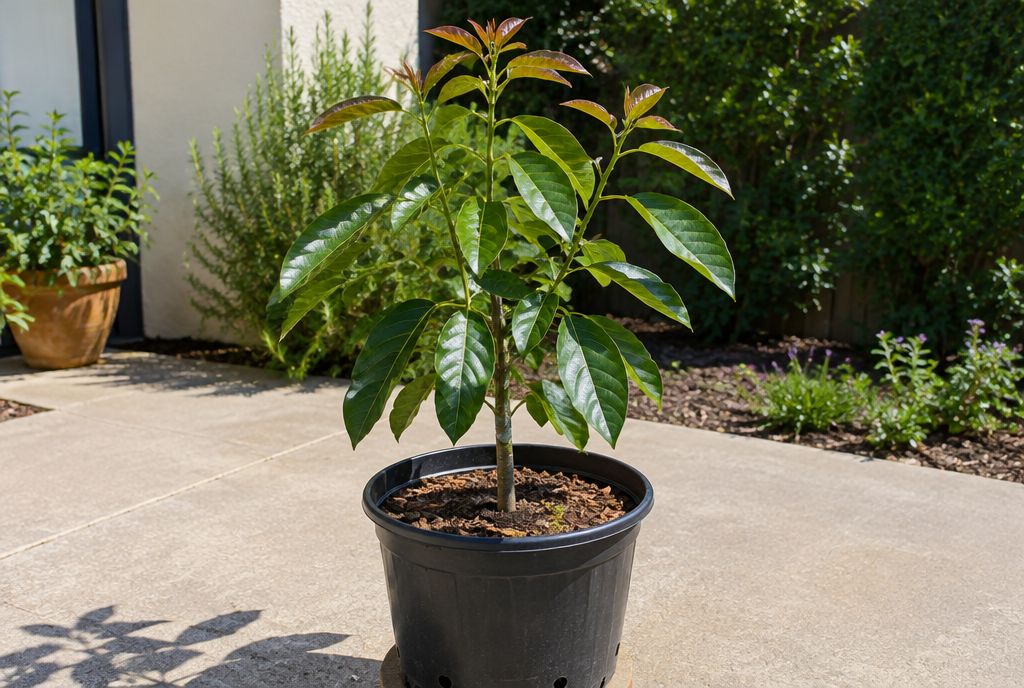
- Avocado, fig and others: buy a labeled, grafted or potted tree with glossy leaves, a healthy trunk and no wilting or dead tips.
Check the plant itself. Look for a firm, well-rooted plant, a trunk with no wounds and no sticky residue or bumps under the leaves, which can be scale or aphids on citrus.
When to plant
Plant in spring after your last freeze, so the tree has a full warm season to settle in before its first winter. Our mango page says to order in spring for the same reason. If you will grow the tree in a pot, a fabric pot gives roots air and drains well: see our guide to growing fruit trees in containers.
Buying checklist
- Know your zone, and check which fruit suit it in our guide to fruit trees by zone.
- Pick a source: a regional nursery, an extension plant sale or a fruit-growers club.
- Ask for a grafted tree, or a rooted cutting where that is the norm.
- Read the label for variety, fruit type, flower type or cold limit.
- For citrus, ask about quarantine rules first.
- Start with a small, healthy tree in a 3- to 5-gallon pot.
- Plant in spring after the last freeze, and plan your winter. See overwintering fruit trees indoors for the pots.
Frequently asked questions
Should I buy a grafted fruit tree or a seedling?
A grafted tree, for most fruit. It matches the variety on its label and fruits sooner. A grafted avocado starts producing after about 3–4 years, against 5–13 years or more for a tree from a pit (UF/IFAS, UC Riverside), and a grafted mango fruits in 3–5 years against 5–8 from seed. Citrus seedlings are not true to type either (Texas A&M AgriLife).
Can I buy a citrus tree from another state?
Check first. UC IPM says Asian citrus psyllid and huanglongbing (HLB, or citrus greening) quarantine zones restrict the movement of citrus trees and fruit. Buy certified, nursery-grown trees from a nearby source, and do not carry trees, cuttings or fruit out of a quarantine area. Your county agricultural office can tell you whether you are in a quarantine zone.
What size fruit tree should I buy?
Our pages favor a small, healthy tree in a 3- to 5-gallon pot. The mango page recommends a grafted tree in a 3-gallon pot over a tiny starter, and the Meyer lemon page says a 3- or 5-gallon tree is easier to establish than a large specimen.
Sources
- Asian Citrus Psyllid and Huanglongbing Disease, UC IPM, University of California
- Figs: How to Grow and Care for Figs in South Carolina, Clemson Cooperative Extension HGIC
- Citrus, Texas A&M AgriLife Extension
- Persimmon Fruit Facts, California Rare Fruit Growers